

Bitcoin Holds $76K as Binance Retail Inflows Crash 73%, $400M Longs Liquidated
Bitcoin retail inflows on Binance hit historic lows as $400M longs liquidate, Strategy adds $2B in BTC, and Treasury yields surge to 16-month highs.

Bitcoin retail activity on Binance has fallen to historic lows, with monthly inflows from wallets holding less than 1 BTC averaging just 314 BTC in 2026. That figure marks a sharp decline from roughly 1,200 BTC seen in March 2024 when Bitcoin first tagged $75,000, and trails the 1,800 BTC range recorded during the 2022 bear market. The 30-day net demand growth on Binance has also dropped 73% over the past three weeks, signaling that smaller traders are stepping back as the price retreats. Analysts attribute part of the decline to retail capital rotating into spot ETFs rather than holding BTC directly on exchanges.
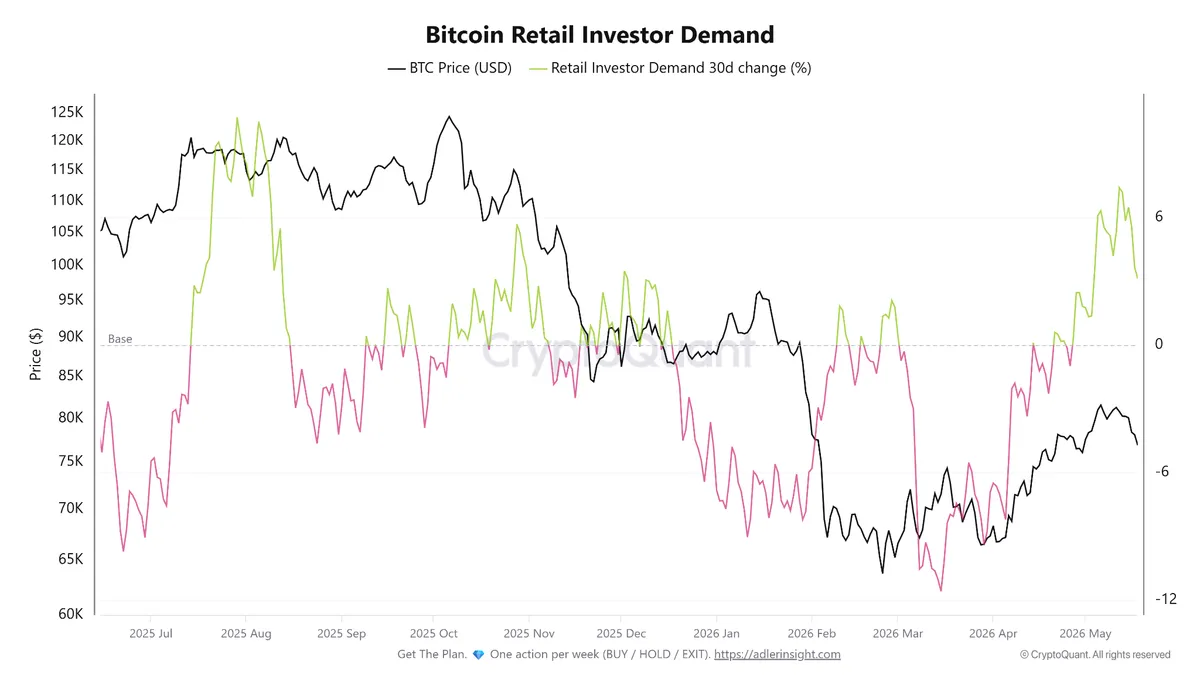
On-chain readings underscore the weakening footprint of smaller buyers. The 30-day change in Bitcoin retail investor demand has cooled to 3.12% from 7.39% just a week earlier, ending what had been the strongest retail expansion since August 2025, when Bitcoin traded near $115,000 in proximity to its all-time high. The reversal points to fragile spot participation after a brief burst of buying, and aligns with a broader cooling in derivatives appetite as leverage unwinds. Historical cycles tell a starker story: retail inflows peaked near 5,400 BTC in 2018 and 2,600 BTC in 2021, leaving today's structure heavily dependent on institutional flows rather than household demand.
The latest leg lower also triggered a brisk liquidation event for long positions. Bitcoin's rejection at $82,000 last Thursday and the subsequent retest of $76,000 wiped out roughly $400 million in bullish leveraged exposure across the past four trading days. The 7% drawdown rattled positioning that had been built up on expectations of a clean break higher, particularly after April's recovery rally. Despite the flush, derivatives skew has not collapsed into outright capitulation, and funding rates remain only modestly negative — a sign that traders are repositioning rather than abandoning bullish theses outright. The prospects of reclaiming $80,000 therefore remain intact for now.
Corporate treasury demand has emerged as a critical counterweight to the retreating retail bid. Strategy, led by Michael Saylor, completed approximately $2 billion in fresh Bitcoin purchases over the past week, extending its multi-year accumulation program against a finite circulating supply. The firm simultaneously repurchased $1.5 billion of its senior convertible notes due in 2029, a move that reduces future dilution risk for shareholders and clears the runway for additional equity issuance to fund further BTC buys. The combination of stock and preferred-share instruments — including the STRC preferred equity vehicle — has allowed Strategy to keep lowering its cost of capital even as broader markets soften.
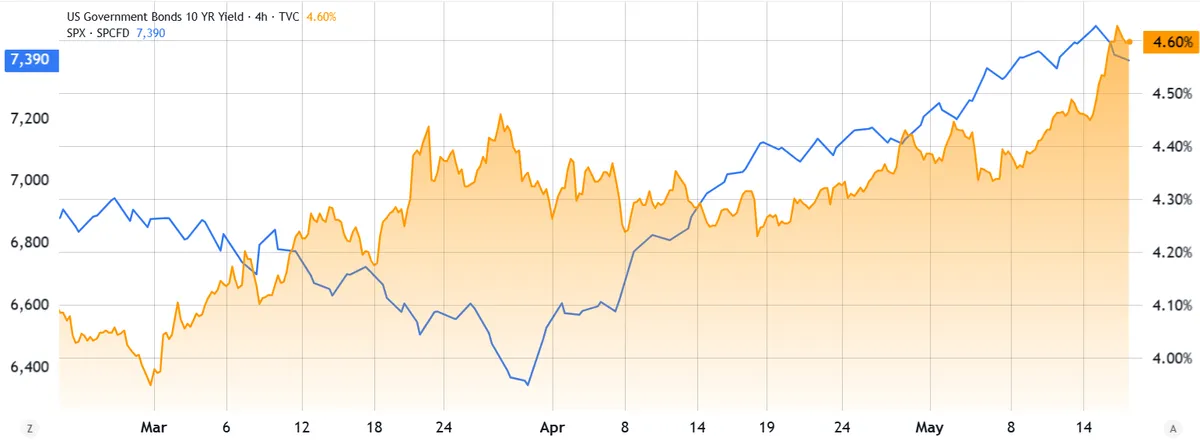
Macro conditions are reshaping how investors view scarce assets. Yields on the US 10-year Treasury have climbed to 4.60%, their highest level in 16 months, as bond buyers demand greater compensation to absorb a heavy supply pipeline. Roughly $2 trillion in long-term US debt is set to mature in 2026, and the prospect of the Federal Reserve resuming balance-sheet expansion to absorb refinancing has revived debasement narratives. Under those conditions, fixed-income returns lose appeal in real terms, and capital tends to migrate toward assets with capped issuance. Gold remains a primary beneficiary, but Bitcoin's fixed supply schedule keeps it firmly within that rotation.
Spot order-flow data on the leading exchange shows that the recent decline was driven by concentrated aggressive selling rather than passive distribution. Binance recorded a taker sell-volume spike of roughly $1.5 billion on May 15, followed by another print above $1.1 billion as Bitcoin breached $77,000. Those bursts compressed the price downward but were not matched by a corresponding wave of buying support — a gap analysts describe as the missing ingredient for a durable recovery. Prior rallies in October 2024, November 2024, and May 2025 each coincided with spot demand expansion that outweighed futures positioning, a balance that has not yet returned in the current setup.
From a charting perspective, Bitcoin trades at $76,735 with the RSI sitting at 44.3, reflecting a neutral-bearish posture, while the MACD remains bearishly aligned and the trend is sideways. The first defended floor sits at $76,103, with deeper supports at $74,668 and $72,673 — losing $76,103 on a daily close would open the path toward the lower band. Resistance begins at $78,004 and extends to $79,413 and $82,828, the latter capping the broader trading range. A reclaim of $79,413 on rising spot volume would invalidate the bearish thesis, while sustained closes below $74,668 would confirm a deeper rotation.
Related Tags

AI-generated, AI-reviewed, under COINOTAG editorial oversight.