

Bitcoin Rebounds Near $77K on Iran Pause as Citi Flags Quantum Risk, ETFs Bleed $1B
Bitcoin climbed near $77K after Trump paused an Iran strike, as Citi warned of quantum risk to BTC and spot Bitcoin ETFs logged $1B in weekly outflows.

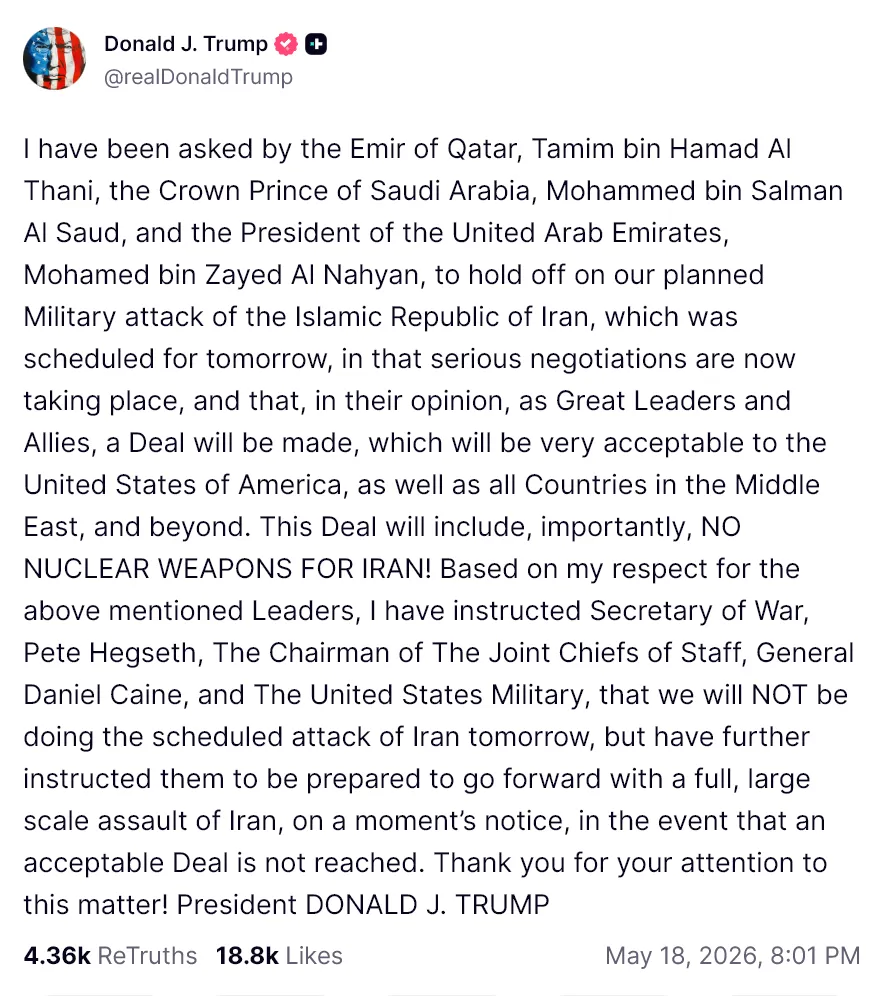
Bitcoin clawed back toward $77,000 late on May 18 after President Donald Trump confirmed he had halted a planned US military strike on Iran at the urging of Saudi Arabia, Qatar, and the United Arab Emirates. The announcement, posted on Truth Social, triggered a quick rotation back into risk assets, with Nasdaq 100 futures, the S&P 500, and spot gold all extending gains within minutes. The Emir of Qatar, Saudi Crown Prince Mohammed bin Salman, and UAE President Mohamed bin Zayed reportedly asked Trump to delay the operation to open space for nuclear negotiations. Trump signaled US forces remain on standby if those talks collapse.
Spot Bitcoin ETFs registered more than $1 billion in weekly outflows leading into Sunday's risk-off move, ending a six-week inflow streak. The reversal coincided with fading rate-cut expectations and a sharp recalibration of geopolitical risk. Combined BTC and ETH ETF redemptions topped $1.29 billion across the week, marking the third largest synchronized drawdown of the cycle. Institutional flows had been the principal demand engine through much of 2026, so the abrupt unwind sharpened concerns that allocators are de-risking ahead of further headlines. Discounts on listed Bitcoin proxies widened in parallel, reflecting the same defensive impulse seen across regulated wrappers.
The unwind extended into derivatives positioning over the weekend. Roughly $580 million in long contracts were liquidated in a four-hour window after Trump warned Iran the clock was ticking, dragging spot prices below $77,000 in thin Sunday liquidity. Funding rates briefly flipped negative on offshore venues as leveraged traders capitulated. Open interest reset lower across major perpetuals, suggesting the cascade purged a meaningful slug of one-sided positioning rather than triggering forced shorts into the rebound. That cleaner book helped explain the velocity of the bounce when news of the strike delay hit, even as broader sentiment remained guarded.
Separately, a fresh research note from Citi warned that recent breakthroughs in quantum computing have shortened the runway for practical attacks on digital asset cryptography. Analysts pegged the so-called Q-Day window to 2030 through 2032 rather than later in the decade, citing Google's recent estimate that a 500,000-qubit machine could break elliptic-curve encryption in minutes. While such hardware does not yet exist, the trajectory of capability gains is steepening. The note framed quantum risk less as a binary threshold and more as a probability curve that blockchain designers are now expected to underwrite explicitly within their multi-year security roadmaps.

The most concentrated exposure sits in dormant Bitcoin cold wallets. Roughly 6.7 to 7 million BTC are parked in addresses whose public keys are already visible on-chain, including approximately 1 million coins attributed to Satoshi Nakamoto. Those holdings represent the cleanest target for any actor with a sufficiently capable quantum machine, because the cryptographic work needed to derive private keys collapses dramatically once the public key is known. Analysts argue the prospect of any of these wallets moving, voluntarily or otherwise, would carry market consequences far beyond the immediate supply impact, given the symbolic weight attached to the network's earliest coins.
The governance gap between Bitcoin and Ethereum sharpens the asymmetry. Migrating to quantum-resistant cryptography would require broad consensus across miners, node operators, and developers, plus a hard fork, mechanics that Bitcoin's deliberate culture has historically resisted. Ethereum and other proof-of-stake networks operate under a more flexible upgrade cadence and have shipped major protocol changes within compressed timelines. Citi's analysts conceded Ethereum is not immune, noting a quantum-equipped attacker could theoretically corral enough validator keys to threaten finality. Still, the structural ability to move faster gives chains beyond Bitcoin a clearer path to retrofit their security model before the threshold arrives.
With spot pinned at $76,990 and momentum on the back foot, near-term price action hinges on whether the $76,816 shelf absorbs continued selling. A clean break opens room toward $75,062 and the deeper $72,673 pocket, both of which align with prior accumulation ranges and would risk extending the bearish structure. To regain initiative, bulls need a decisive reclaim of $77,984 to neutralize the bearish MACD cross, with $79,369 and $82,904 as the next overhead waypoints. RSI at 45.44 leaves headroom in either direction; a daily close above $79,369 on expanding volume would invalidate the current sideways-with-bearish-bias structure.
Related Tags

AI-generated, AI-reviewed, under COINOTAG editorial oversight.