

DeFi Faces Clarity Act Threat as Bitget Wallet Lists 130 Tokenized Stocks
A late Clarity Act amendment raises alarm over DeFi developer liability as Bitget Wallet integrates 130+ tokenized equities through xStocks infrastructure.


A late-stage amendment to the Digital Asset Market Clarity Act has sparked alarm across the DeFi sector after lawmakers stripped out language that previously shielded non-controlling blockchain developers from securities oversight. The revised text could allow federal regulators to classify software builders as securities intermediaries if any operational influence over a protocol can be demonstrated. The amendment was attached during a high-stakes Senate Banking Committee markup, where two Democrats crossed over to push the bipartisan crypto market structure bill forward. Industry advocates fear the broader wording could ensnare legitimate decentralized exchanges, personal wallet teams and open-source contributors under rules designed for centralized intermediaries.
Bitget Wallet has integrated xStocks infrastructure, adding more than 130 tokenized stocks and exchange-traded funds to its self-custodial platform serving roughly 90 million users. The update expands the wallet's tokenized real-world assets catalogue past 300 products spanning equities, commodities, precious metals and index-linked instruments. Tokenized equity products operating under that umbrella have processed more than $30 billion in transaction volume since launching last year, though the offering remains unavailable in the United States, United Kingdom and other restricted jurisdictions. Users can access tokenized equities alongside cryptocurrency swaps and storage from one interface while retaining custody of their private keys and funds.
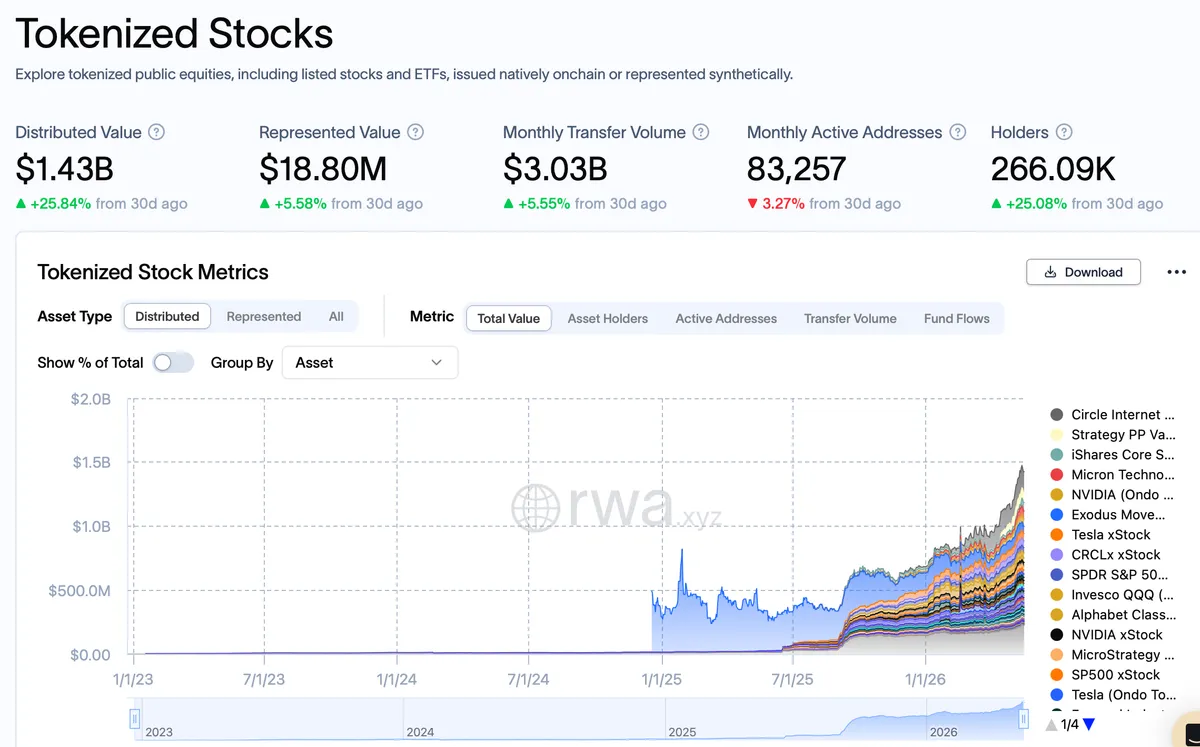
The broader tokenized equities sector has expanded rapidly to approach $1.5 billion in represented value, with products linked to Circle, Nvidia, Tesla, Alphabet and Strategy now ranking among the largest tokenized assets in the segment. Ondo Finance currently leads with roughly $883 million in represented stock value, followed by xStocks at about $391.5 million. The Bitget integration leverages both request-for-quote and automated market maker liquidity models, offering zero trading fees and gasless execution to non-restricted users. Competition has intensified as multiple venues race to capture demand for 24/7 equity exposure delivered through onchain rails rather than legacy brokerage infrastructure.
Republican Senator Cynthia Lummis described the Clarity Act's advancement out of the Banking Committee as a historic step forward for the industry, though concerns linger over the revision attached to one of her own earlier amendments. The compromise language now extends potential reach over anyone acting pursuant to an agreement, arrangement, or understanding to control a protocol — a threshold attorneys describe as alarmingly broad. Lawmakers did preserve the Blockchain Regulatory Certainty Act, which generally protects software developers who do not control user funds from being treated as money transmitters. Negotiations continue ahead of a full Senate floor vote expected later this quarter.
The xStocks platform is now operated by Payward, the parent company of Kraken, following the exchange's acquisition of Backed Finance late last year. The deal handed Payward direct ownership of tokenized equity issuance infrastructure and accelerated the rollout of equity-linked perpetual futures for non-US clients. Coinbase has launched its own stock perpetual futures product for international users, offering leveraged round-the-clock exposure to publicly traded American equities through its derivatives venue. Binance has signaled interest in returning to tokenized equities after shuttering its 2021 stock token product following European regulatory pressure, intensifying competition between centralized venues and self-custodial wallets across the segment.
DeFi advocates did secure one meaningful win in the negotiations: the Blockchain Regulatory Certainty Act survived intact, preserving the long-sought protection for blockchain developers who never custody user funds. The carve-out had been a top industry ask for nearly three legislative sessions and was viewed as essential for shielding open-source contributors from prosecution under existing money transmission statutes. However, the broader securities intermediary language remains a flashpoint, and lobbying groups are preparing technical amendments aimed at restoring the non-controlling developer shield. The final text could shift again before a floor vote, with industry coalitions urging senators to narrow the scope of the control test affecting decentralized exchange operators.
The week's developments underscore a defining tension this cycle: as Washington moves toward formal market structure rules for digital assets, the line between genuine decentralization and regulated intermediation is being drawn in real time. Tokenized equities now sit at the intersection of traditional capital markets and onchain infrastructure, while DeFi protocols face renewed questions about how protocol governance and developer influence will be treated. The dominant narrative is regulatory codification — and the decisions lawmakers and platform builders make over the coming months will determine whether the onchain economy scales through clear permissioning or through expanding compliance burdens on the builders driving innovation.
AI-generated, AI-reviewed, under COINOTAG editorial oversight.