

NCUA's GENIUS Act Stablecoin License Proposal

Contents
The U.S. National Credit Union Administration (NCUA) has proposed its first rules under the GENIUS Act, defining the application process for subsidiaries of federally insured credit unions to become federally supervised payment stablecoin issuers. NCUA oversees more than 4,000 credit unions, requiring these subsidiaries to obtain NCUA-approved payment stablecoin issuer (PPSI) licenses. Federally insured credit unions cannot invest in or lend to unlicensed issuers. This development could enhance market confidence by integrating the stablecoin ecosystem with traditional finance.
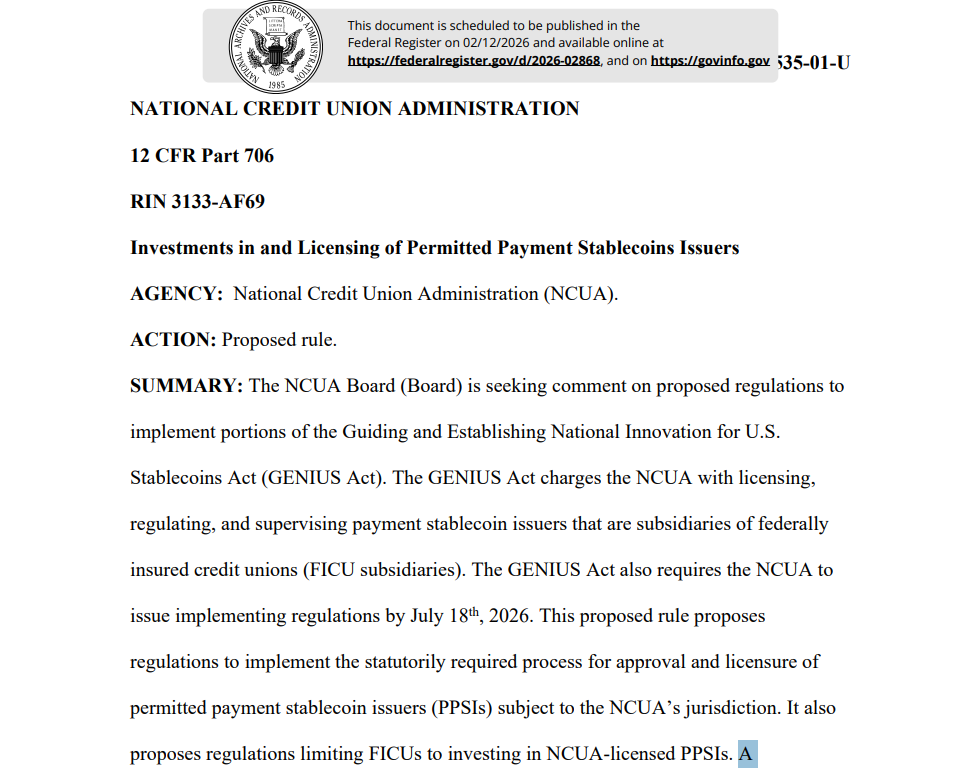
NCUA proposed rule for licensing of PPSIs. Source: NCUA
Technical Details of the NCUA PPSI Licensing Process
The proposal focuses on licensing and investment limits; a separate proposal will come for standards like reserves, capital, liquidity, illicit finance, and IT risk management. NCUA cannot reject stablecoin applications issued on open public or decentralized networks for this reason. Decisions on completed applications must be made within 120 days, otherwise they will be automatically approved. The proposal states that credit unions cannot issue stablecoins directly, only through subsidiaries. There is a 60-day period for public comments from the Federal Register publication.
Impacts of the GENIUS Act on Credit Unions
The GENIUS Act opens credit unions to stablecoin issuance, potentially allowing more than 4,000 institutions to enter this space. This could give birth to new PPSIs competing with existing stablecoins like USDC or USDT. Experts predict that this regulation will strengthen stablecoin reserves and increase market stability. However, the subsidiary requirement is a critical step for risk isolation.
Stablecoin Regulation and ALT Price Movement
This regulatory news is receiving positive echoes in the crypto market, and according to ALT detailed analysis data, ALT rose 9.33% in 24 hours to reach the $0.01 level. RSI at 38.23 is in the oversold region, but the overall trend is downward. Supertrend is giving a bearish signal, trading below EMA 20 $0.0095. The regulation could trigger an altcoin rally by increasing stablecoin liquidity.
ALT Support and Resistance Levels Table
| Level | Price | Score | Distance | Sources |
|---|---|---|---|---|
| S1 | $0.0082 | 77/100 (⭐ STRONG) | -5.42% | Fibo 0.114, LVN 4, S3, Prev Day Low |
| S2 | $0.0069 | 70/100 (⭐ STRONG) | -20.42% | Fibo 0.000, Donchian Lower |
| R1 | $0.0113 | 67/100 (⭐ STRONG) | +30.33% | SMA 50, Keltner Upper, Fibo 0.382 |
| R2 | $0.0087 | 63/100 (⭐ STRONG) | +0.35% | Prev Day High, Pivot Point |
Risk and Opportunity Analysis for ALT Investors
Despite being in a downtrend, the NCUA proposal could increase stablecoin volume, thereby boosting ALT futures volume. Expert opinion: S1 $0.0082 is strong support, watch S2 if broken. R1 $0.0113 is key for breakout. Positive regulation signal for ALT spot market followers.
Expert Predictions for Market Expansion
This step could take the US stablecoin market to $150 billion. Credit unions, by linking traditional finance to blockchain, can provide liquidity to layer-2 projects like ALT. Investors should monitor the 120-day approval process.