

SEC Plans Biggest IPO Overhaul in 20 Years as Stablecoin Supply Tops $300 Billion
SEC unveils its biggest IPO overhaul in 20+ years, easing crypto listings as stablecoin supply tops $300B and Bank of England backs tokenization.
The U.S. Securities and Exchange Commission has unveiled the most extensive overhaul of public listing rules in more than two decades, a package that could materially lower the bar for crypto firms eyeing a Wall Street debut. The proposal would let newly public companies tap shelf registrations immediately after going public — eliminating the roughly one-year waiting period — and remove the $75 million public float threshold tied to unrestricted shelf offerings. Officials framed the reforms as a way to reverse a multi-year decline in U.S. listings. For mid-sized digital asset firms such as Securitize and Kraken, the changes could trim compliance costs and shorten capital-raising cycles for Bitcoin-aligned issuers.
The Bank of England is intensifying its push into digital money infrastructure, with Deputy Governor Sarah Breeden positioning tokenization as a vehicle for lower payment costs, faster settlement and broader competition. Speaking at London's City Week, Breeden said central bank money would remain the anchor of the monetary system even as tokenized deposits and regulated stablecoins gain ground. She floated a future in which consumers transact across traditional deposits, tokenized bank deposits, regulated stablecoins and a potential retail CBDC issued on a public blockchain rail. The BoE is simultaneously reviewing limits on pound-denominated stablecoin holdings, signaling a calibrated loosening of guardrails as the UK aligns its rules with the broader digital asset transition.
A new peer-reviewed study from researchers at Sun Yat-sen University finds that consumers are significantly more willing to lie, exaggerate or exploit pricing errors when dealing with AI agents than with human staff. Published in the Journal of Business Research, the work identifies "anticipatory face loss" — the discomfort of expected social disapproval — as the missing brake on dishonest behavior in machine interactions. Field experiments showed participants inflating outcomes for extra rewards more often when paired with chatbots. The findings carry weight for crypto-adjacent platforms increasingly relying on AI for support and onboarding, particularly as agentic systems are projected to resolve 80% of customer-service queries by 2029.

Total stablecoin supply has crossed the $300 billion threshold, yet beneath that milestone the sector is increasingly a one-issuer story. Tether's USDT added more than $5 billion over the past month, while USDC, USDe and PYUSD collectively lost roughly $4.2 billion. Net growth across the category landed at just 0.3%, suggesting that every marginal stablecoin dollar entering the system is effectively a USDT dollar replacing a redeemed competitor. The data reframes the GENIUS Act-era expectation that bank-issued and compliance-first entrants would rapidly chip away at Tether's dominance. So far, those second-tier issuers have struggled to match USDT on yield, distribution or regulatory positioning.
Ethena's synthetic dollar has become the clearest casualty of the current reshuffle, with USDe down 28% over the past month and nearly 34% year to date. The token's yield model depends on positive perpetual funding rates, and that engine sputtered after the October 10 deleveraging event left perp funding sharply compressed. Capital has rotated decisively into overcollateralized DeFi-native alternatives: Sky's USDS is up roughly 48.9% year to date and World Liberty Financial's USD1 has added 33.7%. PYUSD, meanwhile, has shed 13% in a month as its institutional distribution narrative fails to translate into supply growth, underscoring how quickly stablecoin yield mechanisms can unwind.
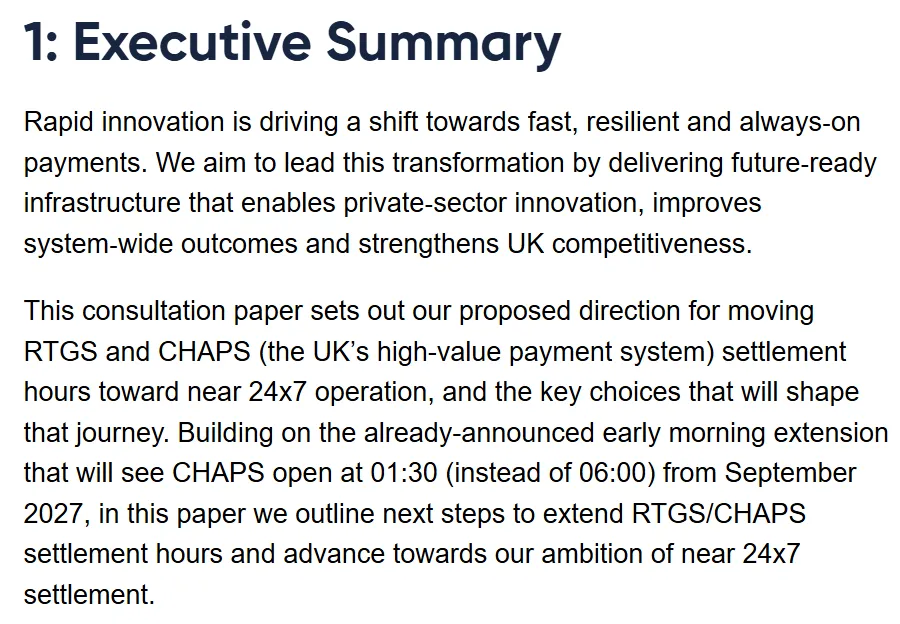
The UK is moving in parallel to upgrade the rails that will carry tokenized assets. On Monday the Bank of England proposed extending the operating hours of its core settlement infrastructure to near 24/7 availability, citing the need to keep pace with cross-border payment demand and emerging digital asset technologies. The change would close one of the structural gaps between traditional clearing and crypto-native venues, which already operate continuously thanks to their always-on consensus mechanism. Combined with the review of stablecoin holding limits, the proposal points to a regulatory posture that increasingly treats programmable money as core infrastructure rather than a sandboxed experiment.

Stitching these threads together, the dominant narrative this cycle is convergence — between traditional finance rails and crypto-native infrastructure. The SEC's listing overhaul prepares Wall Street to absorb a new wave of digital asset issuers; the Bank of England's tokenization push and extended settlement window collapse the operational gap with on-chain markets; the stablecoin sector's $300 billion milestone, even with its Tether-skewed concentration, confirms that dollar demand has structurally re-rated onto public ledgers. And as AI agents take on more of the user interface, behavioral research signals that trust and accountability layers will need redesigning. The plumbing of finance is being rewritten in real time.
Related Tags
AI-generated, AI-reviewed, under COINOTAG editorial oversight.