

SEC Eyes Tokenized Stock Exemption, House Pushes CBDC Ban, Warsh Confirmed
SEC readies an innovation exemption for tokenized stock trading, House lawmakers push a permanent CBDC ban, and Kevin Warsh is confirmed as Fed chair.

A pair of Republican lawmakers is moving to enshrine a permanent ban on a US central bank digital currency inside the 21st Century ROAD to Housing Act, with a House floor vote expected this week. The Senate draft already prohibits the Federal Reserve from issuing a CBDC through December 31, 2030, but House Representative Mike Flood championed an amendment that converts the moratorium into a permanent prohibition. Representative Warren Davidson framed the 2030 sunset as a quiet pre-launch development window. If the amended text passes the House, it returns to the Senate before reaching President Trump's desk for signature.
Institutional capital entering digital assets in 2026 is concentrating in tokenized real-world assets, regulated stablecoins, institutional trading infrastructure, and AI-linked compute networks, according to allocators speaking at a recent Hong Kong Web3 industry gathering. Family offices in Asia remain conservative, with one of the largest multi-family offices reportedly directing under 5% of client capital toward digital assets, weighted almost entirely to Bitcoin, Ether, and spot ETFs. Investors increasingly demand documented strategies, real-time reporting, and licensed custodians rather than speculative upside. Friction around banking, compliance, and legal structure still slows broader allocator participation, while tokenized RWAs and DeFi rails emerge as preferred entry vectors.

Roughly one in ten US adults invested in or used crypto during 2025, the highest reading in three years, per the Federal Reserve's annual economic well-being survey. About 9% of respondents held digital assets as an investment vehicle, 2% used crypto for payments, and 1% sent money to family or friends across digital rails. Adoption ran notably higher among the unbanked, with 6% transacting in crypto versus 2% of banked adults. Despite the year-over-year increase, total usage still trails the 12% peak recorded in 2021, when retail enthusiasm for Bitcoin and broader markets reached a cyclical high.
Kevin Warsh was confirmed by the Senate as the next chair of the Federal Reserve, succeeding Jerome Powell whose term ended on Friday. Warsh, a former Fed governor between 2006 and 2011, has previously expressed a favorable view of Bitcoin, suggesting the asset could provide market discipline and likening it to gold for investors under forty. Markets read his appointment as a hawkish tilt on monetary policy, yet his openness toward digital assets contrasts with Powell's historically cautious posture. Industry observers expect a friendlier regulatory tone from the central bank as Warsh begins his term and reshapes internal supervisory priorities.
The Securities and Exchange Commission is preparing an innovation exemption that would allow blockchain-based tokenized trading of public company shares, potentially as soon as this week. The framework would cover firms that do not consent to having their equity represented by third-party tokens, extending exposure to names such as Nvidia, Apple, and Tesla onto decentralized exchange venues. Proposed conditions require tokens to carry rights equivalent to common stock — including voting and dividends — or face delisting. Commissioner Hester Peirce led the effort following feedback from hundreds of market participants, though several internal SEC officials reportedly oppose the move on investor-protection grounds.
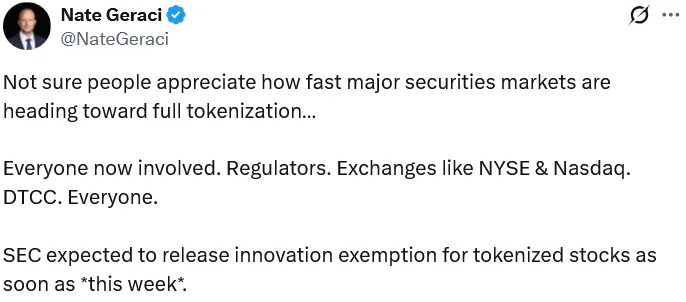
Wall Street's tokenization push accelerated as crypto exchange Bullish, led by former NYSE president Tom Farley, completed a $4.2 billion acquisition of transfer agent platform Equiniti to deepen its on-chain securities capabilities. The deal lands as Intercontinental Exchange — parent of the New York Stock Exchange — advances its own tokenization platform for 24/7 trading and settlement of stocks and ETFs using a blockchain post-trade system. Backers argue tokenized equities can promote financial inclusion by extending US-listed company exposure to retail without traditional brokerage accounts, while critics flag fragmented liquidity and unclear corporate-action handling as unresolved structural risks.
Across this 24-hour cycle, the dominant narrative is a structural pivot from speculative crypto trading toward regulated, asset-backed integration with traditional finance. Lawmakers are sharpening the perimeter against state-issued digital money while regulators simultaneously open new lanes for private-sector tokenization of equities. Allocator preference is rotating toward yield-bearing real-world assets and compute infrastructure rather than directional altcoin bets, and a new Fed chair with crypto-curious views could reshape the monetary backdrop. Together, these threads describe an industry maturing into financial plumbing — less about narrative cycles, more about which rails global capital settles on.
Related Tags

AI-generated, AI-reviewed, under COINOTAG editorial oversight.