

Tor Project Launches Web3 Crowdfunding Drive as Checker Raises $8M for Stablecoin Rails
Tor Project launches a Web3 crowdfunding drive for censorship-resistant tools as Checker raises $8M to scale stablecoin infrastructure for institutions.

A coalition led by the Tor Project has launched its first Web3 crowdfunding campaign aimed at supporting censorship-resistant digital infrastructure. Beginning May 19, the initiative will channel funds to 10 nonprofit projects spanning privacy tools, secure communications, and public-interest digital infrastructure. Contributors can donate in Bitcoin, Ethereum, Zcash, Monero, and Golem. Organizers structured the drive alongside Funding the Commons to direct community-driven capital toward developers building tools that protect free internet access. The launch arrives at a moment when more than half the world's population faced internet shutdowns or systemic censorship in 2025, according to advocacy researchers tracking digital rights.
Stablecoin infrastructure startup Checker has closed $8 million in combined pre-seed and seed funding, with Galaxy Ventures, Al Mada Ventures, and Framework Ventures anchoring the round. The company offers a unified API that helps financial institutions launch and scale stablecoin products, addressing liquidity fragmentation and compliance overhead that have slowed institutional adoption across the DeFi stack and traditional payments. Additional backers included Bitso, Airtm, DFS Lab, Onigiri Capital, SNZ Capital, and Velocity, alongside angel investors such as Mesh CEO Bam Azizi and Tala CEO Shivani Siroya. Checker now serves more than 30 regulated clients and plans to expand across Brazil, Kenya, Hong Kong, and the United States.
A $115,000 matching pool backed by Cake Wallet, Zcash Community Grants, Logos, and Octant will amplify donations during the Tor Project drive through June 18. Organizers adopted a quadratic funding model, a participatory framework that rewards breadth of donor participation over the size of any single contribution. Under this approach, ten donors contributing $10 each outweigh one wealthy backer pledging $100, ensuring grassroots support shapes how capital is distributed. The mechanism has gained traction across DAO ecosystems as a method to align institutional capital with genuine community signals, particularly for public goods like privacy infrastructure that rarely attract conventional venture funding.
Checker's raise lands amid a surge of corporate appetite for stablecoin rails. Stripe acquired Bridge for $1.1 billion late last year, and Mastercard agreed to purchase BVNK for as much as $1.8 billion earlier this year — two deals that underscored how mainstream payment giants now view tokenized dollars as core blockchain infrastructure rather than experimental rails. The trend extends beyond acquisitions: venture flows into stablecoin issuers, on/off-ramps, and treasury management firms have accelerated as regulators in the United States and Europe finalize frameworks bringing digital-dollar issuance under formal oversight, reducing ambiguity that previously kept some institutional allocators on the sidelines.
Forecasts for stablecoin market growth diverge widely. Standard Chartered projects that total stablecoin supply could approach $2 trillion by the end of 2028, citing surging cross-border payment use and institutional treasury adoption. More conservative analysis from JPMorgan places the figure in a $500 billion to $600 billion range over the same horizon, arguing that rising stablecoin velocity — the rate at which the same token supports multiple transactions — naturally caps headline market capitalization growth. Both camps agree that real-world utility rather than speculative trading will drive the next leg of adoption, particularly across emerging-market corridors where reliable dollar access remains constrained.

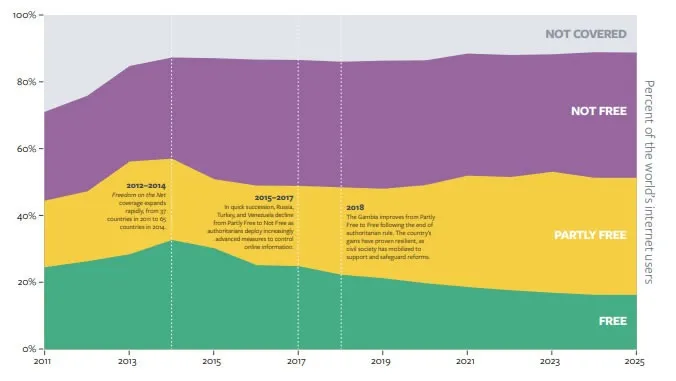
Global internet freedom has now declined for 15 consecutive years, with conditions worsening in nearly 40% of the 72 countries evaluated in the latest Freedom on the Net assessment. Asia remained the leading region for digital censorship, while shutdowns, surveillance mandates, and platform restrictions expanded in jurisdictions previously considered open. Privacy advocates argue that governments are exerting growing control over the technology stack ordinary users rely on, from messaging apps to browsers. The Tor Project's pivot toward crypto-native funding reflects a broader recognition that nonprofit privacy tools need durable, distributed financing models capable of withstanding political pressure on traditional grantmakers and donor pipelines.
The thematic thread running through this week's developments is the institutional formalization of crypto infrastructure across two distinct tracks. On one side, stablecoin rails are professionalizing — venture funding, M&A activity, and converging regulatory regimes are turning what was once a frontier altcoin experiment into core payment plumbing for global finance. On the other, privacy and censorship-resistance tools are leaning further into Web3-native funding to preserve independence from increasingly restrictive states. Together they highlight crypto's dual character this cycle: a maturing financial layer for legacy institutions, and a resilient funding backbone for the open internet.
Related Tags
AI-generated, AI-reviewed, under COINOTAG editorial oversight.