

Bitcoin Holds $77K as Node NBO Opens in Nairobi and South Carolina Signs Crypto Law
Bitcoin trades near $77,188 as Node NBO launches in Nairobi, South Carolina enacts a crypto-friendly law, and the Decay Channel eyes a $255,000 target.


On May 16, a new physical hub dedicated to  Bitcoin (BTC), energy, and compute opened its doors in Nairobi, Kenya. Named Node NBO after the city's airport code, the facility serves as a co-working space anchored by Fedi, Gridless, BTrust, and the Human Rights Foundation. The soft launch drew Fedi chief executive Obi Nwosu, Gridless co-founders Janet Maingi, Erik Hersman and Philip Walton, BTrust head Abubakar Nur Khalil, and Minmo's Jodom Konuko. Hersman framed the project as a way to put builders working on the hardest problems in Bitcoin and freedom tech into close physical proximity, accelerating overlapping work across the African continent.
Beyond shared desks, Node NBO houses three research labs covering open-source energy systems, Bitcoin mining hardware, and artificial intelligence compute, alongside an event space that hosts up to 150 attendees for meetups and demos. The hub sits in Gigiri, a diplomatic district within walking distance of the United Nations' Nairobi headquarters, positioning African builder teams for direct engagement with international delegations and policy visitors. Monthly gatherings already include BitDevs Nairobi sessions and quantum computing research circles. The hub signals deepening institutional infrastructure for African Bitcoin (BTC) innovation, replacing the ad-hoc meetup culture that historically defined the region's developer scene with a permanent base.

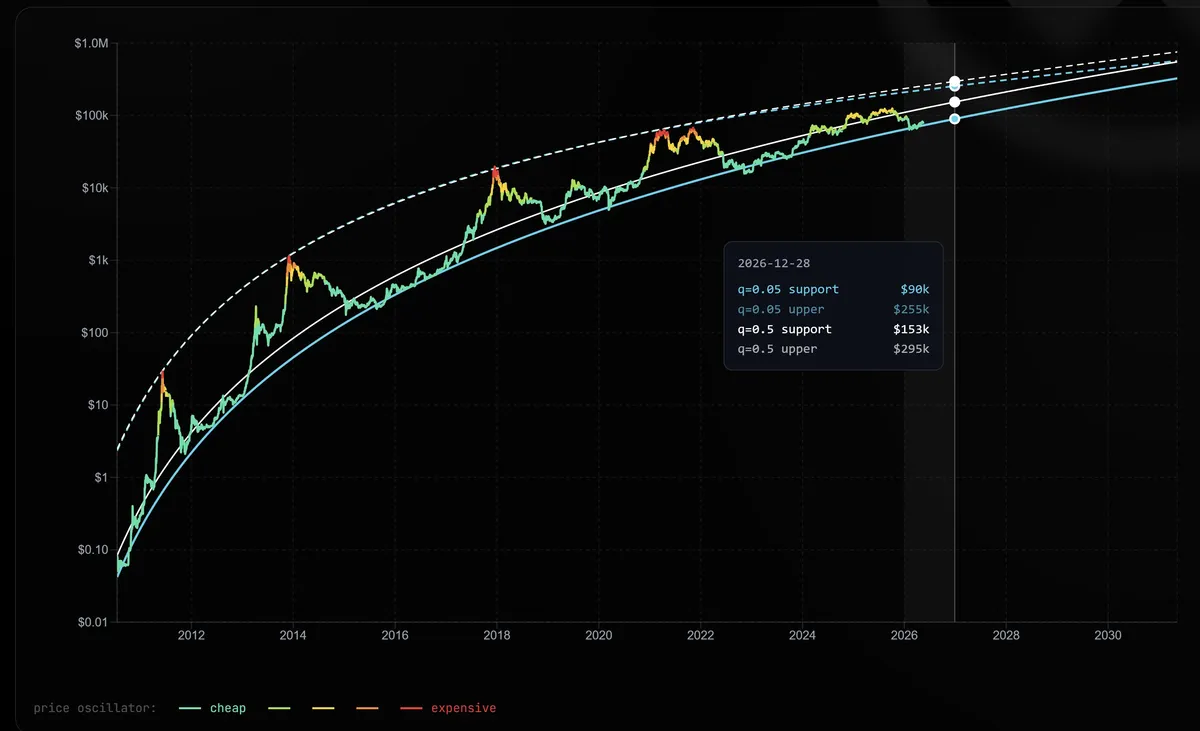
A long-running valuation framework called the Bitcoin Decay Channel projects a conservative year-end range of $90,000 to $255,000 for the leading cryptocurrency, with 2027 estimates stretching to $128,000–$308,000. The logarithmic model maps Bitcoin's long-term uptrend while accounting for diminishing returns each cycle, and historical tops in 2013, 2017, and 2021 all formed near its upper valuation band while bear-market lows clustered around the lower support zone. Analyst Sminston noted the asset's March–April rebound began near that lower bound, leaving the cyclical bull case intact despite a roughly 40% drawdown from the October 2025 all-time high.
Not every signal points higher. A multi-month bear flag currently shadowing price action threatens a measured-move breakdown toward $56,000 — roughly 30% below current levels — if support fails to hold, deepening the prevailing bear-market framing among technicians. Other forecasts sit between those extremes: BitMEX co-founder Arthur Hayes targets a $126,000 reclaim this year, citing fiat liquidity pressure from U.S. war spending in Iran and AI infrastructure demand, while Bernstein analysts maintain a $150,000 objective for 2026 and pushed their $200,000 peak call into 2027. The dispersion underscores how cycle-extension theses now share the stage with structural breakdown risk.
On the regulatory front, South Carolina Governor Henry McMaster signed Senate Bill 163 into law on May 19 after the measure cleared the legislature 38-1 in the Senate and 110-1 in the House. The statute affirms the right of individuals and businesses to use digital assets in commerce, blocks any entity from refusing crypto payment for goods and services, and explicitly protects self-custody through hardware and self-hosted cold-wallet setups. State and local governments are also barred from layering additional taxes or fees on crypto-funded transactions, with lawmakers framing the parity provision as essential to keep digital assets competitive with U.S. dollars at the register.
The same legislation bars state agencies and political subdivisions from accepting or requiring payments in a central bank digital currency and prohibits participation in any Federal Reserve CBDC pilot, reflecting privacy and surveillance concerns voiced during committee hearings. Mining operations gain explicit protections: local governments cannot single out facilities for stricter zoning or noise rules than apply to peer industries in industrial zones. The law further exempts mining, node operation, blockchain software development, and crypto-to-crypto trading from money transmitter licensing. South Carolina now joins Kentucky and a widening cohort of states codifying digital-asset rights ahead of federal action.
Bitcoin (BTC) trades at $77,188, up 0.58% on the session with $12.8 billion in 24-hour volume and a sideways structural read. RSI sits at 47.37 in neutral territory and the MACD remains bearish, leaving momentum ambiguous around the $76,803 first support; a daily close below $75,080 would open the $72,673 zone and validate the multi-month bear flag thesis. Reclaiming $78,457 is the prerequisite for any push toward $80,476 and the $82,912 swing high. Loss of mid-$76,000s invalidates the constructive setup, while sustained closes above $80,500 would shift bias back toward the decay-channel bullish projections.
AI-generated, AI-reviewed, under COINOTAG editorial oversight.