

Bitcoin at $77.8K: Trump Iran Vow Sparks $185M Short Squeeze, Quantum Risk Hits 4.12M BTC
Bitcoin holds near $77.8K as Trump's Iran pledge triggers $185M in short liquidations, while Glassnode flags 4.12M BTC exposed to quantum risk.

Donald Trump's May 20 social media pledge to end the Iran war quickly sent ripples through crypto derivatives within hours. Roughly $184.59 million in short positions were liquidated across the market over the following 24-hour window, with BTC-USDT shorts absorbing the bulk of the squeeze. Bitcoin (BTC) traded at $77,808 as the cascade unfolded, holding above a key channel support that has framed its action since early May. The geopolitical de-escalation read across markets quickly — softer oil expectations, eased inflation pressure and a more dovish path for the Federal Reserve all sit downstream of a calmer Middle East.
Price has traded inside a falling channel since May 6, with sellers controlling the structure for the past two weeks. An attempted breakdown of the lower trendline on May 18 was rejected almost immediately as buyers stepped in, fuelling a 2.82% rebound that pushed price back toward the channel's upper boundary. The recovery is not without warning signs — eight-hour candles climbing back up have done so on declining volume, suggesting some profit-taking is leaking into the move as Bitcoin approaches resistance. A clean break above the channel would shift the structural read meaningfully for the leading cryptocurrency by market capitalisation.
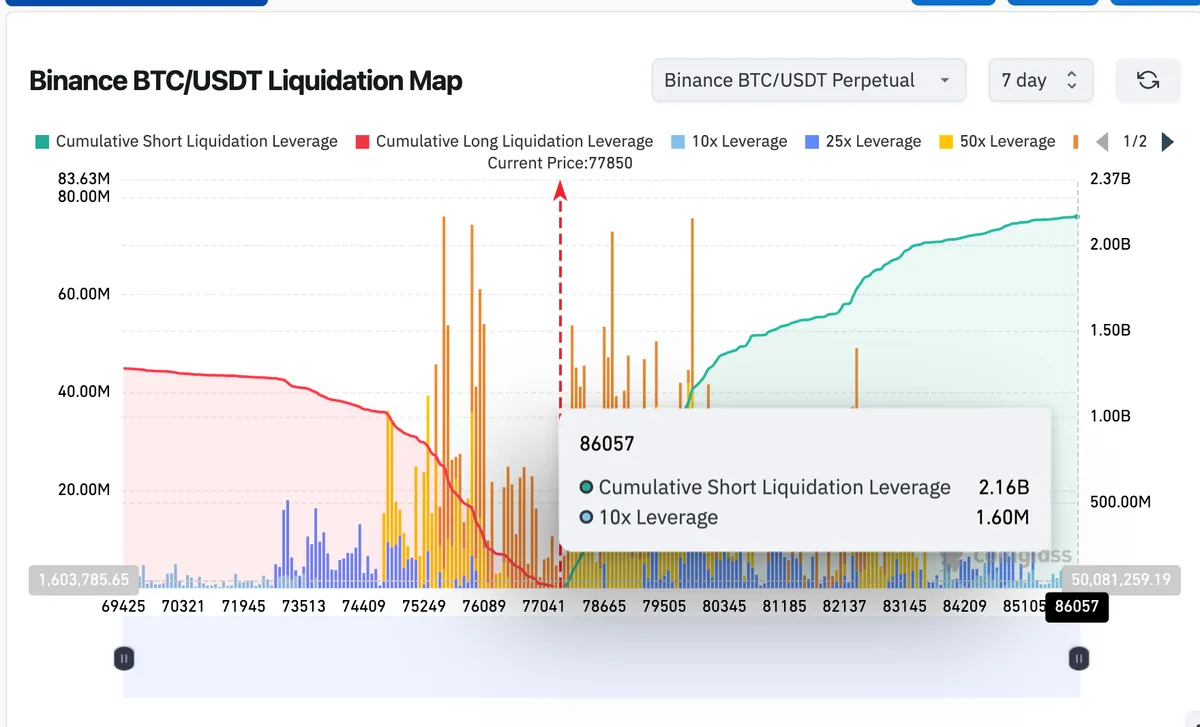
A leverage map published by Alphractal CEO Joao Wedson shows roughly $9.35 billion in short liquidations stacked above current price, against $12.73 billion in long liquidations sitting further below. The asymmetry skews the short-term path toward an upside squeeze if Bitcoin pushes higher from here, while still leaving meaningful downside exposure if the May 18 low gives way. Long-term holders have been quietly accumulating during the channel formation, a pattern historically associated with local bottoms. Combined with the geopolitical catalyst and a thinning order book on the topside, conditions favour a sharp expansion of range — though direction will hinge on macro follow-through.
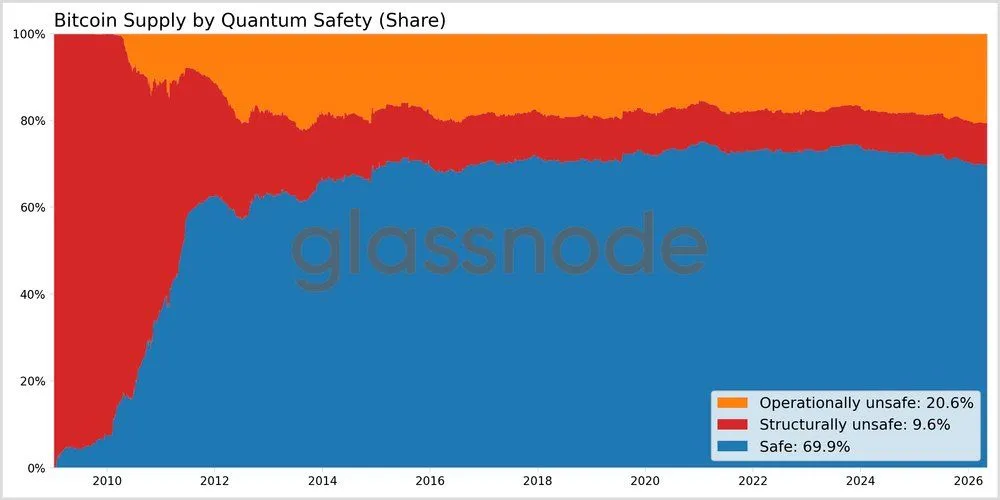
Separately, on-chain analytics firm Glassnode published fresh research framing Bitcoin's quantum-computing exposure as primarily a behavioural problem rather than a protocol problem. According to the data, 4.12 million BTC sit in addresses exposed by reuse, partial spending and custody practices — more than double the 1.92 million BTC vulnerable through older script types embedded in the protocol itself. Combined, the two buckets represent roughly 30.2% of all issued supply, with the operational share running 2.1 times larger than the structural one. The framing matters because remediation paths differ — protocol upgrades address one bucket, wallet hygiene addresses the other.
Structural exposure covers outputs where the public key sits on-chain by default, including early Pay-to-Public-Key coins from the Satoshi era, bare multisig and modern Pay-to-Taproot outputs. Operational exposure works differently — address types such as Pay-to-Public-Key-Hash hide keys behind a hash at rest, but once a holder reuses an address or partially spends from it, that protection lapses for any remaining balance. The distinction reframes a debate that has typically focused on legacy script design. The dominant risk vector now flows from how coins are managed, not how they were originally written into the blockchain ledger.
Exchange balances form the largest identifiable cluster within the operationally exposed pool, holding roughly 1.66 million BTC, or close to 40% of that bucket. Custodian behaviour varies sharply — Coinbase balances register at only 5% exposed, while other major venues sit materially higher. The takeaway for holders parallels the takeaway for venues: rotating coins through fresh addresses, avoiding partial spends from reused wallets and prioritising cold storage practices reduce exposure long before any quantum threat materialises. The research arrives as quantum-resistance proposals continue circulating among core developers, though no consensus path to migration has crystallised on a concrete timeline.
Bitcoin trades at $77,781 with the 24-hour change at +0.66% and market capitalisation near $1.56 trillion. The immediate support stack sits at $77,529, $76,137 and $74,281, while resistance lines up at $78,458, $80,428 and $82,850. RSI prints 48.13, parked in neutral territory but biased slightly to the downside, and the MACD reads bearish despite the recovery attempt. Trend remains sideways. A clean reclaim of $78,458 on rising volume would open a path toward $80,428; a breakdown beneath $76,137 would invalidate the short-squeeze thesis and refocus attention on the $74,281 demand zone.
Related Tags

AI-generated, AI-reviewed, under COINOTAG editorial oversight.