

Bitcoin Slips to $77K on Momentum Fade as South Carolina Shields Miners, Bans CBDC
Bitcoin momentum fades after $82K rejection as price tests $77K support; South Carolina signs S.B. 163 banning CBDC and shielding crypto miners.

Bitcoin (BTC) is flashing classic signs of momentum exhaustion after its rejection above the $82,000 level, with the leading cryptocurrency now trading near $77,200 after sliding roughly 8% from multi-month highs. Private wealth desks tracking flows describe positive Bitcoin momentum as having lost force with every bounce, framing the recent pullback to $76,000 as a process that typically precedes deeper corrections rather than the breakdown itself. The true market mean and short-term holder cost basis sit around $78,000 and now act as immediate overhead resistance, leaving bulls with limited room to recover lost ground before sellers regain the upper hand.
A separate set of on-chain readings reinforces the cautious tone, with Bitcoin's slow-impulse performance indicator turning negative for the first time since April. That shift is widely treated as a signal that every relief rally remains unconfirmed until the metric pushes back above zero. The broader price momentum indicator has fallen 29% over the past week, dropping to 47.1 from 66.7 and pointing to a clear handoff from strong upward thrust to weakening conviction. Spot demand, speculative positioning, and overall market structure are softening in tandem, raising the odds that the current consolidation tilts toward a deeper retracement before fresh demand returns.
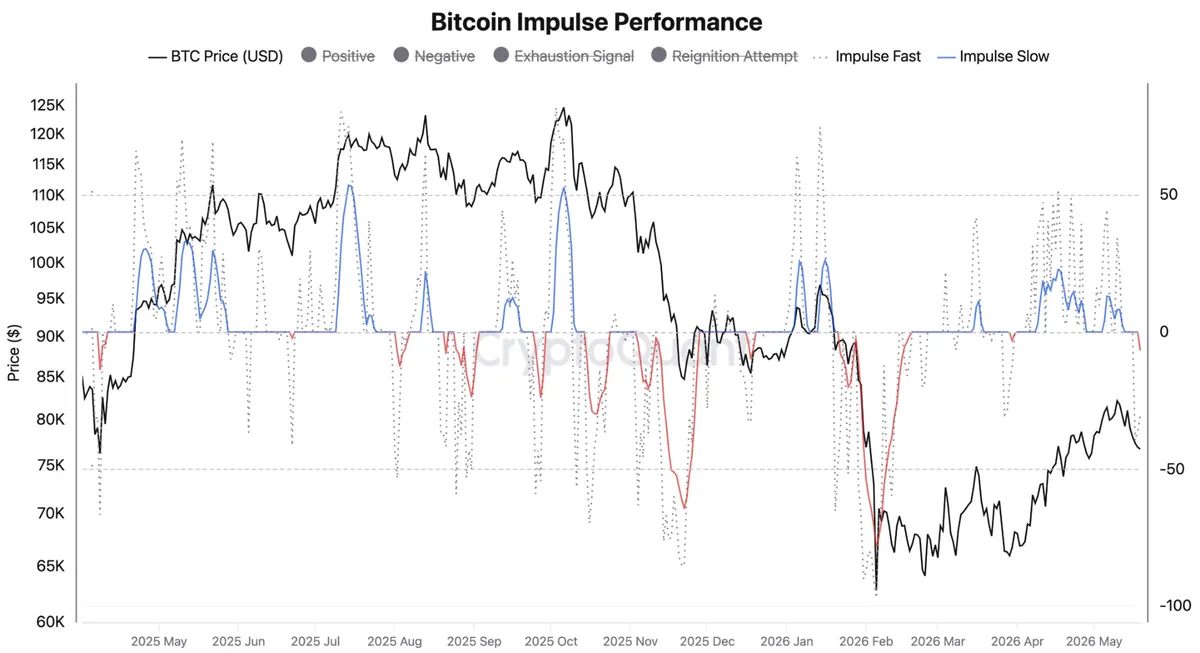
Should the $74,000-$76,000 support band fail to hold, analysts warn the next meaningful demand zone may not appear until $65,000, an outcome that would erase the bulk of the year's gains and reset positioning across leveraged venues. That scenario hinges on whether bulls can defend the late-April pivot now being retested, and several desks are watching realized-loss prints and exchange inflows for evidence that long-term holders are starting to capitulate. For now the structure has not broken, but the longer Bitcoin trades beneath $78,000 without reclaiming it, the higher the probability of a slide into a confirmed bear market phase.
On the policy front, South Carolina Governor Henry McMaster signed Senate Bill 163 into law on Tuesday, advancing what is now one of the most explicitly crypto-friendly state frameworks in the United States. The legislation, which cleared the Senate 38-1 and the House 110-1, prohibits any state agency or political subdivision from accepting, requiring payment in, or participating in Federal Reserve-led digital currency trials, including pilot programs run by federal counterparts. The CBDC ban dovetails with a broader political push at the state level to insulate residents from any future programmable-money rails routed through public-sector channels and built atop a centrally controlled blockchain architecture.
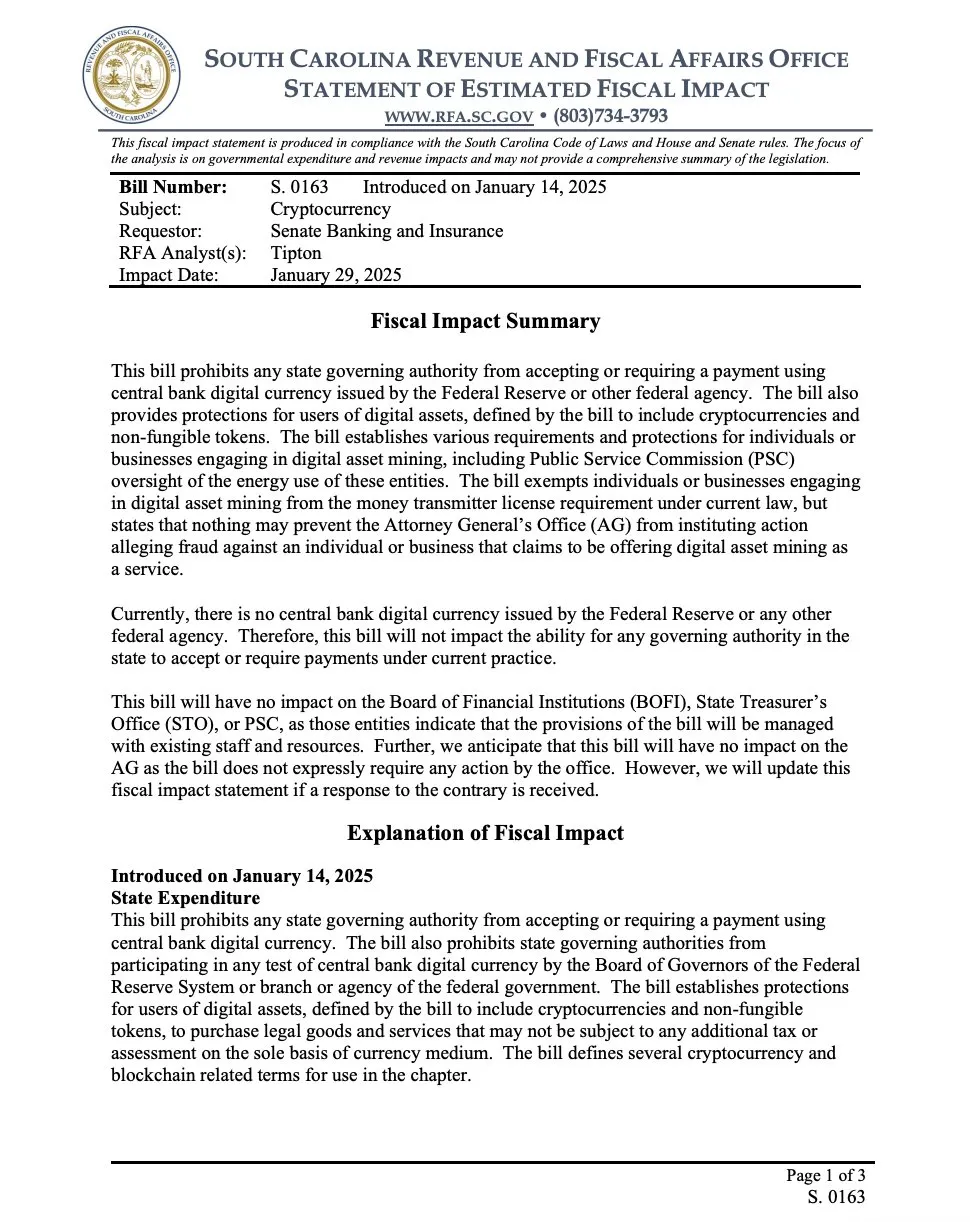
The bill carves out specific protections for Bitcoin miners operating in industrial zones, barring local governments from imposing restrictions that do not apply to other industrial operations or from setting mining-specific noise limits beyond existing pollution rules. Zoning changes targeting a digital-asset mining business must follow proper notice-and-comment procedures and can be appealed in court, removing a common pressure point used to push operators out of jurisdictions. The law also exempts mining, node operation, blockchain software development, and crypto-to-crypto trading from money-transmitter licensing requirements, while mining-as-a-service and staking-as-a-service providers fall outside securities classification, a meaningful clarification for operators sustaining the network's consensus mechanism.
S.B. 163 also explicitly protects self-custody, preventing state and local authorities from restricting the use of hardware devices and self-hosted wallets while barring discriminatory tax treatment for crypto transactions relative to comparable US-dollar payments. South Carolina now joins a widening bloc of states, including Kentucky, Oklahoma, Arkansas, Florida, Mississippi, Montana, North Dakota, Louisiana, and Arizona, that have codified similar protections for residents who hold their own keys in a cold wallet. The pattern points to a durable state-level counterweight emerging while federal market-structure legislation continues to inch through the Senate, giving operators and self-custodians more reliable ground to plan around.
At press time Bitcoin trades near $77,577, up 0.83% on the day with a market capitalization of $1.55 trillion and 24-hour turnover of $12.33 billion. RSI sits at 47.32, deep in neutral territory but tilting lower, while the MACD signal remains bearish and price action stays sideways. Immediate support clusters at $76,801, $75,080, and $72,673. Resistance stands at $78,455, $80,476, and $82,912; a daily close back above $78,455, visible on the candlestick chart, would weaken the bearish thesis, while a clean break of $75,000 opens the door to the $72,673 shelf.
Related Tags
AI-generated, AI-reviewed, under COINOTAG editorial oversight.