

Fairshake PAC Notches Six Primary Wins as SEC's Hester Peirce Exits for Academia
Crypto PAC Fairshake claimed six primary wins backed by $20M, while SEC's Hester Peirce announced her exit to join Regent University law faculty.

The crypto industry's most influential super political action committee declared a "powerful bipartisan mandate" after six of its endorsed congressional candidates secured wins in Tuesday's primary elections. Fairshake, principally bankrolled by Coinbase, Andreessen Horowitz, and Ripple, deployed more than $20 million across the contests, backing five Republicans and one Democrat. The committee operates with funding from major exchanges and venture firms invested in blockchain infrastructure. Successful Fairshake-backed candidates spanned Alabama, Georgia, and Kentucky, where Senate hopeful Andy Barr and a slate of House contenders prevailed. Pro-crypto messaging featured prominently throughout the committee's closing-stretch advertising blitz, though the connecting thread of presidential support was equally hard to miss.
A closer reading of the results suggests Donald Trump's grip on Republican primary voters carried more weight than industry advertising. Every successful GOP candidate Fairshake supported had previously received the president's endorsement, a pattern critics argue undermines the committee's claim of a crypto-driven mandate. In a striking display of political power, Trump's handpicked challenger Ed Gallrein, a retired Navy SEAL, unseated incumbent Representative Thomas Massie of Kentucky after Massie pushed for release of the Jeffrey Epstein files. Fairshake's own television spots leaned heavily on the Trump endorsement angle while conspicuously omitting any reference to digital assets, complicating the narrative that voters were specifically rewarding pro-crypto positions.
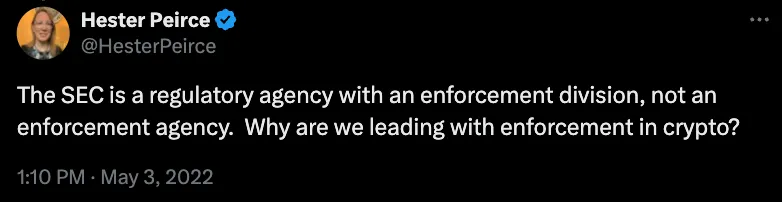
Hester Peirce, the two-term SEC commissioner widely known as "Crypto Mom" for her early advocacy of clear rules covering Bitcoin and other digital assets, will depart the regulator to join Regent University School of Law as an associate professor beginning in November. Her formal commissioner term expired in June 2025, though agency rules permit holdover service of up to roughly 18 months while replacements remain unconfirmed. Peirce currently chairs the SEC's crypto task force, which has steered the agency's pivot away from an enforcement-first posture. At Regent, she is expected to bolster the institution's curriculum across federal litigation, securities regulation, and the emerging digital assets practice area.
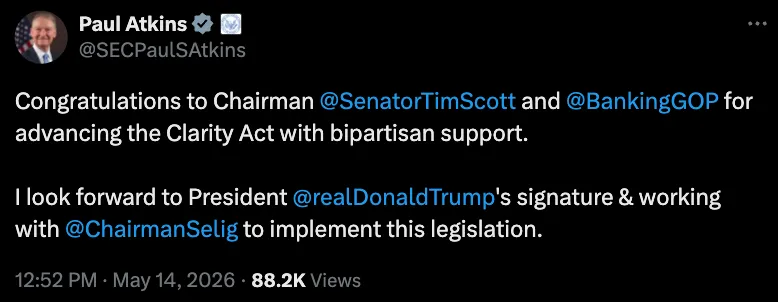
Her exit will leave the five-seat Commission with only two Republican members—Chair Paul Atkins and Mark Uyeda—at a moment when Congress is advancing market-structure legislation that would meaningfully expand SEC authority over digital markets. Caroline Crenshaw, the previous Democratic commissioner, stepped down in January after her own 18-month holdover ended, and the Trump administration has not advanced replacement nominees. The thinning bench arrives as the agency dismantles much of its prior enforcement program targeting altcoin issuers, including dropping cases tied to firms connected to Trump and his family. Lawmakers across both parties are now publicly pressing the White House to advance a balanced slate of replacements without further delay.
The Commodity Futures Trading Commission faces an even starker staffing gap. Acting Chair Michael Selig is the sole sitting commissioner on a panel statutorily designed for five, even as the agency prepares to assume expanded jurisdiction over spot crypto and DeFi markets under pending legislation. Selig and Atkins have publicly committed to ending what both describe as longstanding "regulatory turf wars" between their agencies, framing coordinated rulemaking and joint guidance as the operational template going forward. The skeletal commissioner ranks nonetheless raise practical questions about quorum, enforcement priorities, and the long-term institutional capacity of either body to police a rapidly expanding on-chain financial system across derivatives, lending, and tokenized assets.
Outside Washington, biotechnology firm Colossal Biosciences announced that its artificial-womb platform has reached what chief executive Ben Lamm called "the one-yard line" of full development, with internal tests now showing a 100% development rate through current iterations. The system, designed to gestate mammals entirely outside another animal's body, was built at the company's Australian laboratory under chief biology officer Andrew Pask using a dialysis-based architecture paired with AI-driven monitoring algorithms. The remaining technical hurdle, the company says, is reproducing the chemical signaling cascade between developmental stages. Colossal noted the platform is not part of its woolly-mammoth revival timeline targeting late 2028, separating the engineering breakthrough from its better-known de-extinction work.
The dominant arc across these developments is unmistakable: political alignment is reshaping the regulatory perimeter around digital assets faster than the industry can refactor its compliance posture. Crypto capital is bidding aggressively in primary contests, yet presidential endorsements remain the decisive variable, and the agencies tasked with writing rules are hollowing out at precisely the moment market-structure legislation demands their bandwidth. Even the Colossal milestone underscores a broader theme of capital migrating into deep-tech frontiers as crypto-aligned investors diversify. Regulatory clarity, political influence, and capital allocation are converging into a single bipartisan negotiation that will define the next bull market cycle.
Related Tags

AI-generated, AI-reviewed, under COINOTAG editorial oversight.