

Fed Proposes Skinny Accounts, Pauses Tier 3 as Kraken Secures Dubai VARA Approval
Fed proposes skinny master accounts and pauses Tier 3 reviews; Kraken parent Payward secures Dubai VARA approval and confirms $600M Reap deal.

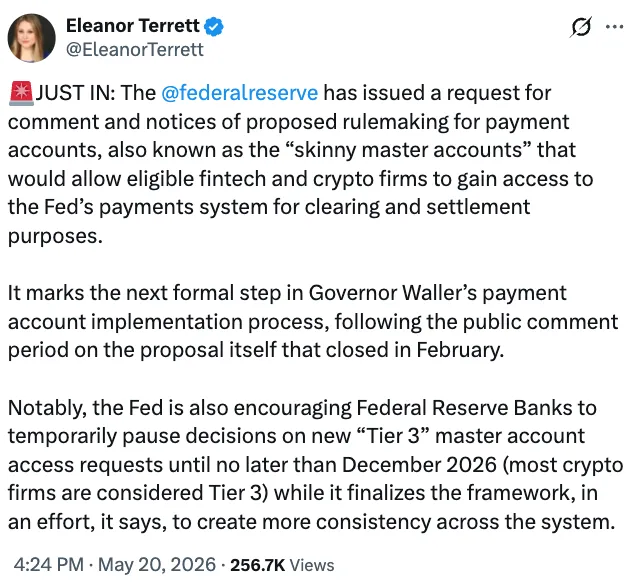
The US Federal Reserve has proposed a narrower framework for fintech and crypto-linked banks to access its payment rails, releasing a request for comment on Wednesday for so-called "skinny master accounts" tailored to nonbank financial institutions. The framework would allow eligible firms a limited connection to Fed payment systems without the full backstops afforded traditional banks. The proposal reflects ongoing regulatory caution toward digital asset firms, even as broader political signals have shifted toward integration. Industry watchers view the move as a measured attempt to extend partial access while preserving guardrails around systemic risk in the evolving blockchain-adjacent banking sector.
Alongside the skinny accounts proposal, the central bank encouraged regional Reserve Banks to halt decisions on Tier 3 master account requests during the rulemaking process. Staff said the temporary freeze is expected to conclude on or before December 31, 2026. A Board memo accompanying the announcement listed pending Tier 3 applications as of February 28, 2026, with companies including Kraken Financial — the banking arm of cryptocurrency exchange Kraken — appearing on the docket. Kraken Financial had previously been granted a limited-purpose master account through the Federal Reserve Bank of Kansas City in early March 2026, classified under the same Tier 3 designation now under broader review.
On the international front, Payward — the parent of crypto exchange Kraken — secured preliminary authorization from Dubai's Virtual Assets Regulatory Authority for a broker-dealer, investment, and management license. The clearance positions the firm under VARA's supervisory perimeter and opens the door to regulated services in the UAE spanning spot, margin, and OTC trading, alongside staking and institutional access via Kraken Prime. Local clients will tap Kraken's global orderbooks across Europe, the United States, and the Asia-Pacific region, with dirham funding and withdrawals routed through a locally regulated Payward subsidiary. Unlike DEX alternatives, the offering keeps custody and matching under the firm's regulated perimeter.
Payward has separately moved to expand its infrastructure stack in Asia, agreeing to acquire Hong Kong-based stablecoin payments firm Reap Technologies for $600 million in cash and stock. The transaction values Payward shares at a $20 billion implied valuation and marks the company's first infrastructure-focused purchase in the region. The deal underscores how exchanges are racing to vertically integrate payments rails and stablecoin issuance capabilities, positioning themselves to capture flows beyond pure spot trading and increasingly across DeFi-adjacent infrastructure. It complements Payward's earlier purchase of derivatives venue Bitnomial and signals continued consolidation across the broader crypto financial services landscape.

On the earnings front, Payward reported first-quarter 2026 adjusted revenue of $507 million, a modest 3% year-over-year increase that highlights the maturation of the exchange's revenue base. Adjusted EBITDA, however, fell sharply to $18 million from $168 million in the prior-year period, reflecting elevated operating expenditures tied to licensing, regulatory expansion, and acquisition integration. The figures arrive against a backdrop of intensifying competition among large exchanges seeking jurisdictional diversification. Cost discipline and scale economics will likely become defining metrics in coming quarters as exchanges absorb compliance overhead while pursuing both retail and institutional growth across regulated markets across multiple continents.
The latest Fed proposal lands amid heightened political momentum for digital asset integration, following President Donald Trump's executive order calling for broader fintech and digital asset access to the financial system. Yet the central bank's framework stops short of granting cryptocurrency exchanges direct admission to Fed master accounts. Firms would instead need to operate through an affiliate qualifying as an eligible depository institution. The cautious posture reflects a structural tension between political openness toward Bitcoin and stablecoin firms on one side, and supervisory discretion on the other — leaving the industry to navigate a layered perimeter spanning federal and state-level oversight.
This week's developments crystallize a clear cycle theme: regulatory architecture is being rebuilt around crypto firms rather than against them, but the boundaries remain tightly scripted. From the Fed's measured access framework to VARA's licensing of major exchanges in Dubai, jurisdictions are formalizing pathways for compliant operators while shutting down ambiguity. Mergers, licensing wins, and balance-sheet scaling are converging into a single trend — institutional-grade infrastructure is consolidating around a smaller cohort of well-capitalized exchanges handling Bitcoin and altcoin markets alike. The defining battleground is no longer whether crypto belongs in the financial system, but on whose rulebook it will operate.

AI-generated, AI-reviewed, under COINOTAG editorial oversight.