

JPMorgan Flags Stablecoin Dominance as Trump Backs $2B Quantum Push and EU Banks Launch Tokenized Settlement
JPMorgan says stablecoins still dominate tokenized funds; Trump backs nine quantum firms with $2B; Boerse Stuttgart and SocGen launch EU tokenized settlement.


Tokenized money market funds still represent only around 5% of the broader stablecoin universe, even though they offer holders a yield component that dollar-pegged tokens lack. Analysts argue that stablecoins remain the default cash leg for trading, collateral, settlement and cross-border flows across centralized venues and DeFi protocols. Tokenized funds face a structural handicap because they are classified as securities, triggering registration, disclosure and transfer restrictions that hinder free circulation onchain. Demand is largely confined to crypto-native treasurers and institutions seeking programmable settlement with traditional investor protections. Growth beyond 10%-15% of the stablecoin market is considered unlikely without meaningful regulatory reform.

The Trump administration is preparing to deploy $2 billion across nine quantum computing firms, taking minority equity stakes in each recipient. IBM will receive roughly $1 billion, GlobalFoundries $375 million, and smaller awards will flow to D-Wave Quantum, Rigetti Computing, Infleqtion and Diraq, the latter slated for $38 million in silicon-spin qubit work. The structure mirrors last year's Intel arrangement that converted CHIPS Act funding into a stake later valued above $56 billion. Shares of publicly traded recipients climbed between 7% and 21% in premarket trading, as the portfolio spans superconducting, annealing and neutral-atom approaches across the competing hardware frontier.
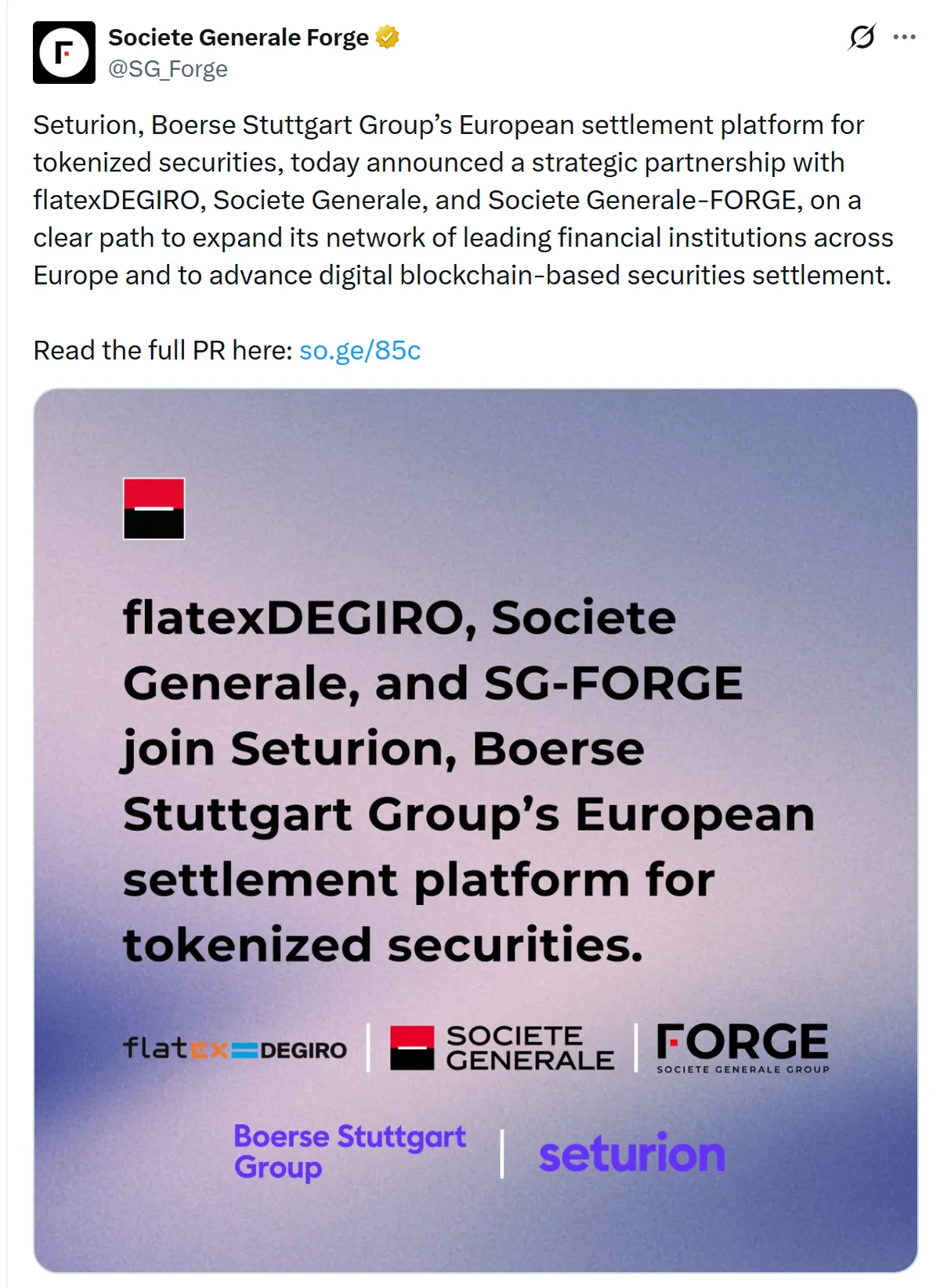
Boerse Stuttgart Group's Seturion platform has onboarded Societe Generale, its crypto arm SG-Forge and broker flatexDEGIRO to build a pan-European tokenized securities settlement stack. Societe Generale will issue tokenized turbo warrants and investment certificates onchain, while SG-Forge will settle trades using its MiCA-authorized EURCV and USDCV stablecoins. FlatexDEGIRO is plugging in its 3.5 million retail clients across 16 countries, and Nasdaq's European venues will connect to facilitate secondary trading. Seturion has filed for a DLT Pilot Regime license with German regulator BaFin. The infrastructure supports public and private chains and settles in both central bank money and onchain cash.
Cycles, the multilateral clearing protocol founded by Cosmos co-founder Ethan Buchman, has closed a $6.4 million funding round led by Blockchange Ventures, lifting total backing to $8.7 million. Coinbase Ventures, Compound VC and Primitive Ventures joined the raise, which underwrites Cycles Prime — a beta network connecting market makers, prime brokers and up to ten tier-one trading firms. The protocol uses zero-knowledge proofs, trusted execution environments and graph algorithms to net obligations across counterparties with minimal capital movement. Lynq and FalconX are anchor partners. A complementary stablecoin, Cycles Pay, will plug directly into the clearing engine to modernize 24/7 onchain settlement rails.
Foundation has raised $6.4 million in a Fulgur Ventures-led round to launch Passport Prime, a hardware device aimed at securing digital actions during the AI-agent era. Arche Capital also participated, bringing total funding to $16.5 million. The Boston-based firm is expanding from Bitcoin self-custody into identity management, multi-factor authentication and authorization layers for autonomous agents. Passport Prime bundles a hardware wallet, FIDO keys, a 2FA vault and 50GB of encrypted storage, running on KeyOS — a Rust-based microkernel with post-quantum cryptography via QuantumLink. Chief executive Zach Herbert argues that key approval must move to isolated hardware as agent-driven automation reshapes operational security.
The broader market backdrop continues to favor regulated rails over experimental yield products, as blockchain infrastructure quietly absorbs traditional finance functions. European banks are racing to launch MiCA-compliant euro stablecoins, with consortium Qivalis expanding to 37 members, while tokenized fund issuance scales alongside but remains constrained by securities law. The convergence of state-backed deep tech funding, institutional clearing protocols and hardware-rooted identity points to a maturing onchain stack rather than a speculative cycle. Liquidity remains anchored in stablecoins, while capital efficiency, settlement finality and agent-era custody emerge as the structural battlegrounds defining the next phase of crypto adoption.
The dominant narrative across this week's headlines is the institutionalization of crypto infrastructure under tightening regulatory perimeters. Sovereign capital is now taking equity in frontier technology, European exchanges are wiring stablecoin settlement into legacy securities markets, and venture capital is funding the unglamorous plumbing of clearing and key management rather than retail-facing tokens. Yield-bearing tokenized funds remain hemmed in by securities classification, reinforcing stablecoins as the system's reserve asset. Together these threads describe a market shifting from speculative narratives to operational integration, where regulatory clarity, institutional rotation and hardware-anchored security increasingly determine which protocols and assets survive the cycle.
AI-generated, AI-reviewed, under COINOTAG editorial oversight.