

Missouri Sues CoinFlip, Binance Debuts SpaceX Pre-IPO Perps, SEC Pauses ETFs
Missouri AG sues CoinFlip over crypto ATM fraud. Binance lists SpaceX pre-IPO perpetuals. SEC delays prediction market ETFs pending public comment.


Missouri Attorney General Catherine Hanaway filed a civil action against the operator of crypto ATM network CoinFlip, alleging the company knowingly facilitated fraudulent transactions and profited from inflated kiosk fees. The state is pursuing penalties of up to $1.826 million and a court order to halt CoinFlip operations within its borders. The complaint stems from a December probe into Bitcoin ATM operators launched after rising scam reports targeting Missouri residents. CoinFlip currently runs 136 kiosks across the state and 4,229 nationwide. A company spokesperson called the suit meritless, saying the firm has actively lobbied for stronger consumer protection rules in Missouri and other states.
The CoinFlip action arrives amid a widening crackdown on the broader cash-to-crypto kiosk segment. Bitcoin Depot, another operator examined under the same Missouri probe, filed for Chapter 11 bankruptcy protection earlier this month, underscoring the financial and legal pressure now bearing down on the industry. Several US states and Canadian municipalities have moved to restrict or ban the devices outright in recent quarters, citing repeated incidents where victims were directed to deposit cash into machines by scammers impersonating officials or family members. The combined effect is a rapidly shrinking blockchain onboarding footprint for retail users who once relied on these kiosks.

Binance opened a new front in derivatives by launching perpetual futures tied to private companies before they go public. The first listing, SPCX, tracks the anticipated valuation of SpaceX and is margined in tether. Contract pricing initially reflects publicly available signals such as private funding rounds and announced IPO ranges, then transitions to live market data once shares begin trading on a public exchange. The exchange's derivatives chief described the product as part of a financial super app vision that fuses crypto-native infrastructure with major capital-markets events. The launch effectively gives retail traders a venue to take leveraged positions on listings traditionally reserved for venture funds.
SpaceX filed its S-1 registration statement with the Securities and Exchange Commission this week, disclosing holdings of 18,712 BTC at an average cost basis of roughly $35,000 per coin. The filing also revealed first-quarter revenue of $4.69 billion against a $4.28 billion net loss, with a potential Nasdaq debut expected as soon as next month. Traders on the decentralized prediction venue Polymarket are pricing in more than a 70% probability that the listing closes above $2 trillion. The disclosure positions SpaceX among the largest publicly known corporate Bitcoin treasury holders, with reserves of that size typically maintained in deep cold wallet custody.
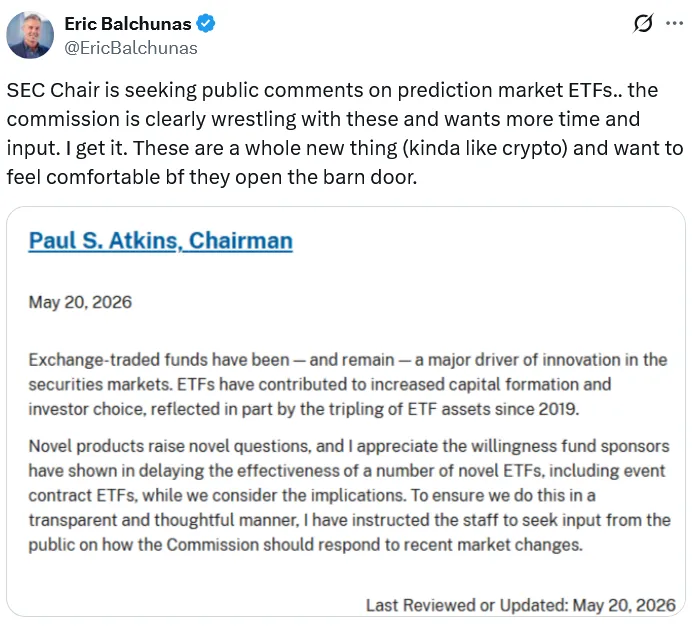
The Securities and Exchange Commission has paused several pending applications for novel exchange-traded products tied to event-outcome contracts. Chair Paul Atkins instructed staff to solicit public comment on how the agency should approach prediction-market ETFs after Bitwise, Roundhill Investments, and GraniteShares each filed for funds tracking election and event-driven outcomes. Atkins said novel products raise novel questions and signaled that the regulator wants to gather feedback before opening the door. Market analysts compared the deliberative tone to the agency's multi-year approach with spot crypto ETFs, suggesting that eventual approval is plausible but unlikely to be rushed. The delay does not amount to a denial.
Prediction markets have emerged as one of crypto's fastest-scaling use cases, recording more than $15 billion in monthly trading volume across elections, sports, financial results, and cultural outcomes. Bitwise's PredictionShares filings target US election results specifically, while Roundhill and GraniteShares pursue broader event coverage. A regulated ETF wrapper would route this activity through traditional brokerage accounts, mirroring how DeFi exposure reached institutions through tokenized vehicles and how altcoin spot products eventually cleared US regulators. Platforms such as Kalshi continue to navigate state-level court challenges in parallel, signalling that the legal framework around event contracts remains fluid.
The day's news points to a structural deepening of crypto's interface with traditional finance and regulators. State attorneys general are cracking down on consumer-facing cash kiosks even as exchanges push deeper into capital-markets territory through pre-IPO perpetuals and event-outcome products. Federal regulators are taking a more deliberate stance, pausing novel ETF wrappers rather than rejecting them outright. Threaded through these stories is a single arc: crypto rails are no longer parallel to legacy finance — they are increasingly fused with it, attracting both the capital flows of a sustained bull market and the enforcement attention that mainstream relevance brings.
AI-generated, AI-reviewed, under COINOTAG editorial oversight.