

NEAR Eyes $2 Test, Oil Holds $107 on Iran Risk, AI Spam Floods Bug Bounties
NEAR rallies past $1.64 with a $2 target in view, US crude holds near $107.80 on Iran-Russia waiver mix, and AI-generated spam forces bug bounty pauses.

Companies running bug bounty programs are confronting an unprecedented wave of low-quality, AI-generated vulnerability submissions that are eroding the value of the practice. Security teams report that machine-generated reports have flooded inboxes faster than human researchers can validate them, with many submissions fabricating issues that do not exist in production code. San Francisco-based Bugcrowd disclosed that reports through its platform more than quadrupled during a three-week stretch in March, the bulk of which proved fictitious. The trend is reshaping a market in which Meta, Microsoft, Apple, and Crypto.com collectively paid researchers roughly $58 million in 2025 to surface software flaws before adversaries did.
The financial pressure has forced several operators to pull back. In April, HackerOne and self-hosted cloud provider Nextcloud both suspended paid bounty initiatives, with Nextcloud stating that no financial rewards would be issued for any submissions regardless of severity. Ross McKerchar, chief information security officer at Sophos, acknowledged that the model itself must evolve, noting that bounties will persist but in a meaningfully changed form. Security specialists warn that generative tooling has lowered the barrier to submission so dramatically that triage budgets are being consumed by noise rather than verified findings, an industry-wide problem with no standardized filter yet in place.

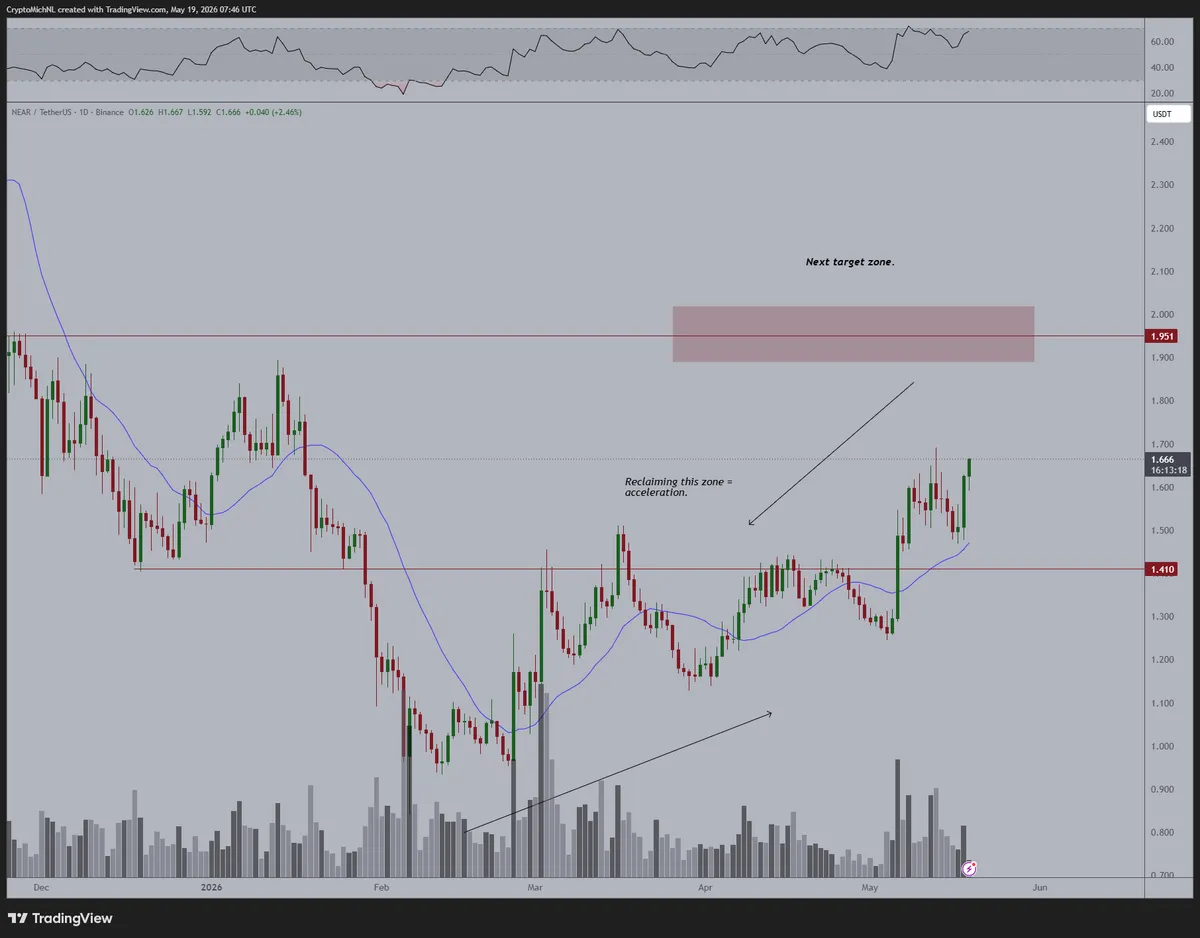
NEAR Protocol changed hands near $1.64 after a 10.58% daily advance, with chart analysts identifying the token as one of the more constructive setups across the AI-adjacent corner of the market. The altcoin reclaimed an acceleration zone between $1.50 and $1.70 that buyers had been watching for weeks, while daily volume trended higher off the February low. The relative strength index printed around 62, still short of overbought territory. Trader Michaël van de Poppe flagged $1.40 as the must-hold support and pointed to a $1.95 target zone, framing a potential test of the psychological $2 level as the next leg of the bull market structure.
Beyond the chart pattern, the fundamental case for NEAR centers on revenue growth tied to NEAR Intents and the global footprint of its developer community. The NEAR Legion community map shows active contributors clustered across San Francisco, Delhi, Lagos, São Paulo, Europe, and Southeast Asia, a geographic spread that supporters argue gives the blockchain durable distribution as AI utility expands on chain. Higher highs since February have built a constructive structure, and momentum traders see continuation so long as price respects the $1.40 floor. The broader thesis assumes AI infrastructure tokens lead rotation as capital filters down the risk curve.
US crude traded near $107.80 per barrel after mixed signals from the Trump administration unsettled energy desks. Traders shrugged off chatter of a temporary sanctions waiver on Iranian oil and refocused on the structural risk of broader Middle East escalation. The intraday move briefly pushed prices below $105 on reports of a proposed waiver tied to renewed nuclear talks, before the discount unwound as participants reassessed follow-through. Former hedge fund manager Jim Cramer warned that crude could revisit its $119 all-time high if Washington-Tehran negotiations collapse, citing an asymmetric pattern in which war headlines move price further than diplomatic ones.
President Donald Trump postponed a planned strike on Iran while extending separate waivers covering Russian crude shipments, prolonging an uneasy equilibrium that has kept global benchmarks rangebound at elevated levels. The decision shaved roughly 1% off intraday futures but did little to compress longer-dated risk premium baked into the curve. Energy analysts argue that the combination of geopolitical fragility and sticky inflation continues to weigh on liquidity available to risk assets, including Bitcoin and other digital currencies, raising the probability that any sustained oil spike could re-anchor a bear market impulse across high-beta crypto.
The throughline this cycle is a regime change in trust. Bug bounty programs are buckling because generative tooling is overwhelming the human verification layer that secured them; AI-linked tokens like NEAR are bid because investors believe machine-learning infrastructure will be productively monetized rather than merely speculated upon; and oil refuses to settle because the macro stack now prices conflict more heavily than diplomacy. Together, these threads describe a market negotiating two opposing forces simultaneously, accelerating automation on the supply side of information and analysis, and persistent geopolitical fragility on the demand side of risk. The price action is increasingly an attempt to reconcile both.
Related Tags

AI-generated, AI-reviewed, under COINOTAG editorial oversight.