

South Korea Crypto Tax Petition Hits 50K, CFTC Signs NHL Prediction Markets MOU
Crypto News
A petition opposing South Korea's planned 22% tax on crypto investment gains has crossed the 50,000-signature threshold required to trigger a formal review by the country's Finance and Economic Planning Committee. Set to take effect in January 2027, the levy imposes additional financial and reporting burdens on retail investors while offering preferential treatment to other asset classes. Petition organizers argue the policy will accelerate a capital and talent outflow from Asia's most active retail trading hub, with younger Koreans already locked out of housing markets by surging real estate prices. The campaign has now surpassed 52,000 signatures and demands lawmakers reconsider the rate before implementation.
The escalating pushback comes against a sharp contraction in South Korea's domestic crypto market. Aggregate holdings across local investors slid from roughly 121.8 trillion won, equivalent to about $83.3 billion in January 2025, to approximately 60.6 trillion won — near $41.4 billion — by February 2026. Daily turnover on the five largest licensed venues, including Upbit, Bithumb, Coinone, Korbit and Gopax, also collapsed from $11.6 billion in December 2024 to roughly $3 billion. Roughly 32% of the population still owned digital assets in early 2025, though that share has eroded as token prices stayed under sustained pressure throughout the year.
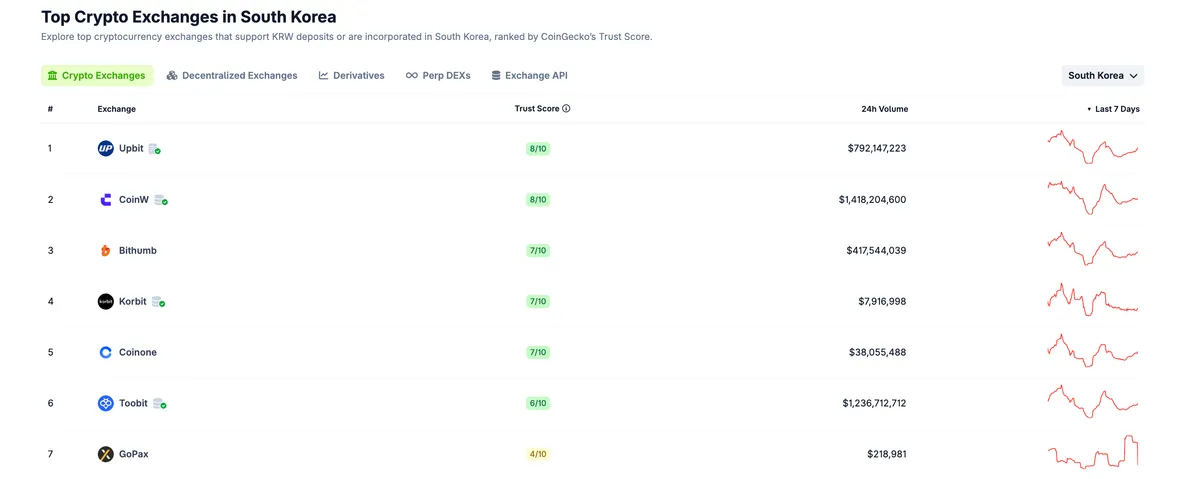
Tighter anti-money-laundering frameworks and stricter know-your-customer requirements are also reshaping participation in the Korean market. Domestic exchanges have been pushed to upgrade compliance stacks, restrict access to high-risk wallets, and increase scrutiny on inbound and outbound transfers — measures critics argue are funneling retail flow toward offshore venues. The financial regulator has signaled further controls in 2026, including pending guidelines for tokenized securities expected in July. Combined with the looming 22% capital gains levy, the regulatory layering has fueled concerns inside the industry that the country could lose its longstanding edge in altcoin trading volumes to neighboring jurisdictions.
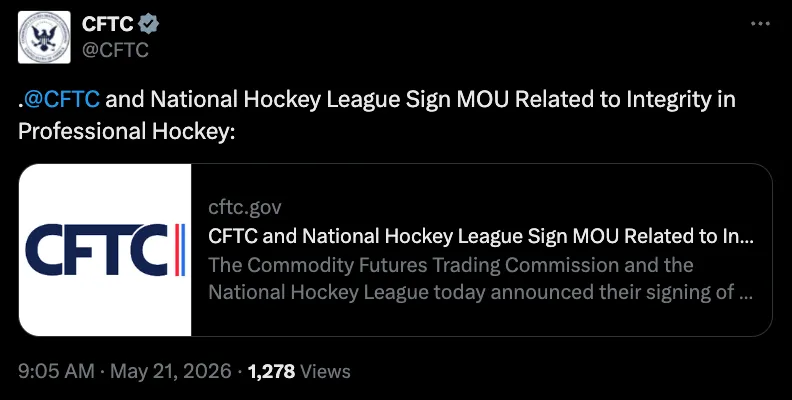
Across the Pacific, the US Commodity Futures Trading Commission announced a memorandum of understanding with the National Hockey League aimed at safeguarding the integrity of professional hockey contests and the prediction markets that price them. CFTC Chair Michael Selig framed the pact as a defense against insider trading, fraud, and other abuse on platforms such as Kalshi and Polymarket. The agreement mirrors a March pact between the agency and Major League Baseball, which coincided with Polymarket being designated as MLB's Official Prediction Market Exchange. The NHL's 2026-27 season opens in September, while Stanley Cup playoff contracts have already been actively listed on regulated venues.
The hockey agreement reinforces the CFTC's broader posture that prediction markets fall under its sole federal authority. Acting as the agency's only sitting commissioner since December, Selig has filed legal actions against Ohio, Connecticut, Illinois, New York, and most recently Minnesota — the latter described as the first outright state-level ban of regulated event contracts. The commission is statutorily designed to seat five bipartisan commissioners, yet the White House has not advanced public nominations to fill the vacant chairs. Industry observers warn that prolonged single-commissioner leadership concentrates enforcement discretion in one office while pending CLARITY Act questions over blockchain-based markets remain unresolved.
On the product side, Polymarket filed a self-certification letter with the CFTC seeking authorization to list combinatorial outcome contracts — instruments that combine two or more underlying event markets into a single tradable structure. The filing, dated Wednesday, would let users wager on linked outcomes such as paired sports results or compound election scenarios, expanding the platform's design space beyond binary event markets. Combinatorial products typically improve capital efficiency for traders and broaden hedging strategies, mirroring how multi-leg DeFi derivatives evolved on permissionless venues. If approved, the change would meaningfully extend the regulatory perimeter the CFTC is actively building around onshore prediction markets.
The week's developments trace a clear thematic arc: regulators on both sides of the Pacific are tightening the perimeter around digital-asset and event-contract markets simultaneously. Seoul is pushing forward with a capital gains regime that participants warn could hollow out local Bitcoin and altcoin liquidity, while Washington's CFTC is consolidating authority over prediction venues through bilateral pacts and aggressive litigation. The common thread is a transition from passive oversight to active jurisdictional assertion. For market participants navigating either ecosystem, the operating reality of 2026 is one of expanding compliance surfaces and shrinking ambiguity around what regulators consider their turf.
COINOTAG does not provide financial advisory services. This content is for informational purposes only and should not be considered investment advice. Cryptocurrency investments involve high risk.
Add COINOTAG as a Preferred Source
Add COINOTAG to your preferred sources in Google News and Search to see our coverage first.
Add on GoogleRelated Tags
AI-generated, AI-reviewed, under COINOTAG editorial oversight.