

Tether Buys SoftBank Out of XXI, South Carolina Bans CBDC as Bitcoin Holds $77K
Tether absorbs SoftBank's $711M stake in Twenty One Capital, South Carolina shields miners and bans CBDC as Bitcoin holds near $77,162.


Tether has tightened its grip on Twenty One Capital after acquiring the entirety of SoftBank's stake in the Bitcoin treasury firm, removing the Japanese investment giant from the cap table less than a year after it backed the venture with nearly $1 billion. A regulatory filing confirms that Tether absorbed 89.1 million shares, a position recently valued near $711 million at $7.98 per share. SoftBank's exit forced the immediate resignation of its board designees, leaving Twenty One temporarily non-compliant with NYSE governance rules. The firm currently sits on 43,514  Bitcoin (BTC), worth roughly $3.4 billion at current spot prices.

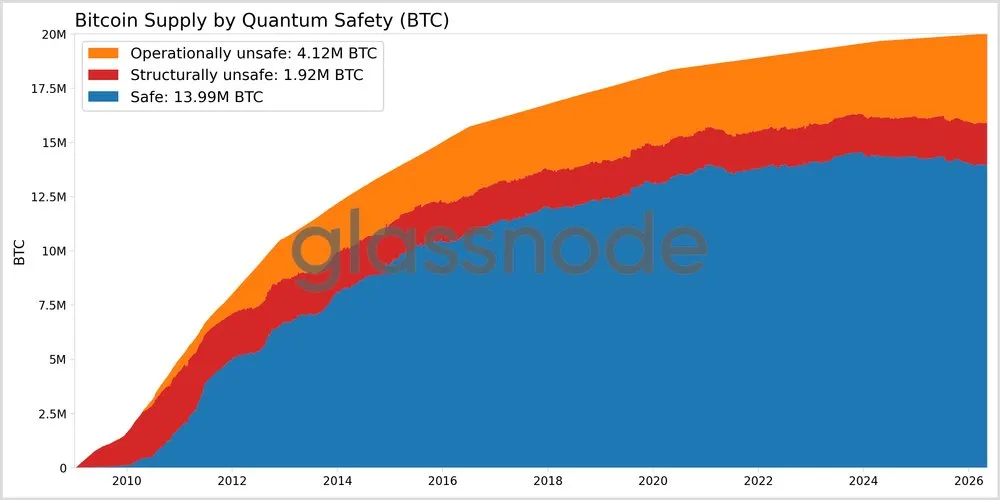
On-chain analysis indicates that nearly 10% of Bitcoin's total supply — about 1.92 million coins — is structurally exposed to a future quantum computing breakthrough because its output type reveals the public key by design. The vulnerable cohort spans Satoshi-era Pay-to-Public-Key outputs, legacy multi-sig structures, and modern Taproot addresses. Roughly 1.1 million of those coins are tied to Satoshi Nakamoto himself, accounting for 5.5% of total supply. The risk is conditional on machines capable of breaking elliptic curve cryptography, an estimated 2,330 logical qubit threshold. Proposals such as BIP-360's Pay-to-Merkle-Root output type aim to harden the blockchain ahead of that scenario.
South Carolina has joined the growing list of US states adopting overtly crypto-friendly statutes. Governor Henry McMaster signed Senate Bill 163 on Tuesday, formally banning the use of any central bank digital currency inside state agencies and prohibiting state participation in any federal CBDC pilot. The same legislation enshrines the right of individuals and businesses to accept digital assets, operate self-hosted wallets, and pursue mining activity in industrial zones without a money transmitter license. Bitcoin (BTC) miners gain explicit protection so long as they meet noise limits and avoid placing additional stress on the electrical grid, codifying self-custody rights directly into state law.
Bitcoin mining economics have entered an uncomfortable phase, with hashprice — the daily revenue earned per unit of hashrate — touching an all-time low of $28.90 per petahash per day. The compression followed a brutal stretch in which six of seven recent difficulty adjustments printed negative, a pattern not seen since 2011. Operators are decommissioning legacy ASIC fleets and reallocating data center capacity toward AI inference workloads, a pivot that doubles as a cushion against the shrinking block subsidy. With the next halving on the horizon and coinbase rewards trending structurally toward zero, the long-term thesis increasingly rests on transaction fees funding the network's consensus mechanism.
Tether's consolidation of Twenty One also signals a broader shift in the corporate Bitcoin (BTC) treasury narrative that drove last year's wave of public listings. XXI's stock trades down 83% from its peak of $53, a level reached shortly before the firm merged with a Cantor Fitzgerald-affiliated blank check vehicle, despite a current market capitalization of $5.2 billion. The company has not disclosed a new BTC purchase in over nine months, a notable gap given how aggressively rival treasury vehicles have accumulated. Chief executive Paolo Ardoino framed the SoftBank buyout as a vote of conviction, even as the discount to the equity's all-time high underscores how brutally the sector has rerated.
Taken together, the quantum exposure data and the mining revenue squeeze sketch a long-horizon structural agenda. Network security, today denominated almost entirely in block subsidy economics, must eventually transition to a fee market while developers stage post-quantum signature schemes. Analysts highlight that roughly 70% of supply remains unexposed to a quantum theft scenario, providing time to coordinate soft-fork-level upgrades. The mining sector's AI pivot, meanwhile, may keep meaningful ASIC hashpower online by subsidizing facility overheads. Both threads point to a more mature, slower-growth phase for the protocol rather than an existential break in security or supply integrity.
Bitcoin trades near $77,162, up 0.51% on the day, sitting almost on top of its near-term support at $76,805. The next defensive shelves are $75,080 and $72,673, while overhead resistance clusters at $78,588 followed by $80,475 and the psychological $82,850 zone. RSI at 47.75 reads as neutral with a slight downward lean, and the MACD signal remains bearish, consistent with the sideways trend. A clean daily close above $78,588 would invite a retest of $80,475, while losing $76,805 would expose price to the $75,080 pocket and tilt structure toward a bear-market continuation read.
AI-generated, AI-reviewed, under COINOTAG editorial oversight.