

Anchorage Steps Back From Robinhood and Kraken-Backed USDG Stablecoin Consortium
JUST (JST) trades near $0.0878 as Anchorage retreats from USDG, Circle values Arc at $3B, Solana tests Alpenglow and Visser buys ETH on AI agent demand.


Anchorage Digital, the first federally chartered crypto bank in the United States, is dialing back its prominent role inside the Global Dollar (USDG) stablecoin consortium that counts Robinhood, Kraken, Galaxy Digital, OKX, Visa, Worldpay and Bullish among its members. Chief executive Nathan McCauley said the firm will adopt a posture of "increased neutrality" rather than actively promoting a single token. USDG, issued by Paxos Digital Singapore under Monetary Authority of Singapore supervision, carries a circulating supply of roughly $3 billion. Anchorage remains a consortium participant, but with as many as 20 banks and tech firms exploring white-label stablecoin issuance through its rails, the custodian is recalibrating incentives to avoid favoring any one issuer.

Macro investor and former hedge fund manager Jordi Visser disclosed a fresh Ether position, framing the trade as a bet on tokenization and autonomous AI agent payments. Visser argued that AI agents lack access to bank accounts and traditional credit, leaving stablecoins and Ether as their natural settlement layer. Autonomous online payments have already cleared more than $24 million on the Coinbase x402 standard over the past month, while the Algorand Foundation partnered with Google on the AP2 Agentic Payments Protocol. Ethereum commands more than 60% of tokenized real-world asset market share including layer-2 networks, positioning the blockchain as a primary beneficiary of price discovery flows from dormant private credit and venture capital pools.
A wave of more than 20 prediction market exchange-traded funds tied to political and economic outcomes was delayed again by the U.S. Securities and Exchange Commission, missing what was widely expected to be a Monday debut. Regulators requested additional time to scrutinize disclosures, marking the second postponement in as many weeks for would-be issuers including Bitwise, Roundhill and GraniteShares. Trading volumes on Polymarket and Kalshi continue to climb, and Roundhill is preparing election-themed products such as RPM Democratic President, RPM Republican President, RPM Democratic Senate and RPM Republican Senate funds. The delays underscore how closely regulators are weighing precedent before approving instruments that pay out on election outcomes.
Circle is repositioning itself as more than a stablecoin issuer with the Arc blockchain, valuing the new network at roughly $3 billion through a $222 million token presale backed by a16z crypto, Apollo, BlackRock and ARK Invest. Chief executive Jeremy Allaire pitched Arc as an "economic operating system" engineered for payments firms, asset issuers and capital markets, with mainnet launch planned for summer after test-mode operations since October. Circle shares surged more than 15% on the news, signaling investor appetite for institutional-grade rails as Congress advances stablecoin legislation that could allow banks and fintechs to issue their own digital dollars and commoditize the underlying token business.
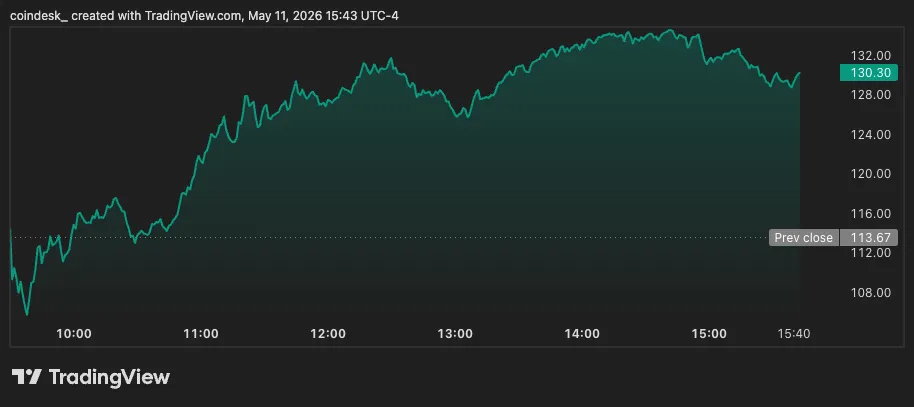
OpenAI unveiled the OpenAI Deployment Company, a majority-owned subsidiary capitalized with more than $4 billion at a $10 billion valuation and backed by 19 firms including TPG, Goldman Sachs, SoftBank, Capgemini and McKinsey. The new entity will embed forward deployed engineers inside enterprise clients, modeled on the Palantir playbook of living inside legacy infrastructure and compliance constraints. To staff from day one, OpenAI agreed to acquire U.K.-based consulting firm Tomoro, adding roughly 150 deployment specialists with prior work at Tesco, Virgin Atlantic and Supercell. The launch arrives days after a rival $1.5 billion enterprise venture from Anthropic backed by Blackstone, Goldman Sachs and Hellman & Friedman, intensifying the race for the AI implementation layer.
Solana developer Anza confirmed that Alpenglow, the network's largest proposed consensus mechanism overhaul, is now live on a community test cluster, clearing a major hurdle on the road to mainnet. The upgrade is designed to replace Solana's existing Proof-of-History and TowerBFT stack with a redesigned architecture that compresses transaction finality from several seconds toward near real-time settlement. Validator operators successfully executed what developers call the "Alpenswitch," transitioning nodes from the legacy process to Alpenglow inside a live environment. Co-founder Anatoly Yakovenko has signaled that mainnet activation could arrive as soon as next quarter if testing continues without incident, potentially reshaping Solana's responsiveness during peak demand.
JUST (JST) is trading near $0.08783, up 3.58% on the day with a market capitalization around $749 million. Price sits just below first resistance at $0.0879, with subsequent ceilings at $0.0908 and $0.105, while the nearest support rests at $0.0849 ahead of deeper floors at $0.0785 and $0.073. The RSI at 62.09 confirms momentum in bull market territory without yet reaching overbought conditions, though the bearish MACD crossover warns the rally may be losing steam. A clean break above $0.0879 on rising volume would open the path to $0.0908, while a daily close beneath $0.0849 would invalidate the near-term uptrend thesis and expose $0.0785.
AI-generated, AI-reviewed, under COINOTAG editorial oversight.