

Bitcoin Climbs to $77K as Senate Curbs Iran Powers, Implied Volatility Hits 2026 Low
Bitcoin rebounded to $77,200 after the Senate voted to curb Trump's Iran war powers, while implied volatility printed a fresh 2026 low near 42%.


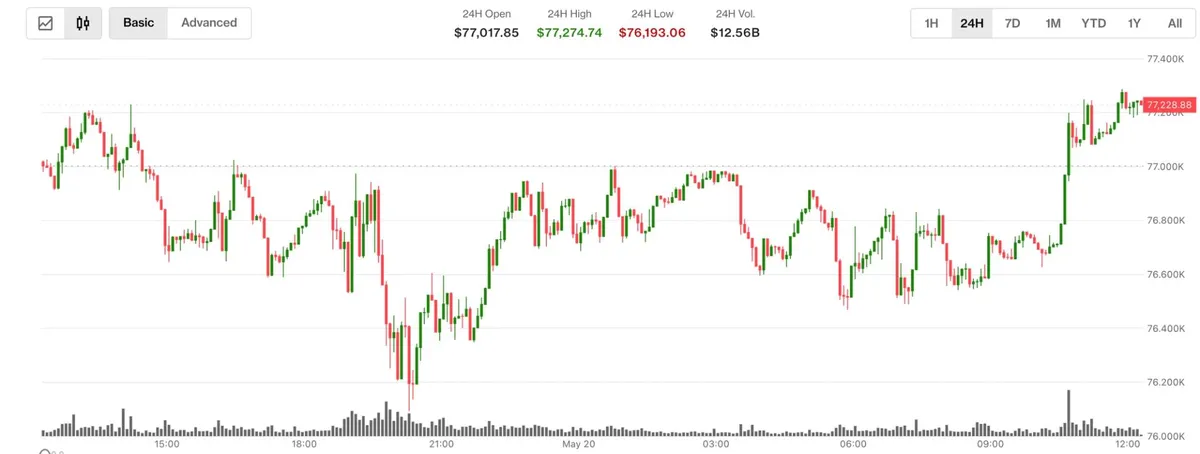
Bitcoin staged a modest rebound early Wednesday, climbing roughly 0.5% to around $77,200 after the U.S. Senate voted 50-47 to advance a resolution curbing President Donald Trump's war powers in Iran. The procedural breakthrough came on the seventh attempt since the conflict erupted in late February and helped major tokens snap a five-session losing streak. XRP, Ether and Solana joined the move higher with gains of 0.4% to 0.8%, lifting several large-cap altcoins in tandem. The reprieve followed a punishing pullback that dragged  Bitcoin (BTC) from $82,000 toward $76,000, as hardening Treasury yields and accelerating spot ETF outflows squeezed risk assets through the second half of last week.
Sentiment received a second tailwind from a White House directive instructing the Federal Reserve to review how depository institutions may be granted access to payment services. The order is widely read as a structural win for the digital-asset industry, which has long struggled to secure stable banking relationships after years of debanking pressure. Industry executives argued wider access to payment rails could lift institutional confidence, improve liquidity, sharpen settlement efficiency and accelerate long-term adoption. The move also dovetails with a broader regulatory pivot under the current administration, which has prioritized integrating crypto firms into the traditional financial system rather than restricting their fiat on-ramps.
Cross-asset signals reinforced the risk-on shift. WTI crude futures slipped 0.75% to $103.42 as the Iran-related geopolitical premium unwound, while yields on the 10-year and two-year Treasury notes each eased more than two basis points. Nasdaq futures ticked up 0.33%, suggesting equity desks were positioning for a softer macro backdrop. For Bitcoin (BTC), the relief in bond yields is particularly important: the May slide coincided with the 10-year repricing higher and a sharp pickup in volatility on the long end of the curve, both of which had compressed valuations across duration-sensitive assets. A sustained yield rollover would remove one of the cycle's heaviest overhangs.
Traders are now bracing for Wednesday's release of the April Federal Open Market Committee minutes at 18:00 UTC, widely viewed as the next major catalyst for both fixed income and crypto. Analysts expect markets to parse the document for how persistently above-target inflation is being weighed against growth risks and the timing of any policy recalibration. A dovish lean could amplify the relief rally, while hawkish surprises risk reigniting last week's deleveraging and tipping sentiment back toward bear market conditions. Bitcoin's correlation with rate-sensitive macro indicators has tightened materially in 2026, leaving any shift in the Fed's reaction function capable of dictating short-term direction across the broader digital-asset complex.
Despite the steep drawdown from $82,000, options markets continue to price unusually muted future swings. The 30-day annualized implied volatility benchmark has held near 42%, just above its year-to-date floor of 40% and well below levels typically seen during sharp directional moves. The disconnect stands out because Treasury volatility has surged, with the MOVE index leaping from 69% to 85%, signalling real stress in the bond complex. Derivatives strategists argue Bitcoin (BTC) volatility looks cheap in absolute terms, with implieds compressing into the high-30s and printing fresh 2026 lows even as spot grinds lower and spot ETF outflows accelerate.

That compression has revived interest in long-volatility structures. Specialists at the largest crypto options venue, which clears more than 70% of global flow, point to long straddles as a clean way to monetize the apparent mispricing. The trade pairs an at-the-money call with an at-the-money put on the same expiry, profiting if Bitcoin breaks decisively in either direction. With macro catalysts stacking up, from the FOMC minutes to ongoing geopolitical recalibration, positioning for a regime shift in realized volatility has become an increasingly crowded thesis on the institutional desk side, even as directional conviction on spot remains noticeably thin.
BTC trades at $77,329 with a 0.42% gain on the day and a $1.55 trillion market cap, though the broader posture on the candlestick structure remains sideways. Immediate support sits at $76,136, with deeper cushions at $74,281 and $72,673. Resistance clusters at $78,430, then $80,477 and $82,793, the upper edge of last week's range. RSI at 46 sits in neutral territory while the MACD remains bearish, consistent with the choppy tape. A reclaim of $78,430 on rising volume would invalidate the bearish lean and open a path back toward $80,000; a clean break of $76,136 would expose the lower-$74Ks quickly.
AI-generated, AI-reviewed, under COINOTAG editorial oversight.