

Bitcoin Drops Below $77K as Iran Eyes BTC Tolls, Saylor Signals Buy, ETFs See $1B Outflow
Bitcoin slides under $77K amid Iran tensions and $1B ETF outflows as Saylor signals fresh buy, Intesa doubles crypto to $235M, and Bitcoin Depot files Ch.11.

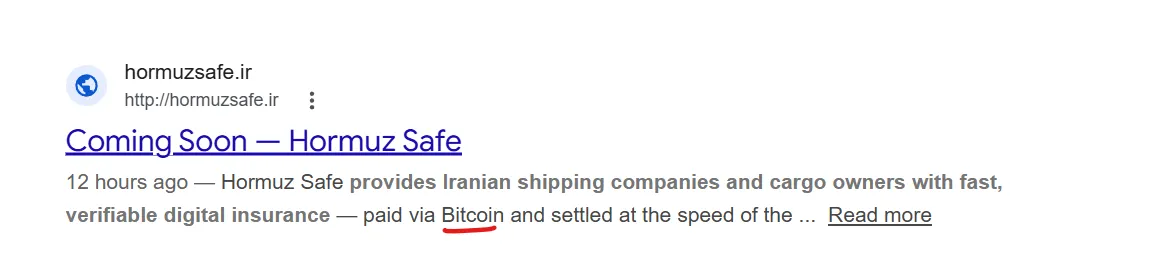
Iran is reportedly weighing a maritime insurance framework to control transit through the Strait of Hormuz, with some accounts suggesting payments could be denominated in Bitcoin. State-affiliated reports describe a Ministry of Economic Affairs proposal that would issue marine insurance policies and certificates of financial responsibility for vessels crossing the strategic waterway, potentially generating more than $10 billion in annual revenue. A purported website branded "Hormuz Safe" advertised Bitcoin payment options for "secure digital insurance," though the site went offline and its authenticity remains unverified. The shipping lane handles roughly one-fifth of global oil flows, and Tehran began collecting first tolls after US airstrikes escalated tensions in February.
Nasdaq-listed Bitcoin ATM operator Bitcoin Depot filed for Chapter 11 protection in the Southern District of Texas, citing an unsustainable business model under tightening state-level regulation. Chief executive Alex Holmes pointed to stricter compliance obligations, new transaction limits, and outright bans in some jurisdictions as drivers of the wind-down. The company's network of Bitcoin ATMs has been taken offline, and overseas units including the Canadian arm will also close. Preliminary first-quarter figures showed revenue falling 49.2% year-on-year and a $9.5 million net loss, reversing the prior year's $12.2 million profit. A $3.7 million security breach earlier this year compounded the pressure.
Bitcoin slipped below $77,000 over the weekend as renewed US-Iran tensions and stubborn inflation fears triggered broad risk-off positioning. President Donald Trump posted a sharply worded warning on Truth Social, threatening military escalation if Tehran continued to delay a peace agreement. Brent crude jumped 1.78% to $111.20 and WTI rose 2.2% to $107.70, fueling worries that elevated energy costs could keep inflation entrenched and push the Federal Reserve to defer rate cuts. Treasury yields hit twelve-month highs and the dollar strengthened, pressuring risk assets across the board. Spot Bitcoin ETFs posted roughly $1 billion in weekly net outflows, ending a six-week inflow streak.
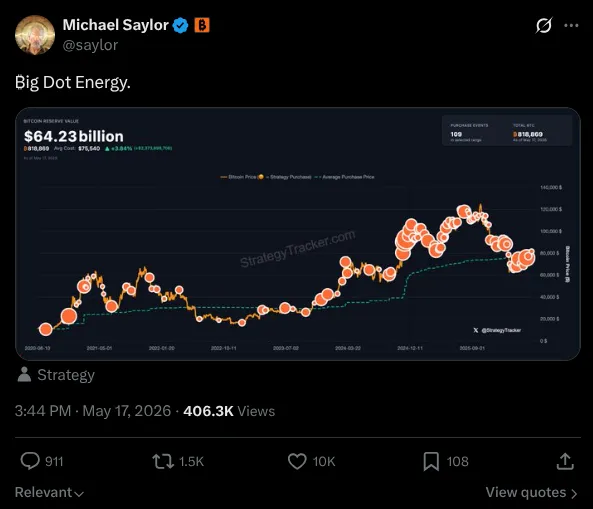
Strategy chairman Michael Saylor signaled another Bitcoin purchase is on the way, posting his familiar "Big Dot Energy" message alongside a tracker of the firm's accumulation history. The image, consistent with past pre-purchase tweets, dropped over the weekend and pointed to a fresh acquisition in the week ahead. Saylor also amplified a proxy push, urging retail holders of Strategy's STRC perpetual preferred stock to support a measure that would enable semi-monthly dividend payouts. Retail investors own roughly 80% of the STRC float, making their participation pivotal to the outcome. The signal landed as Bitcoin slid into the high $76,000s, reinforcing his long-only treasury thesis.
Italy's largest bank more than doubled its cryptocurrency exposure in the first quarter, with Intesa Sanpaolo lifting holdings from roughly $100 million at the end of 2025 to approximately $235 million by March 31. The growth came primarily through expanded Bitcoin exposure via the ARK 21Shares BTC ETF and BlackRock's iShares Bitcoin Trust, alongside a first-ever Ethereum allocation through BlackRock's staked ETH product. The bank also added a roughly $26 million stake in Grayscale's XRP Trust and opened a debut derivatives position through call options on the iShares Bitcoin Trust. The positions are held for proprietary trading, signaling deepening institutional engagement among European banking heavyweights through regulated exchange-traded vehicles.
Analysts remain split on whether Bitcoin faces a repeat of the historical "sell in May" weakness seen in 2018 and 2022. One camp notes that mid-term election years have coincided with sharp drawdowns, projecting a worst-case slide toward $33,000 if key support breaks. Others argue the calendar itself never caused those crashes — the Mt. Gox aftermath, Fed tightening, and Terra-FTX contagion did. Structural shifts since the last bear market cycle, including spot ETF adoption, corporate treasury buyers, and the advancing CLARITY Act, are seen as broadening the buyer base. A move into the mid-$60,000s remains conceivable under a macro shock, though a full 70-80% drawdown is viewed as unlikely.
Bitcoin trades near $77,154 after a 1.27% daily decline, with the candlestick structure settling into a sideways range between immediate support at $76,758 and resistance at $77,974. RSI at 44.95 sits in neutral-but-soft territory, while the bearish MACD signal aligns with current macro headwinds. A clean break above $79,287 would open the path toward $80,594 and shift momentum back to bulls, particularly if ETF flows reverse. Conversely, a daily close below $76,758 risks a deeper test of $74,974 and the major $72,673 demand zone. The constructive thesis invalidates on a sustained break under $72,500 with no on-chain accumulation pickup.
Related Tags

AI-generated, AI-reviewed, under COINOTAG editorial oversight.