

Bitcoin ETFs Bleed $1.3B as Coinbase Premium Hits Monthly Low, Korea Reviews Crypto Tax Repeal
BTC/USDT
$21,365,441,751.92
$59,457.00 / $57,800.19
Change: $1,656.81 (2.87%)
+0.0041%
Longs pay

Crypto News
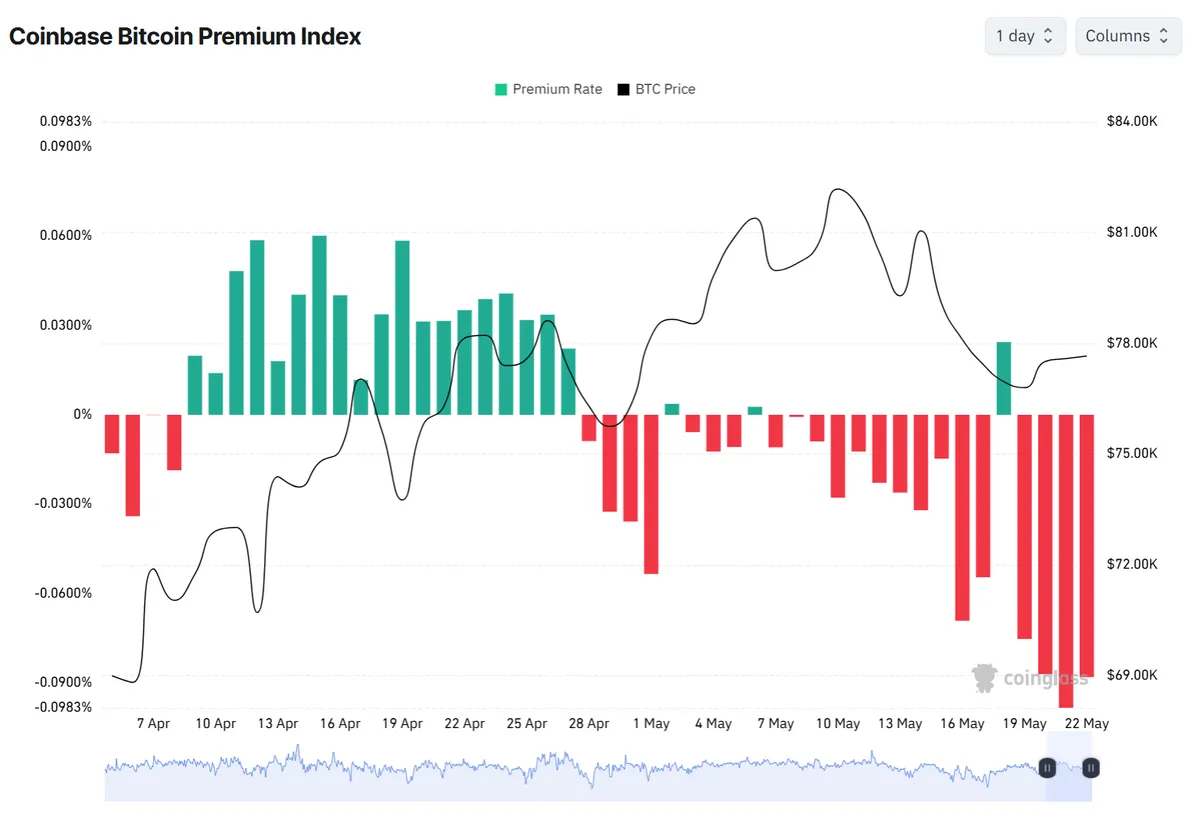
The Coinbase premium has sunk to its lowest level this month, signaling intensifying institutional selling pressure across the US spot market. The indicator, which measures the price gap between Bitcoin on Coinbase and Binance, fell to -0.0983% on May 21 after weeks of negative readings dating back to late April. On-chain analysts note that professional investors trading through Coinbase Advanced are unloading positions far more aggressively than retail counterparts on offshore venues. The deepening discount reflects waning confidence from US institutional desks, with capital rotating into equities like the S&P 500 and Dow Jones rather than alternative store-of-value assets such as Bitcoin or gold.

US spot Bitcoin exchange-traded funds extended their bleeding streak to four consecutive trading sessions, hemorrhaging a combined $1.3 billion since May 14. The persistent outflows mark one of the most aggressive redemption phases of the year, mirroring the institutional caution visible in the Coinbase premium. Market participants describe the move as a coordinated risk-off rotation, with fund managers trimming exposure across the broader altcoin and Bitcoin complex as macroeconomic uncertainty clouds near-term direction. The four-day exodus suggests allocators are repositioning toward hedging strategies rather than accumulating at current levels. With ETFs serving as the dominant institutional access point, the sustained outflows weigh meaningfully on near-term price momentum.
Bitcoin derivatives markets are flashing a parallel cooling signal, with aggregate open interest across futures and perpetual contracts shedding roughly $1.5 billion this week. The deleveraging clears out a significant portion of speculative positioning that had built up during the recent advance. Traders point to the open interest reset as evidence that excessive leverage is being flushed, often a precursor to lower volatility periods and, in some cycles, the onset of a bear market phase. Funding rates have also normalized, with the bullish skew that defined early-month conditions giving way to neutral readings. The combination of falling open interest, ETF redemptions, and a negative Coinbase premium paints a coherent picture of institutional risk reduction.
Polymarket is laying groundwork for a regulated entry into Japan, appointing a country representative as it begins formal engagement with local authorities. The prediction markets platform, which settles outcomes on a public blockchain, has named Mike Eidlin, previously a senior figure at Jupiter, to lead its Japan operations, with the company targeting full regulatory authorization by 2030. Japan currently classifies Polymarket as a restricted jurisdiction due to compliance constraints, and the country's penal code criminalizes most forms of gambling outside narrow public-lottery exceptions. The appointment signals that prediction markets see Asia as a strategic frontier despite steep legal hurdles, with operators willing to commit multi-year timelines to navigate complex regulatory frameworks.
The Japan push arrives as Polymarket faces mounting competitive heat at home, with monthly trading volume slipping for the first time since August. April activity registered $9 billion, down from $10.57 billion in March, even as rival Kalshi surged to $14.81 billion across the same period. Polymarket's reentry into the US market via its acquisition of derivatives exchange QCEX delivered a regulated foothold, though the platform continues operating under limited capacity while negotiating with the Commodity Futures Trading Commission. Several state regulators have moved to classify Polymarket's sports-related contracts as illegal gambling, intensifying legal pressure even as the company aggressively expands its global geographic footprint.
South Korea's National Assembly will formally review proposals to scrap its planned cryptocurrency tax regime after a citizens' petition cleared the 50,000-signature threshold required for legislative consideration. The petition, which reached the threshold just eight days after filing, argues that imposing a 22% levy on crypto gains above 2.5 million won—roughly $1,650—is inconsistent after Seoul abolished similar taxes on stocks and bonds. The motion contends that persistent fraud, weak token listing standards, and extreme price volatility expose Korean investors to risks the current framework fails to address. The crypto tax has already been postponed three times, and the National Tax Service recently confirmed it intends to implement the levy on schedule despite mounting opposition.
The combined picture is one of cautious institutional positioning intersecting with a fragmented regulatory landscape. In the United States, professional desks are reducing exposure through ETF redemptions and derivatives unwinds while waiting for macroeconomic clarity. In Asia, regulatory direction diverges sharply—Korean legislators face pressure to retreat from punitive taxation while Japan remains a closed market that even the most prominent prediction platforms can only target on a five-year horizon. Together these signals suggest the current cycle is being defined less by retail euphoria and more by sophisticated capital carefully weighing macro headwinds against the slow grind of jurisdictional rule-making across major economies.
COINOTAG does not provide financial advisory services. This content is for informational purposes only and should not be considered investment advice. Cryptocurrency investments involve high risk.
Add COINOTAG as a Preferred Source
Add COINOTAG to your preferred sources in Google News and Search to see our coverage first.
Add on GoogleRelated Tags
AI-generated, AI-reviewed, under COINOTAG editorial oversight.