

Circle Launches Agent Stack for AI Payments and Raises $222M for Arc Blockchain at $3B Valuation
Circle unveils Agent Stack for autonomous USDC payments and closes a $222M Arc token presale at a $3B valuation led by a16z, BlackRock and Apollo.

Circle has unveiled Agent Stack, a comprehensive suite of developer tools engineered to let artificial intelligence agents autonomously hold funds, settle transactions and procure services using USDC. The rollout introduces agent-native wallets, a command-line interface, a marketplace for agentic services and a nanopayments protocol capable of executing gas-free USDC transfers as small as $0.000001. Chief executive Jeremy Allaire framed the launch as the first complete product line in which AI agents themselves are the customers, not just human developers. The framework relies on programmable spending limits and policy guardrails, designed to support high-frequency machine-to-machine commerce on supported blockchain networks.
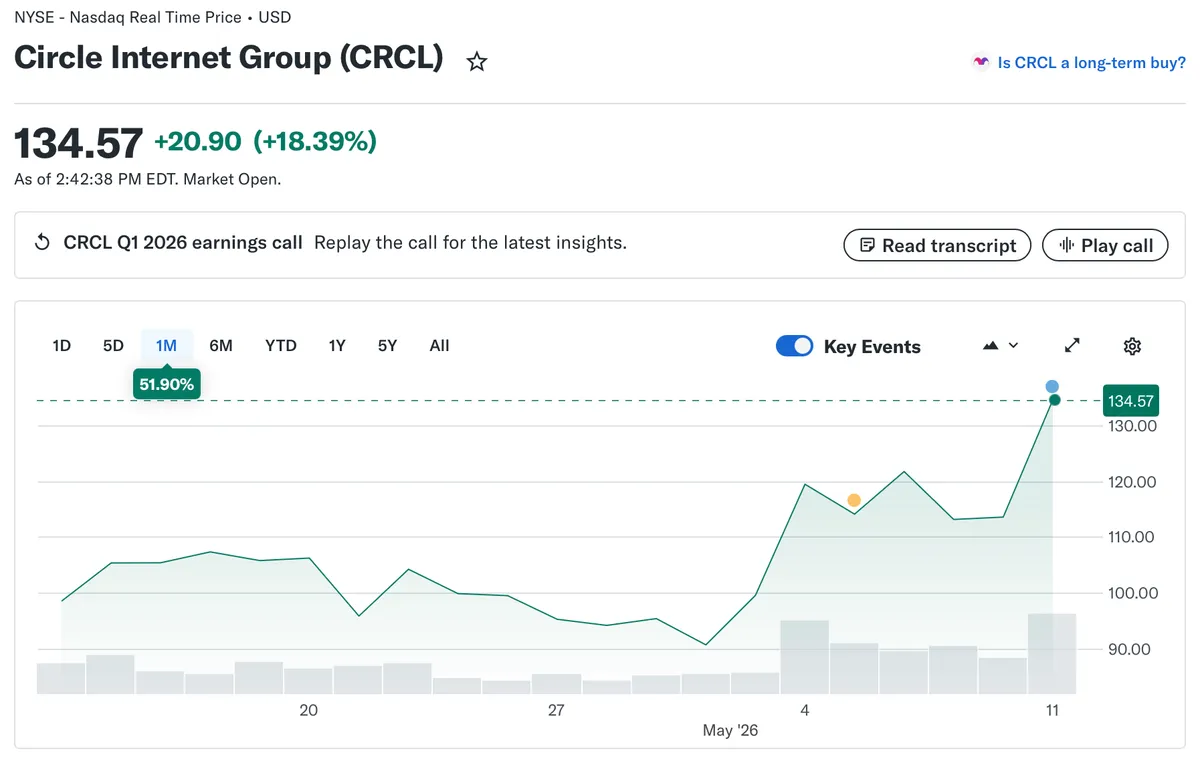
The stablecoin issuer is now actively repositioning itself as a financial infrastructure company rather than a single-product stablecoin firm. Shares of the New York-listed parent surged more than 15% on Monday after executives pitched Arc as a second growth engine targeting Wall Street's compliance demands. Allaire described the network as institutionally ready, built for banks, asset managers and payment firms requiring trust-grade rails for global settlement. The pitch arrives as Congress advances legislation that could allow banks and fintechs to issue their own digital dollars, fueling debate over whether stablecoin issuance itself will be commoditized as competitors enter the regulated market.
Circle disclosed a $222 million presale for the Arc network's native token, anchoring a fully diluted valuation of $3 billion and making the company the first publicly listed firm to conduct a corporate token raise. Andreessen Horowitz led the round with a $75 million commitment, joined by BlackRock, Apollo Funds, Intercontinental Exchange, SBI Group, ARK Invest and Standard Chartered Ventures. The 740 million tokens sold at $0.30 each under a private placement exempt from US securities registration. Of Arc's 10 billion initial supply, 60% is earmarked for ecosystem participants, 25% remains with Circle to operate validator infrastructure, and 15% is held in long-term reserve.
The Agent Stack release reflects a wider industry race to rebuild payment rails for autonomous software. The nanopayments protocol targets transfers too small or too frequent for conventional banking systems, with sub-cent micropayments settling without gas fees. Competing infrastructure pushes from MoonPay, BitGo, Visa and Stripe-backed Tempo are converging on similar territory, while Coinbase's Base layer-2 is preparing dedicated upgrades for agent-driven commerce. Circle's bet is that USDC, with roughly $78 billion in circulation, becomes the default settlement asset for an emerging machine economy where software acts independently within policy-defined permissions and predefined spending controls.
Separately, a whitehat hacker returned roughly $190,000 to Arbitrum-based dark pool protocol Renegade after exploiting a faulty smart contract in its V1 deployment. The breach drained 27 ERC-20 tokens valued at $209,000, including $84,370 worth of USDC, $27,885 in wrapped Bitcoin and $23,950 in wrapped Ether. Following an on-chain message from the protocol requesting 90% returned in exchange for a bounty, the attacker complied within 45 minutes. The exploit traced to deployment code that failed to assign an explicit owner, compounded by a flawed migration introduced in an April 2025 software update, allowing rewriting of the underlying contract logic.
The Arc whitepaper, also published Monday, outlines a hybrid consensus model that begins under proof-of-authority before transitioning toward proof-of-stake validation. The network uses USDC as its native gas token and offers sub-second finality, opt-in privacy through zero-knowledge proofs and trusted execution environments, plus full EVM compatibility for developer migration. Quantum-resistant signature schemes are slated for mainnet launch this summer. Q1 2026 results released alongside the announcement showed USDC circulation rising 28% year over year to $77 billion and on-chain transaction volume jumping 263% to $21.5 trillion, while total revenue and reserve income reached $694 million, up 20% year over year.
USDC's structural role as the second-largest dollar-pegged stablecoin keeps its peg tightly anchored near $1.00, making traditional technical indicators less informative than reserve and circulation flows. With circulation expanding to $77 billion and on-chain settlement volume up 263% year over year, demand metrics signal continued institutional adoption as the core bullish driver. The bearish scenario centers on legislative risk that opens stablecoin issuance to banks, potentially compressing Circle's market share. Traders should monitor weekly USDC mint/burn ratios, Arc testnet throughput milestones and the Coinbase distribution arrangement. The thesis weakens if reserve income declines materially or if a major DeFi protocol shifts default liquidity away from USDC toward a competing altcoin-backed dollar substitute on a rival exchange venue, while a sustained bull market in tokenized assets would reinforce the long-term setup.
Related Tags
AI-generated, AI-reviewed, under COINOTAG editorial oversight.