

Senate Advances CLARITY Act, Poland Adopts MiCA Rules, Strategy Targets $1.5B Note Buyback
Senate Banking advances CLARITY Act as TD Cowen lifts odds to 40%, Poland passes MiCA-aligned crypto law, Strategy files to repurchase $1.5B in 2029 notes.

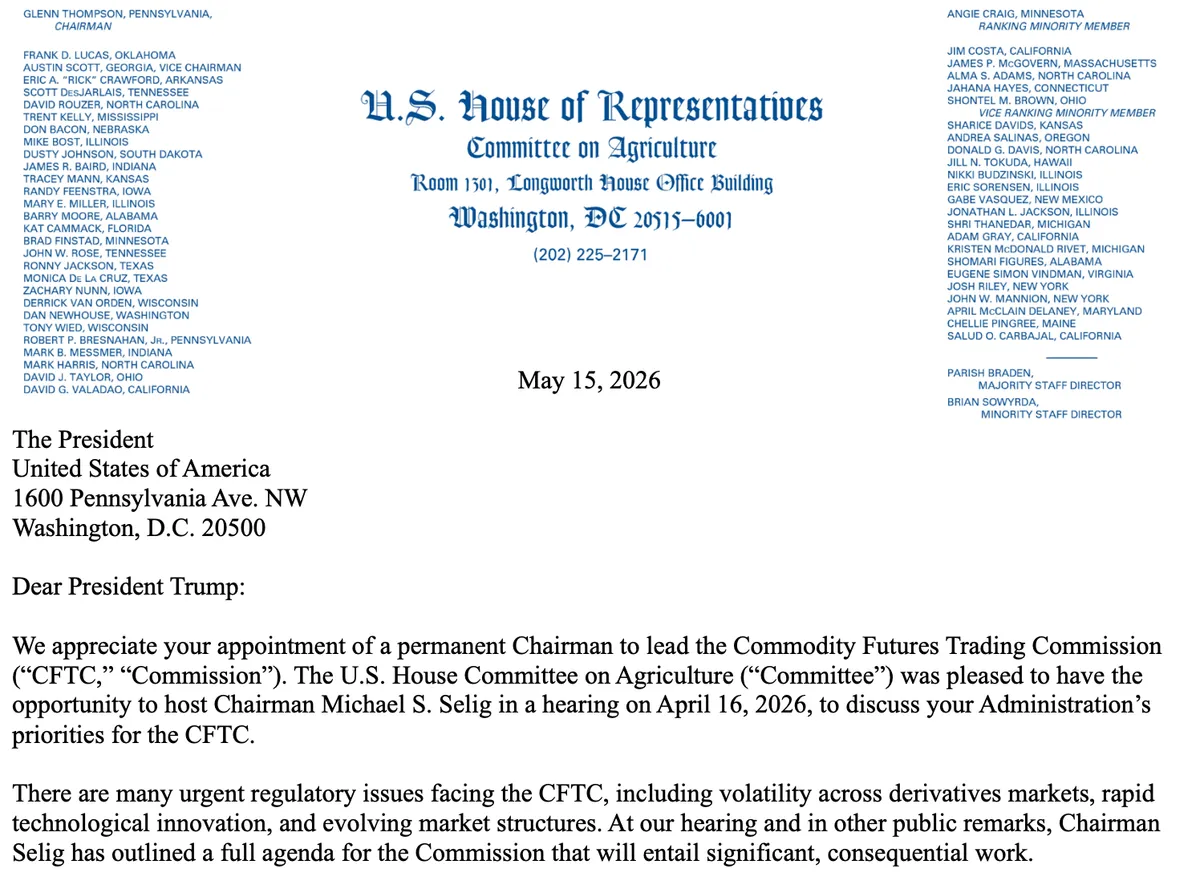
House Agriculture Committee leadership is pressing the White House to fully staff the Commodity Futures Trading Commission, warning that the agency cannot execute the rulemaking demanded by the advancing Digital Asset Market Clarity Act with only one sitting commissioner. Chair Glenn Thompson and ranking member Angie Craig urged President Donald Trump in a Friday letter to nominate a bipartisan slate, citing urgent oversight issues across derivatives and digital assets. Michael Selig has run the regulator alone since Caroline Pham resigned in December 2025, recently asserting exclusive CFTC jurisdiction over prediction markets and signing a coordination memorandum with the SEC covering blockchain markets.
Wall Street research desks are recalibrating odds on the CLARITY Act after the Senate Banking Committee advanced its version of the crypto market structure bill in a 15-9 vote, with Democratic Senators Ruben Gallego and Angela Alsobrooks crossing the aisle. TD Cowen lifted its probability of enactment to 40% from roughly one-in-three, citing renewed Democratic engagement, while Benchmark cautioned that the package must still be merged with the Senate Agriculture Committee text and clear a 60-vote filibuster threshold. Conflict-of-interest amendments targeting the Trump family's crypto ventures remain the most contentious sticking point ahead of any floor consideration before the 2026 midterms.
OpenSea Chief Marketing Officer Adam Hollander argued at Consensus Miami that the next non-fungible token wave will look nothing like the speculative 2021-2022 cycle that pushed the market past $16 billion in annual volume. Hollander pointed to tokenized Pokémon cards, Rolex watches, event tickets, and gaming items as the categories most likely to drive durable adoption, with artificial intelligence tools lowering creation barriers for digital art and animation. The marketplace is rebuilding its product around multi-chain wallet aggregation, fiat onboarding, and dollar-denominated pricing to court mainstream buyers, while the long-delayed SEA token launch remains under the OpenSea Foundation's purview.
Strategy, the corporate Bitcoin treasury vehicle led by Michael Saylor, filed a Form 8-K on Friday outlining plans to repurchase $1.5 billion of its 2029 convertible notes, accelerating a multi-year campaign to swap debt for equity. The announcement followed a record $1.53 billion in daily trading volume on STRC, the firm's variable-rate preferred stock, which now carries an $8.5 billion market capitalization and an 11.5% annualized yield. Saylor framed the demand as institutional validation. The company holds 818,869 BTC acquired at an average cost of $75,537 and could deploy roughly $735 million of fresh issuance toward additional purchases.
Polish lawmakers approved a long-debated digital asset bill on Friday, racing to meet a July deadline under the European Union's Markets in Crypto-Assets framework, even as a fraud investigation tied to collapsed exchange Zondacrypto deepens domestic political fault lines. The new law establishes licensing, supervision, and consumer protection standards across the sector, while prosecutors examine losses estimated at 350 million zlotys, roughly $96 million. Prime Minister Donald Tusk has linked the failed venue to alleged Russian capital, claims Moscow denies, while President Karol Nawrocki and opposition factions have pushed alternative drafts ranging from softer penalties to an outright ban on crypto-related business activity.
Myanmar's ruling military junta tabled an Anti-Online Scam Bill that would impose the death penalty on operators who use violence, torture, or unlawful detention to force victims into running online fraud, with life imprisonment for those managing scam compounds or carrying out crypto-related offenses. The draft also creates a coordinating committee for international cooperation, with parliament set to reconvene in early June. Western enforcement bodies have flagged Myanmar's border regions as hubs for trafficked labor running investment scams, and the FBI's 2025 Internet Crime Report tied $11.4 billion in losses to cryptocurrency-related fraud, with seniors accounting for $4.4 billion of that total.
The thematic arc across this batch is unmistakable: regulators on three continents are racing to install permanent guardrails around digital assets while institutional capital quietly compounds inside compliant vehicles. Washington is wiring statutory authority into the CFTC, Brussels is enforcing MiCA passporting from Warsaw to Luxembourg, and Asian jurisdictions are escalating criminal penalties against fraud rings exploiting the asset class. Underneath the policy churn, treasury operators like Strategy continue refinancing toward equity, marketplaces are repositioning for utility-driven demand, and Korean banks are buying into licensed exchanges. The cycle's defining narrative is no longer speculation but structural absorption of crypto into regulated finance.
Related Tags

AI-generated, AI-reviewed, under COINOTAG editorial oversight.