

Clarity Act Senate Vote Scheduled for Thursday as Stablecoin Yield Fight Reaches Boiling Point
Senate Banking Committee votes Thursday on the Clarity Act as banks battle stablecoin yield, Binance blocks $10.5B fraud, and Morgan Stanley enters crypto.

The Senate Banking Committee is scheduled to hold its long-awaited vote on the Clarity Act this Thursday, a market structure bill that would formally legalize the majority of crypto activity in the United States. After months of negotiation, industry leaders are voicing rare optimism, though unresolved disputes over stablecoin rewards, ethics provisions covering presidential business dealings, and protections for DeFi software developers continue to threaten the package. A compromise from Senators Thom Tillis and Angela Alsobrooks would restrict some stablecoin yield programs while permitting activity-based rewards, but banking groups argue the language still contains exploitable loopholes ahead of Thursday's committee markup.
Binance disclosed that its in-house security stack blocked roughly $10.5 billion in user losses between the start of 2025 and the first quarter of 2026, attributing the result to more than 100 deployed machine-learning models. The exchange said it intercepted 22.9 million phishing and scam attempts in the opening quarter of this year alone, safeguarding an estimated $1.98 billion in customer funds, with the bulk of attempted theft routed through compromised wallets and cross-blockchain bridges. Internal research pegs annual crypto-related fraud at $17 billion in 2025, a 30% year-over-year jump, while recovery operations returned $12.8 million across 48,000 cases.

Morgan Stanley's launch of crypto trading on E*Trade at 50 basis points has reignited a margin compression cycle that exchange operators had been bracing for. The pricing undercuts Coinbase, Robinhood, and Schwab, replicating the fee race that followed the 2024 spot Bitcoin ETF launches. Head of wealth management Jed Finn framed the move as keeping 8.6 million Morgan Stanley clients within the bank's ecosystem rather than allowing them to migrate to standalone platforms. Crypto-native executives pushed back on doom narratives, arguing global exchanges have already evolved beyond fee-only revenue and that the analysis underestimates non-US trading flows and product diversification.
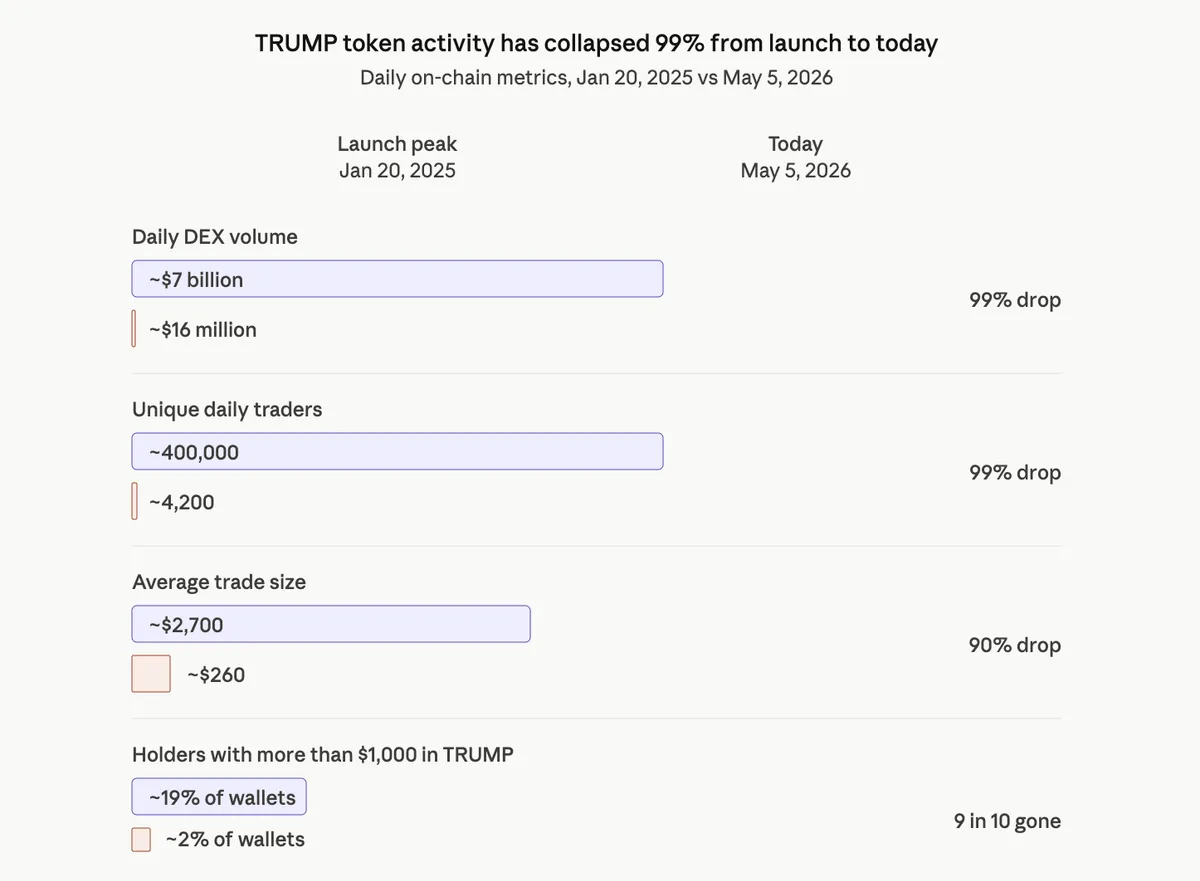
Two Trump-branded ventures targeting retail consumers are in visible difficulty more than a year after launch. Roughly 600,000 buyers paid $100 deposits for the gold-colored T1 Mobile phone — about $60 million collected — yet no confirmed units have shipped, with delivery dates repeatedly pushed back and the binding language quietly stripped from the terms of service in April. The TRUMP memecoin, an altcoin launched in January 2025 at $1.21 and briefly trading at $73, changed hands near $2.45 on Monday, down roughly 97% from peak. On-chain trackers estimate retail buyers have collectively lost close to $2 billion since inception amid persistent unlock-driven supply.
Australia's federal government is reportedly preparing to replace the existing 50% capital gains tax discount on long-held assets with an inflation-indexation regime, a structural change that would meaningfully raise effective tax bills on crypto holdings. The proposal, expected to appear in the FY2027 budget release on Tuesday, would tax full real gains adjusted for inflation rather than offering a flat half-rate cut after 12 months. Industry observers estimate the effective rate on productive investments could approximately double, from around 23.5% to between 46% and 47%, with implementation slated for July 2027 and partial grandfathering for assets acquired before May 10.
Public polling ahead of the November 2026 US midterms suggests crypto and AI industry money may not buy the favorable association their political action committees expect. Recent survey work shows 47% of Americans place greater trust in traditional banks than in crypto platforms, while only 17% rate the two equally. Sentiment toward AI is similarly cautious, with 43% of respondents saying its risks outweigh benefits versus 33% holding the opposite view. Awareness of major industry PACs remains in the single digits, raising questions about whether record war chests built during the current bull market translate into electoral protection for backed candidates.
The thread tying this week's stories together is the collision between regulatory clarity and political risk just as institutional capital arrives at full speed. Washington is racing to enact market structure rules before midterm gridlock sets in, while Wall Street platforms compress retail fees and Asia-Pacific tax regimes rework treatment of long-held positions. Layered over the legislative drama are reminders that retail enthusiasm — for memecoins, branded hardware, or anti-fraud guarantees — still depends on enforcement and infrastructure that lags the marketing. The dominant narrative this cycle is no longer adoption alone but the contest over who writes the rules.
Related Tags

AI-generated, AI-reviewed, under COINOTAG editorial oversight.