

Congress Probes Polymarket and Kalshi as ICE Launches Brent, WTI Perpetuals on OKX
Crypto News
The U.S. House Oversight Committee has opened a sweeping investigation into prediction market platforms Polymarket and Kalshi, with Chairman James Comer demanding internal records from both chief executives. Speaking on CNBC Friday, Comer warned that members of Congress, administration officials, and government employees could be exploiting insider knowledge to generate "huge profits" on policy-driven contracts. He signaled support for legislation barring federal officials from participating in such markets. The probe represents the most aggressive congressional move yet against a sector whose contracts increasingly track geopolitical and military outcomes, raising national security questions tied to classified information leakage and the broader integrity of blockchain-settled wagering venues.
In letters dispatched Friday to Polymarket's Shayne Coplan and Kalshi's Tarek Mansour, Comer pressed both firms on how they verify trader identities, enforce geographic access restrictions, and flag anomalous betting activity. The inquiry zeroes in on whether platform safeguards are adequate to deter abuse by users holding security clearances or non-public government information. Both companies have grown rapidly through cycles of regulatory ambiguity, and the records request signals a tougher compliance environment ahead. Comer indicated the goal extends beyond fact-finding to building a legislative case for restricting government-affiliated traders from participating in event-based contract markets that increasingly intersect with sensitive policy outcomes.
The House action follows a contentious Senate Commerce Committee hearing earlier in the week, where Chairman Ted Cruz openly criticized prediction venues including Kalshi and Crypto.com for hosting contracts tied to sporting outcomes amid widespread cheating allegations. Industry forecasts paint a striking growth picture: prediction market volumes hit $51 billion in 2025, and one Wall Street research note projects the segment could swell to roughly $240 billion in 2026 and approach $1 trillion by 2030. That trajectory positions the platforms as broad-based information markets rather than niche wagering venues, with parallels to the DeFi derivatives boom that preceded today's regulatory scrutiny.
Intercontinental Exchange, the parent of the New York Stock Exchange, and OKX confirmed plans to launch perpetual oil futures referencing ICE's Brent and West Texas Intermediate benchmarks. The contracts carry no expiry, will roll out across jurisdictions where OKX holds perpetual licensing, and represent the first product-level collaboration since ICE took a strategic stake in the exchange. With more than 120 million users worldwide, OKX provides ICE with retail-scale distribution into crypto-native order books, while the partnership extends regulated energy benchmarks to a clientele that traditional commodity venues and any DEX structure have historically struggled to reach directly.
The perpetuals rollout operationalizes the March agreement that valued OKX at $25 billion and granted ICE a board seat. That transaction also committed both parties to a broader roadmap covering licensing of OKX spot crypto reference prices to ICE and the routing of tokenized NYSE-listed equities through the exchange. ICE Chair Jeffrey Sprecher framed the deal as a vehicle for moving on-chain infrastructure into capital formation, trading, and settlement workflows. Friday's launch marks the first concrete deliverable from that roadmap, suggesting the integration between Wall Street rails and crypto venues is moving from announcement to execution as the bull market matures.

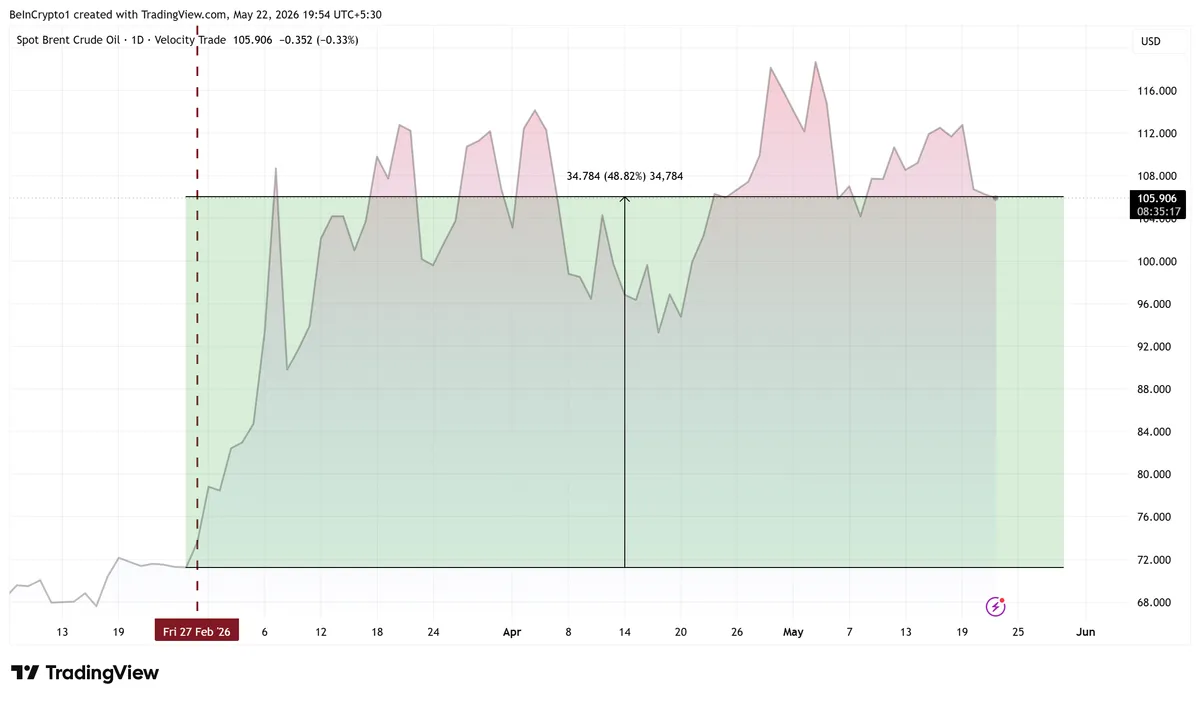
Brent and WTI prices have remained elevated as the Iran war continues to stress global crude logistics, sharpening demand for round-the-clock hedging tools that traditional futures sessions cannot fully accommodate. ICE Senior Vice President Trabue Bland highlighted that the OKX contracts open the company's deep, liquid energy markets to a 120-million-strong retail base. The perpetual structure, which avoids the rolling-contract complexity of dated futures, mirrors the crypto-native instruments traders already favor across Bitcoin and major altcoin derivatives, effectively porting one of Wall Street's most established commodity franchises into a 24/7 venue with crypto-style settlement conventions.
A clear theme is emerging across this week's flow: regulators are tightening oversight of information-driven venues just as legacy financial infrastructure accelerates its push into crypto-native markets. Congress is moving to police prediction platforms where classified information could distort pricing, while Wall Street's largest exchange operator is wiring energy benchmarks and tokenized equities directly into a crypto exchange's order book. Together these threads underscore a maturing convergence, one where traditional rails seek crypto's speed and reach while lawmakers respond by extending familiar disclosure and insider-trading frameworks into newly digital arenas. The line between regulated and unregulated venues keeps narrowing.
COINOTAG does not provide financial advisory services. This content is for informational purposes only and should not be considered investment advice. Cryptocurrency investments involve high risk.
Add COINOTAG as a Preferred Source
Add COINOTAG to your preferred sources in Google News and Search to see our coverage first.
Add on GoogleAI-generated, AI-reviewed, under COINOTAG editorial oversight.