

ECB Blocks Euro Stablecoin Push, China Stocks Stagnant as Retail Rotates to Bitcoin
ECB rejects euro stablecoin expansion citing bank risks. China's Shanghai Composite remains 33% below 2007 peak as retail flows rotate toward Bitcoin.


The European Central Bank pushed back against a proposal at an informal EU finance ministers meeting in Nicosia, Cyprus, urging restraint on plans to widen euro-denominated stablecoin issuance. Policymakers warned that extending central bank-style support to private token issuers could weaken bank deposit stability and complicate monetary policy transmission. ECB President Christine Lagarde led the resistance, arguing that scaled stablecoin adoption would accelerate disintermediation, increase bank funding costs and erode the institution's ability to steer interest rates. The intervention follows a Brussels policy paper that called for easier liquidity rules and possible ECB funding access for euro stablecoin issuers competing with dollar-backed rivals.
Central bankers attending the two-day Economic and Financial Affairs Council session openly questioned the idea of positioning the ECB as a lender of last resort for stablecoin firms, an arrangement currently reserved for regulated banks. Officials argued that conferring such support without comparable supervision would create asymmetric risk-taking across the financial system. Lagarde, speaking earlier this month at a separate forum, conceded that euro-denominated tokens could generate additional demand for euro-area safe assets, but maintained that the trade-offs — redemption pressure during stress, weaker policy transmission and broader stability concerns — outweigh any growth benefits the issuance regime might deliver.
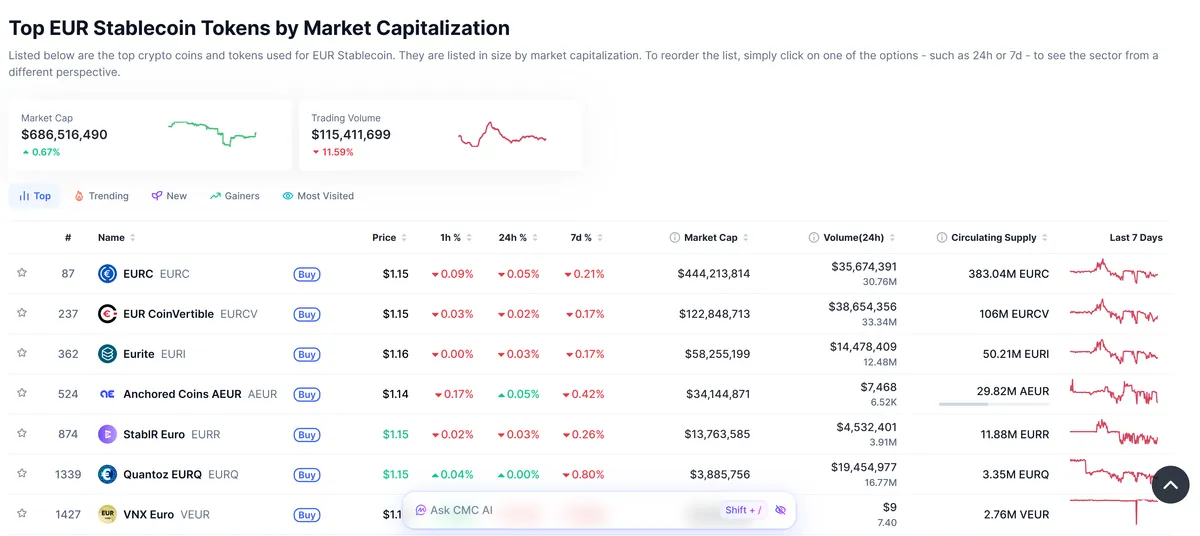
Despite Europe accounting for roughly 38% of global stablecoin transactions, euro-denominated tokens command only about 0.3% of total supply, exposing a structural gap that policymakers have so far declined to close through direct intervention. Circle's EURC sits in twelfth place among stablecoins by capitalization, a position the underlying think-tank paper argued is unsustainable if Europe wants payments sovereignty in tokenized markets. Lagarde steered the discussion toward tokenized deposits and a wholesale digital euro instead, signaling that the institution prefers central bank-issued digital money over reliance on privately issued instruments to anchor the eurozone's on-chain payments stack.
Across the Eurasian landmass, China presents a different structural puzzle. The Shanghai Composite closed Friday near 4,113 points, still roughly 33% below its 2007 peak, even as the country's nominal output has expanded around sevenfold over the same period. Beijing posted a record $1.19 trillion trade surplus in 2025 and grew GDP by 5% in the first quarter of 2026, while overtaking Japan as the world's largest auto exporter. By contrast, the US benchmark has delivered more than 600% in total returns over the same window, leaving mainland equities trapped in what resembles an extended bear market for shareholders.
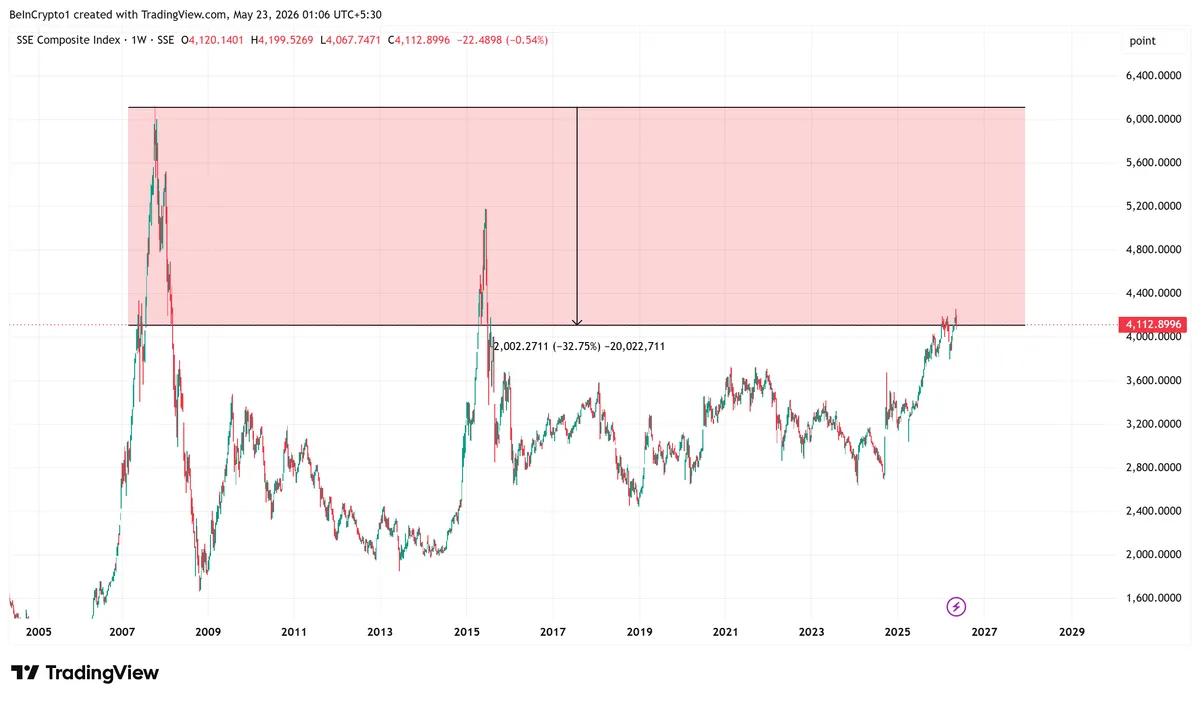
Retail traders account for close to 90% of daily turnover on mainland exchanges, against roughly 20% in the United States. That thin institutional base produces sharp directional moves around policy signals rather than sustained capital formation, and a growing share of speculative Chinese flows has rotated toward Bitcoin (BTC) and select altcoin baskets during prolonged equity drawdowns. Final household consumption sits at just 53% of GDP, compared with about 68% in the US, capping corporate earnings and starving listed firms of the demand growth needed to compound shareholder value. The mismatch has become a defining feature of post-pandemic Chinese capital allocation.
Property compounds the equity drag. Beijing's 2020 Three Red Lines policy triggered a multi-year deleveraging cycle that erased household wealth and froze a primary savings vehicle for mainland investors. Capital controls further restrict outbound diversification, leaving domestic equities and a small handful of state-favored sectors as the only accessible vehicles for many savers, with a growing minority opting for cold-wallet custody of digital assets as an offshore alternative. The result is a market where directional retail momentum overwhelms valuation signals, and where each policy adjustment triggers oversized rotations rather than orderly repricing across mainland venues.
The dominant narrative this cycle is one of regulatory tightening at the institutional layer colliding with savings-seeking capital hunting for yield outside traditional rails. Whether the ECB fences off privately issued euro stablecoins to protect bank lending, or Beijing's policy mix suppresses equity allocations and pushes retail flows toward digital assets, the outcome is similar — incumbent institutions are reinforcing their gatekeeping role while end-user demand for alternatives quietly compounds. The interplay between sovereign monetary policy and privately issued tokens built on blockchain rails is increasingly framing how each region answers the same underlying question: who carries the credit risk of next-generation payments?
AI-generated, AI-reviewed, under COINOTAG editorial oversight.