

Ethereum Foundation Hit by More Exits as ETPs Bleed $249M, Verus Bridge Loses $11M
Ethereum faces fresh Foundation departures, $249M in ETP outflows, an $11M Verus bridge exploit, and Aave's WETH borrowing restart as ETH slides to $2,105.

Ethereum co-founder Vitalik Buterin argued this week that AI-assisted formal verification is becoming essential to protect the network and the broader crypto industry from software flaws and AI-driven cyberattacks. In a blog post published Monday, Buterin said mathematically verified code could harden blockchain networks, smart contracts and cryptographic systems against vulnerabilities that have repeatedly cost users irreversible funds. He framed the technique, rooted in decades of academic research, as the logical endpoint of secure software engineering, noting that recent AI advances are finally making end-to-end verification practical. Buterin warned that frontier models are also accelerating offensive capabilities, citing recent disclosures of AI systems autonomously identifying and exploiting flaws in production software.

The Ethereum Foundation is facing a deepening leadership vacuum as Carl Beek and Julian Ma announced their departures on Monday, extending a months-long wave of senior exits. Their resignations follow the recent step-backs of Barnabé Monnot and Tim Beiko from protocol coordination, Trent Van Epps from Protocol Guild organizing, and Alex Stokes, who began a sabbatical earlier this month. The turnover comes as the foundation reshapes itself around a new mandate redefining its role as a steward, not an owner, of the network. Community commentators are openly questioning the pace of attrition among the researchers historically responsible for Ethereum's roadmap.
Beek's exit is particularly symbolic. He spent seven years inside the foundation and was a central contributor to the Beacon Chain that anchored Ethereum's 2020 transition to a proof-of-stake consensus mechanism. Ma, who departs after roughly four years, focused on mechanism design and cryptoeconomics, co-authoring EIP-7805 to strengthen censorship resistance and leading the Fast Confirmation Rule that compressed Layer 2-to-mainnet bridging time to thirteen seconds. Their exits stack on top of the earlier departures of former co-executive director Tomasz Stańczak in February and longtime contributor Josh Stark in March, intensifying scrutiny over whether the 2025 internal reshuffling has solved or accelerated the organization's talent drain.
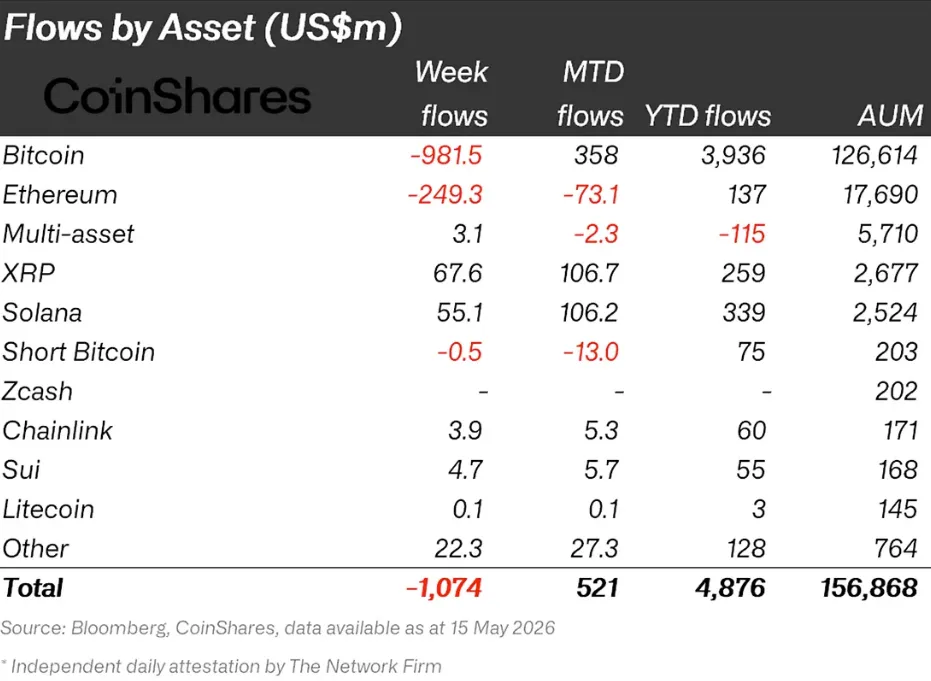
Crypto investment products posted $1.07 billion in net outflows last week, ending a six-week run of inflows and marking the third-largest weekly withdrawal of the year. Ethereum products absorbed $249 million in redemptions, their heaviest outflow since late January, while Bitcoin funds accounted for the bulk of the move at $982 million. Altcoin vehicles bucked the trend, with XRP funds attracting $67.5 million and Solana products adding $55.1 million. Most withdrawals originated in the United States, where investors pulled $1.14 billion as risk-off positioning intensified around Strait of Hormuz tensions, climbing energy prices and renewed US inflation pressure.
Aave restored full borrowing against wrapped Ether across all affected networks on Sunday, completing Phase II of its rsETH recovery plan after April's Kelp DAO exploit. Loan-to-value ratios for WETH on Aave V3 Ethereum Core, Ethereum Prime, Arbitrum, Base, Mantle and Linea returned to pre-incident levels, founder Stani Kulechov confirmed. The freeze had been a precautionary measure after attackers, believed to be linked to North Korean state actors, stole 116,500 rsETH tokens and used them as collateral to extract roughly $195 million in bad debt. Aave's total value locked sits near $14.8 billion, down from $23.5 billion in March, though falling borrow rates near 1.9% may pull leveraged Ether yield strategies back into the protocol.
Cross-chain infrastructure took another hit as the Verus-Ethereum bridge was drained for roughly $11.6 million on Monday. The attacker extracted 103.6 tBTC, 1,625 ETH and 147,000 USDC before swapping the loot into 5,402 ETH, with the funds tracked to a single wallet that had been seeded with 1 ETH through Tornado Cash hours earlier. Security analysts pointed to likely cross-chain message validation, signature forgery, or withdrawal logic flaws as the root cause. The incident extends a brutal year for bridge security, following the $293 million Kelp DAO breach in April, and underlines how attackers continue to favor messaging layers over smart contracts when targeting DeFi.
ETH trades near $2,105 after a 3.3% daily decline, with momentum aligned to the downside as the RSI prints 33.54 and the MACD holds a bearish cross. Immediate support sits at $2,092, with deeper bids stacked at $2,012 and $1,942, while reclaiming $2,131 is the first hurdle for any relief bounce; clearing $2,211 and $2,322 would be required to reverse the structure. The 33-handle RSI signals stretched but not yet capitulated conditions, leaving room for an oversold rebound if buyers defend $2,092. A clean daily close below $2,012 would invalidate the near-term bullish case and open the path toward retesting $1,942.
Related Tags

AI-generated, AI-reviewed, under COINOTAG editorial oversight.