

Ethereum Slides to $2,100 as ETFs Bleed $249M, BitMine Adds $151M ETH
Ether slides to $2,100 amid $249M ETF outflows and aggressive Binance sell pressure, while BitMine adds $151M ETH and Buterin pitches AI-verified security.

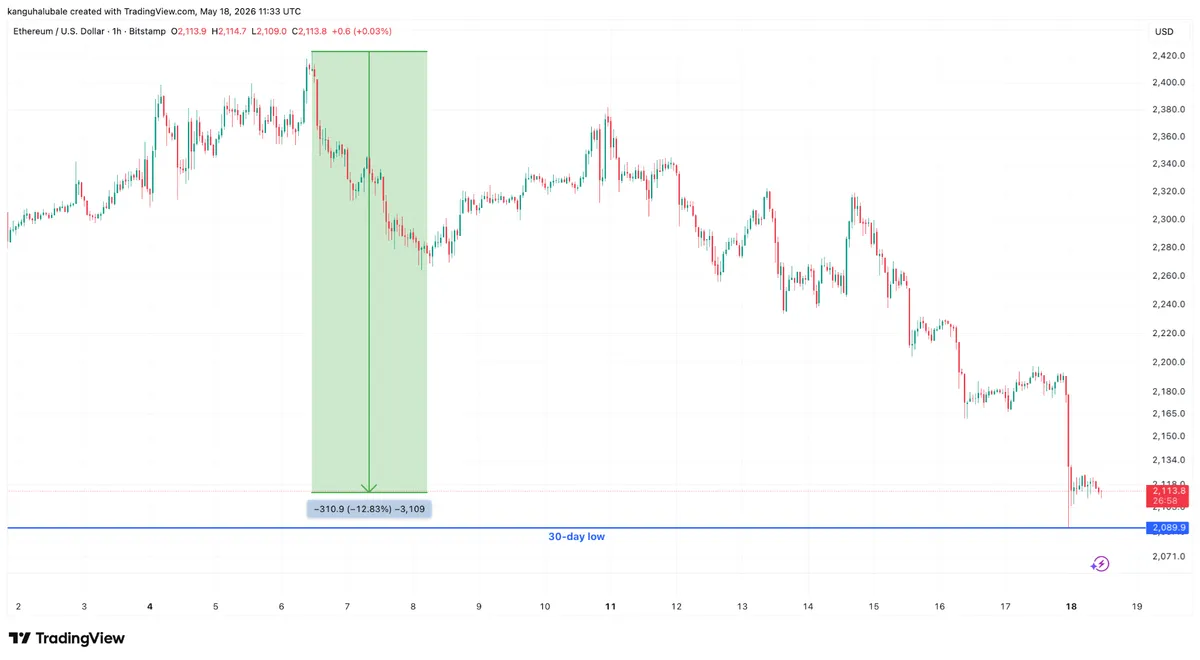
Ether tumbled to roughly $2,100 on Monday, extending a 12% retreat from its early-May local high near $2,420 and marking its lowest print since mid-April. The rejection at the $2,400 zone has handed control back to sellers, with aggressive sell-side flow on Binance futures pushing taker volume above $1.1 billion within a single hour as the price probed sub-$2,100 territory. On-chain trackers describe the move as a clear bout of forced de-risking rather than a confirmed structural breakdown, though analysts warn that a decisive loss of the $2,000 shelf could open the door toward $1,700, a level last visited during the spring liquidity squeeze.
Capital rotation out of regulated ETF wrappers has amplified the spot weakness. US-listed spot Ethereum products posted five straight sessions of net redemptions, draining roughly $255 million from the complex and signaling that the institutional bid which carried ETH through the first quarter has stalled. The pullback coincides with broader risk-off positioning tied to renewed Middle East tensions, and traders point to weakening creation flows as a leading indicator: every fresh redemption forces authorized participants to source ETH from secondary venues, deepening the order-book imbalance that has dominated weekend price action.
BitMine Immersion Technologies leaned aggressively into the drawdown, scooping up 71,672 ETH worth approximately $151 million over the past week and lifting its corporate treasury to 5.28 million tokens. Chairman Tom Lee framed the sub-$2,200 zone as an "attractive opportunity," reversing recent guidance that the firm would moderate purchases. The accumulation cements BitMine as the largest corporate ETH holder globally, controlling 4.37% of circulating supply, with management targeting roughly 6.03 million tokens — about 5% of the float — by year-end. Shares of BMNR slipped over 5% intraday despite the disclosure.
Vitalik Buterin used the volatile backdrop to publish a wide-ranging essay arguing that artificial intelligence could ultimately harden, rather than weaken, crypto security. The Ethereum co-founder championed AI-assisted formal verification — machine-checkable mathematical proofs that software behaves as specified — as a counterweight to AI-accelerated exploit discovery. Buterin singled out blockchain consensus layers, zero-knowledge proof systems and post-quantum cryptography as the highest-leverage targets. He cautioned the approach is no silver bullet, since flawed assumptions or unverified hardware can still break otherwise proven systems, but called the combination of generative coding and rigorous proofs the most promising defensive posture available today.
BitMine's broader balance sheet underscores the scale of the bet: total crypto and cash holdings now sit at $12.6 billion, including 4.71 million staked ETH generating roughly $289 million in annualized revenue at a 2.80% seven-day yield. Management projects staking income could climb to $324 million annually once the entire position is routed through its in-house MAVAN validator network. The treasury also includes 202 BTC, $685 million in cash and equity stakes in Beast Industries and Eightco Holdings. Lee separately attributed ETH's weakness to a record inverse correlation with crude oil, which spiked above $108 per barrel on fresh Iran-related tensions.
Digital-asset investment products as a category shed $1.07 billion last week, snapping a six-week inflow streak and registering the third-largest weekly redemption of 2026. Bitcoin funds absorbed the brunt at $982 million, while Ether vehicles surrendered $249 million — the worst weekly print since January. The damage was overwhelmingly American: US-listed products accounted for $1.14 billion of the outflows, while Switzerland, Germany and Canada all logged modest net inflows. Altcoin wrappers diverged sharply, with XRP and Solana attracting $67.6 million and $55.1 million respectively, suggesting allocators are rotating selectively rather than de-risking wholesale.
Quantum computing also re-entered the institutional risk conversation, with Wall Street research flagging Bitcoin as more exposed than Ethereum to long-horizon cryptographic threats. The argument rests on Bitcoin's slower governance cadence and the estimated 6.5 to 6.9 million BTC sitting in addresses with already-exposed public keys, including dormant Satoshi-era wallets — roughly a third of supply, or about $450 billion at current prices. Proof-of-stake networks like Ethereum are seen as better positioned to migrate to post-quantum cryptography given a more upgrade-friendly consensus mechanism, though validator keys would still require rotation under any realistic migration roadmap.
Spot ETH trades near $2,100 with a 24-hour drop of 3.85% and the RSI compressed to 33, hovering just above oversold and offering tactical bounce conditions even as the MACD remains firmly bearish. Immediate support sits at $2,051, with deeper bids stacked at $1,942 and $1,876 — the last of which aligns with the macro pivot bears are targeting. To neutralize the downtrend, bulls need a daily close back above $2,131, with $2,209 and $2,322 marking the resistance ladder that would confirm trend reversal. A breakdown through $2,051 on rising volume invalidates any recovery thesis and likely triggers liquidation cascades toward $1,700.
Related Tags

AI-generated, AI-reviewed, under COINOTAG editorial oversight.