

Ethereum Staking Climbs to 39M ETH, Accumulation Spikes, Verus Hacker Returns $8.5M
Ethereum staking reaches 39.1M ETH (32% of supply), accumulation addresses absorb 248K ETH in a day, and the Verus bridge hacker returns $8.5M.

Ethereum's long-term investment case is gaining renewed attention even as the second-largest altcoin has shed roughly 28% of its value year-to-date. The network still anchors approximately $43 billion in DeFi total value locked, hosts more than $165 billion in stablecoin supply, and accounts for about 55% of tokenized real-world assets tracked across public chains. Onchain dashboards show tokenized exchange-traded products now exceed $400 million in market capitalization, with Ethereum capturing 76.9% of that footprint. Analysts argue these metrics position ETH as the dominant settlement layer for the narratives driving the next cycle, even while spot trades well below prior peaks.
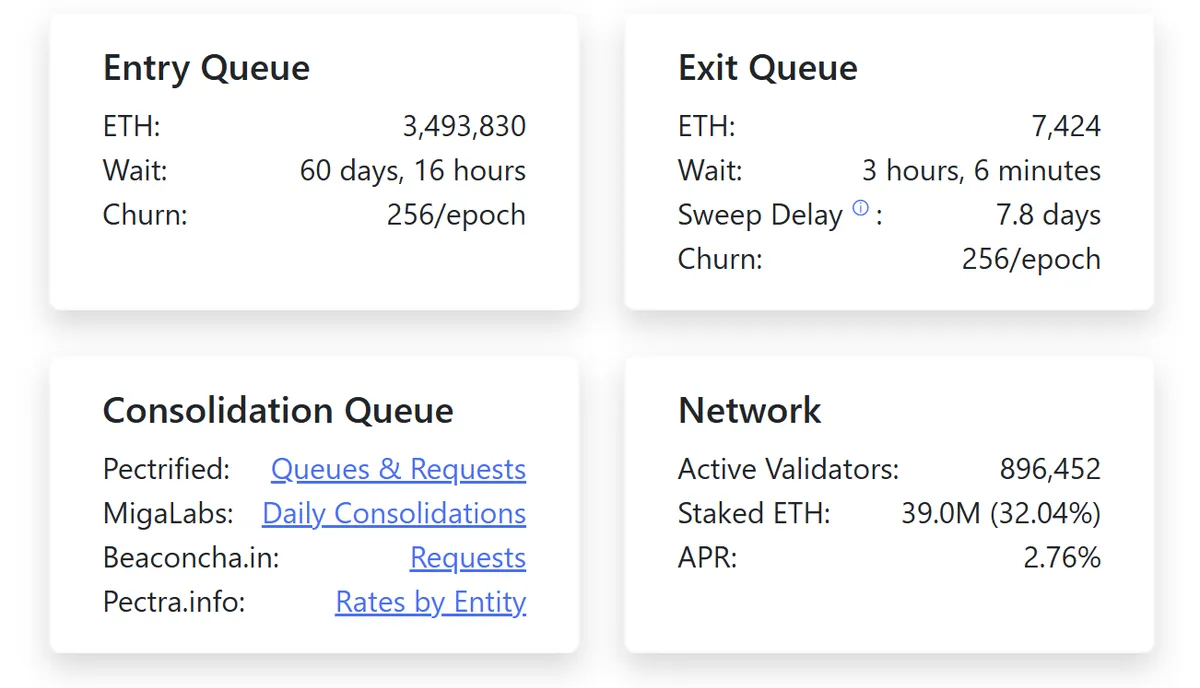
Validator activity continues to climb despite price weakness. Staked ETH has reached approximately 39.1 million coins, equal to about 32% of total circulating supply, distributed across more than 896,000 active validators. The entry queue currently holds more than 3.49 million ETH waiting to be activated, translating to a wait time exceeding 60 days, while the exit queue sits at a minimal 7,424 ETH. The sharp asymmetry between entry and exit demand suggests large holders are leaning into yield rather than rotating out. Persistent inflows into the staking layer typically reduce circulating float available on each exchange, a structural dynamic that historically aligns with constructive long-term setups.
Accumulation wallets are absorbing supply at a pace not seen in months. On-chain data shows ETH inflows into accumulation addresses reached 248,400 ETH on May 20, the strongest single-day intake since early January. These wallets are typically associated with long-term holders, defined by limited or no outbound activity, and their behavior is closely watched as a leading indicator of conviction at the lower end of pricing ranges. The cluster of fresh accumulation arriving while the spot market remains under pressure mirrors prior cycle troughs when patient capital began rotating in. Cohort analysis suggests this wave skews toward wallets that previously loaded up during the 2022 drawdown.
In a separate development, the attacker behind the Verus bridge exploit has returned 4,052 ETH worth approximately $8.5 million to the project's team wallet, recovering roughly 75% of the stolen funds. The exploiter retained 1,350 ETH valued near $2.8 million as a self-claimed bounty after the Verus team formally offered the arrangement and gave a 24-hour window for repayment. Independent blockchain security trackers confirmed the on-chain transfer. The episode illustrates how some teams now negotiate directly with attackers to retrieve a majority of lost capital, although such settlements do not preclude law enforcement involvement or third-party legal action once funds have been returned.

The Verus recovery lands against a backdrop of elevated DeFi exploit volumes. Cumulative losses across decentralized protocols reached $634 million in April, headlined by a $280 million incident at Drift Protocol and a $293 million breach at Kelp. May has so far shown a sharp pullback, with roughly $38 million stolen month-to-date. Over the past decade, crypto attackers have collectively drained more than $17 billion across 518 recorded incidents, with compromised private keys, phishing, and credential-based intrusions accounting for the majority of losses. The pattern continues to draw scrutiny from regulators and remains one of the more persistent friction points slowing institutional adoption.
Tokenized real-world asset issuance further underscores Ethereum's structural position in the institutional pipeline. Recent aggregated data places the market capitalization of tokenized ETF products above $400 million, with Ethereum-based vehicles accounting for nearly 77% of that total. The dominance reflects deep liquidity, mature smart-contract tooling, and broad custodial support that newer execution environments still lack. Major asset managers experimenting with on-chain fund shares have routed pilots primarily through Ethereum or its rollups. Combined with the network's stablecoin and DeFi footprint, the tokenization data reinforces the thesis that Ethereum's revenue and settlement role expands even when the native token endures double-digit drawdowns.
From a technical perspective, ETH is trading near $2,064 after a 3.2% session decline, with the daily structure firmly in a downtrend. Immediate support sits at $2,054, followed by deeper buyers' zones at $1,997 and $1,942. Resistance is layered at $2,075, $2,132, and $2,176. RSI at 32 places price on the doorstep of oversold territory, suggesting selling pressure may be approaching exhaustion, while the MACD signal remains bearish and confirms momentum has not yet flipped. A reclaim of $2,132 would invalidate the near-term bearish setup; a decisive loss of $1,997 likely opens a path toward the $1,942 demand shelf.
Related Tags

AI-generated, AI-reviewed, under COINOTAG editorial oversight.