

Fed Proposes Skinny Crypto Accounts as Spotify Launches Licensed AI Remix Tool
Fed proposes skinny crypto payment accounts, Spotify licenses AI remixes with Universal, Silvergate's Fraher breaks silence, and MoneyGram expands blockchain.

Spotify and Universal Music Group unveiled landmark licensing agreements on Thursday that will let Premium subscribers generate AI-powered covers and remixes from a catalog spanning Taylor Swift, Billie Eilish, Sabrina Carpenter, and The Weeknd. The paid add-on shares revenue with participating artists and songwriters, marking the first major attempt to monetize fan-generated AI music under a consent-based framework. Universal Chairman Lucian Grainge framed the initiative as deepening artist-fan relationships, while Spotify Co-CEO Alex Norström emphasized credit and compensation as core principles. The deal arrives two years after AI-cloned Drake and Weeknd vocals forced platform takedowns and reignited debate over generative audio rights.
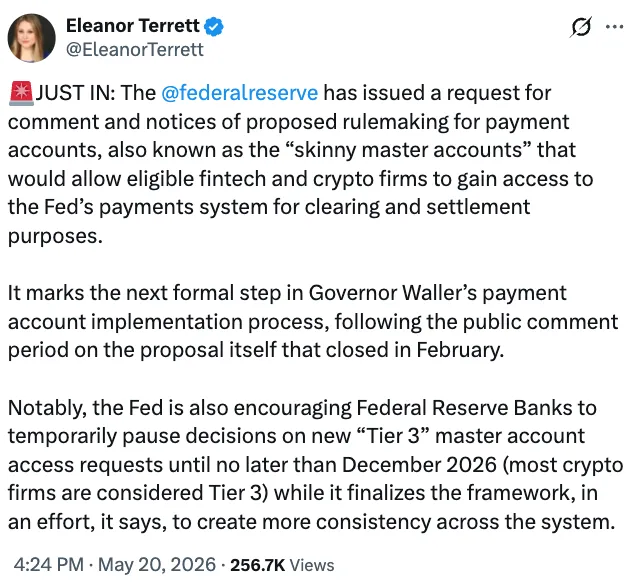
The US Federal Reserve opened a public comment window on a proposed framework for limited "skinny master accounts" that would extend narrower payment-rail access to fintech and blockchain-linked banks. The Board's notice of proposed rulemaking, released Wednesday, asks regional Reserve Banks to pause Tier 3 access decisions while staff finalize the design, a process expected to conclude by December 31, 2026. The cautious posture contrasts with President Donald Trump's executive order pushing broader digital asset integration into the US financial system, underscoring lingering institutional reluctance to grant crypto firms full access to central banking infrastructure.
Former Silvergate chief risk officer Kate Fraher broke her silence on her 2024 settlement with the Securities and Exchange Commission, arguing no agency ever proved the failed crypto-friendly bank's anti-money laundering controls had broken down. Speaking publicly for the first time since the case closed, Fraher said she opted to resolve it to avoid a "multi-year battle" and described being personally de-banked and having credit lines summarily closed. Her comments reopen scrutiny of enforcement tactics deployed during former SEC Chair Gary Gensler's tenure, and follow the rescinding of long-standing rules that previously restricted her ability to comment publicly.
MoneyGram is deepening its push into on-chain settlement through a new partnership with Tempo, expanding the cross-border transfer giant's footprint beyond its earlier USDC and Stellar integrations. The arrangement signals continued institutional appetite for stablecoin-rail remittance corridors despite ongoing regulatory friction. Cross-border payments have emerged as one of the most commercially viable use cases for DeFi-adjacent infrastructure, with transaction-cost savings and settlement-speed advantages drawing legacy payment networks into closer alignment with digital asset systems. The MoneyGram-Tempo tie-up positions the remittance company to compete more directly with stablecoin-native fintechs serving emerging market corridors.
The Spotify announcement landed days after YouTube unveiled a Shorts Remix feature powered by Gemini Omni at Google I/O, allowing creators to reimagine other users' videos as anime sequences, pixel-art renderings, or scenes augmented with new characters and effects. The parallel rollouts highlight an industry-wide pivot toward licensed, generative-AI creative tools that compensate rights-holders rather than relying on unlicensed training data. The shift carries downstream implications for crypto-native music platforms experimenting with on-chain royalty splits, as established Web2 incumbents move to capture the same monetization layer through traditional licensing structures rather than tokenized alternatives.

The Fed's proposal arrives against the backdrop of President Trump's January executive order directing federal agencies to integrate fintech and digital assets more deeply into the US financial system. The order has accelerated regulatory rewrites across the SEC, CFTC, and OCC, but the Fed's measured rulemaking timeline illustrates the central bank's preference for procedural deliberation over executive-branch momentum. Industry observers note that the skinny-accounts framework could either modernize Bitcoin and digital-asset firms' access to payment rails or codify a permanent second-tier status, shaping the next phase of US crypto banking infrastructure.
The convergence of licensed AI media deals, central bank rulemaking, post-collapse regulatory reckonings, and stablecoin remittance expansion sketches a sector maturing along multiple axes simultaneously. The dominant narrative this cycle is institutional reintegration: traditional finance, major media, and federal regulators are no longer treating crypto and adjacent AI infrastructure as fringe phenomena but as systems requiring permanent frameworks. The friction visible across these stories — between executive directives and regulatory caution, between enforcement and rehabilitation, between Web2 monetization and altcoin-native alternatives — reflects an industry settling into the slower workflows of mainstream financial and cultural infrastructure.

AI-generated, AI-reviewed, under COINOTAG editorial oversight.