

India Blocks Polymarket, Kalshi Order Looms as Sandbox Co-Founder's Wife Targeted
Crypto News
Polymarket has gone dark for users in India after the Ministry of Electronics and Information Technology issued a blocking order targeting the world's largest decentralized prediction venue. Visitors to the platform now receive an unreachable-site error, and refresh attempts fail to restore connectivity. The action follows an April 25 advisory directing VPN service providers to terminate access to what regulators classified as illegal prediction-market and online-betting platforms operating despite domestic prohibitions. The directive demanded that internet service providers cut routing to such venues, with Polymarket named as a primary target. The shutdown signals an aggressive enforcement turn against a category that surged globally during the 2024 U.S. election cycle.
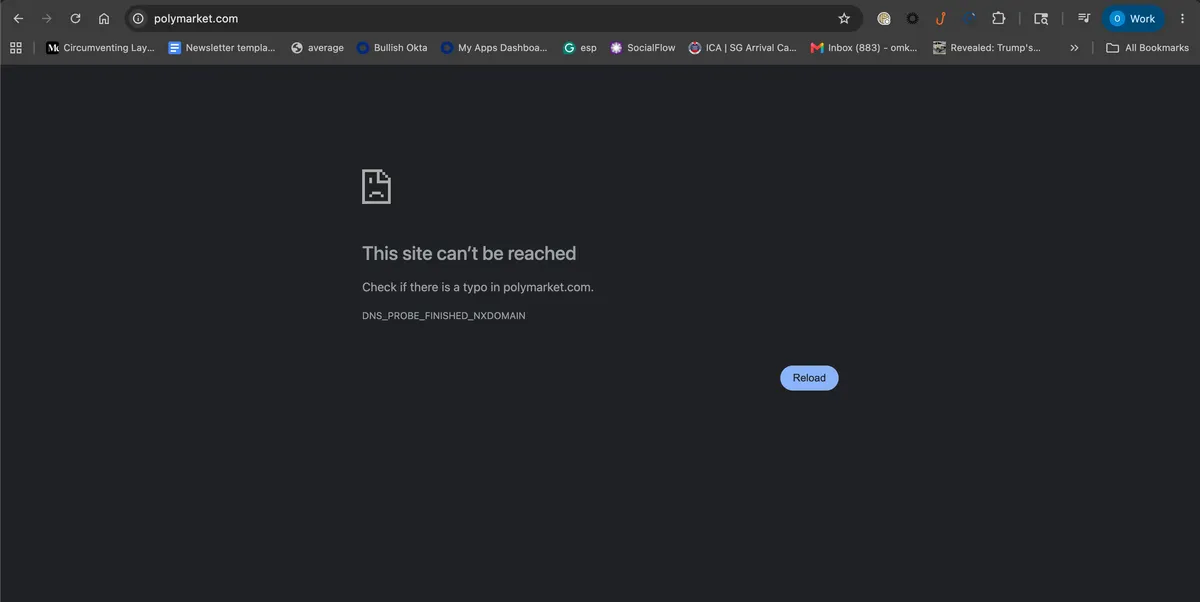
Kalshi, the CFTC-regulated prediction platform, remains accessible inside India for now — but local reporting citing an unnamed source within the ministry indicates a blocking order is being prepared and could land as soon as Friday. The pivot would extend the crackdown beyond decentralized venues to encompass U.S.-licensed prediction markets that have aggressively expanded user bases overseas. Prediction markets allow participants to wager real money on binary outcomes covering referendums, asset price moves, and election results, drawing surging volumes through 2024 and 2025. The expected Kalshi block underscores how Indian authorities are treating the entire category as online money gaming irrespective of regulatory pedigree abroad.
The prediction-market action sits inside a wider regulatory posture that industry observers describe as a shadow ban on retail digital-asset activity. A 30% flat tax on gains paired with a 1% tax deducted at source on every transaction has compressed domestic trading volumes across Bitcoin and broader altcoin markets, while the Promotion and Regulation of Online Gaming Act 2025 sweeps prediction venues into a fully prohibited category. The Ministry of Finance has also tightened Anti-Money Laundering and Counter-Financing-of-Terrorism oversight through the Financial Intelligence Unit, pushing local crypto startups to relocate operations offshore. The combined framework prioritizes financial stability over sector growth.
In France, a violent kidnapping attempt targeting the wife of Sandbox co-founder Sébastien Borget has heightened concern over physical attacks against crypto-industry families. One attacker disguised as a delivery driver allegedly convinced her to open the gate at the couple's Île-de-France residence before five masked accomplices rushed the courtyard and tried to force her into a waiting vehicle. Neighbors intervened, forcing the group to flee — four escaped by car while two attempted to slip away on foot. Borget's wife was unharmed, and preliminary police inquiries have already linked the attempted abduction to her family's perceived crypto wealth.
The two fleeing suspects ordered an Uber from the scene, a decision that proved decisive: the Meaux Anti-Crime Brigade intercepted the rideshare and arrested both. Officers reportedly recovered a replica handgun, cable ties, and balaclavas — equipment consistent with a planned kidnapping rather than an opportunistic confrontation. The remaining four accused remain at large. The incident fits a broader 2025–2026 pattern in which crypto holders' relatives have become primary targets, including last year's attempted abduction of the daughter and grandchild of French exchange executive Pierre Noizat in Paris, and several other high-profile cases that have rattled the European industry.
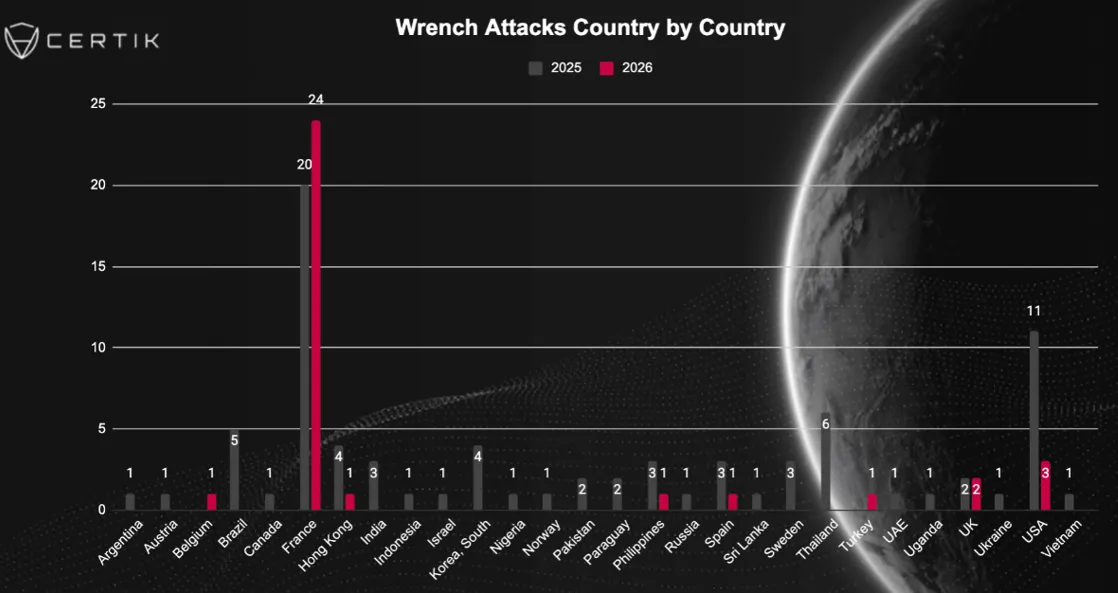
Web3 security researchers have flagged Europe — and France specifically — as the global hotspot for so-called wrench attacks, in which assailants use physical force or threats to extract private keys or cold wallet access. Recent industry analysis indicates that most assault crews comprise three to five operatives, typically amateurs recruited through Telegram and Snapchat, while orchestrators direct operations from abroad. Blockchain intelligence firms attribute the surge to the perceived pseudonymity of on-chain transactions, the visibility of accumulated wealth across wallets, and the ease of harvesting personal data online. Targeting of family members has become routine, marking a structural shift in the threat model facing high-net-worth crypto operators.
Two parallel pressures define this stretch of crypto news: state authorities tightening the legal perimeter around novel products, and criminal networks tightening their physical perimeter around the people who build them. India's prediction-market sweep illustrates how regulators are extending prohibition beyond exchanges into adjacent venues like binary-outcome trading, while the France attacks show that operational security for industry insiders has become a board-level concern. The dominant narrative this cycle is no longer purely market direction; it is the convergence of regulatory enforcement and personal-safety risk forcing builders and investors to redesign jurisdiction, custody, and visibility from the ground up.
COINOTAG does not provide financial advisory services. This content is for informational purposes only and should not be considered investment advice. Cryptocurrency investments involve high risk.
Add COINOTAG as a Preferred Source
Add COINOTAG to your preferred sources in Google News and Search to see our coverage first.
Add on GoogleAI-generated, AI-reviewed, under COINOTAG editorial oversight.