

Iran Weighs $58M Bounty Bill on Trump and Netanyahu as Consensus 2026 Sparks Industry Backlash
Iran's parliament weighs a $58M bounty on Trump and Netanyahu, raising crypto-rails questions, while Consensus 2026 ignites an industry culture debate.

Iran's parliament is reviewing legislation that would commit the state to paying €50 million — roughly $58 million — to anyone who kills US President Donald Trump, Israeli Prime Minister Benjamin Netanyahu, or US Central Command leader Admiral Brad Cooper. Lawmaker Ebrahim Azizi unveiled the proposal on state television, framing it as retaliation for the February 28 strikes that killed former Supreme Leader Ayatollah Ali Khamenei. The bill, titled "Reciprocal action by military and security forces of the Islamic Republic," elevates a long-running rhetorical campaign into a formal financial mandate. Its introduction lands at a moment when geopolitical risk premiums are once again influencing global asset markets, including Bitcoin.
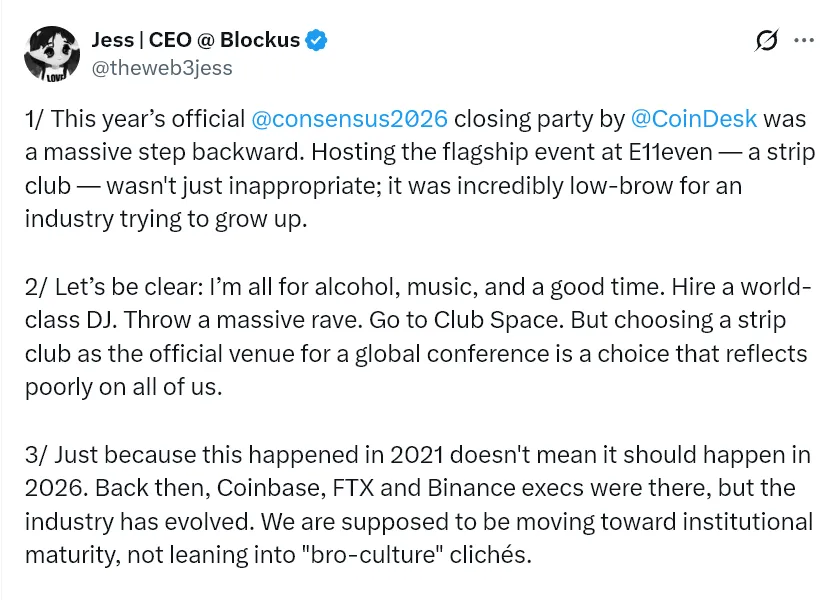
Separately, Consensus 2026 in Miami closed with a controversy that has quickly overshadowed much of the conference's official programming. Organizers selected E11even, a Miami strip club, as the venue for the official closing party, prompting visible discomfort from attendees and sharp criticism on social platforms. Jess Zhang, chief executive of Blockus and a longtime NFT and gaming-sector founder, recounted entering the venue near midnight to find a room full of guests in business casual still wearing their conference lanyards. Her assessment was blunt: the atmosphere felt dingy and confused, mismatched with an industry actively pitching itself to institutional capital.
Within the parliament chamber, the proposal is being shepherded by Azizi, who chairs the National Security and Foreign Policy Committee. He told state media the named officials must be "subjected to reciprocal action" and characterized the act as a religious duty for any "Muslim or free person." Fellow parliamentarian Mahmoud Nabavian confirmed the measure is moving toward a floor vote and warned that any attempt on Iran's new Supreme Leader, Ayatollah Mojtaba Khamenei, would trigger a "devastating" response. The bill has not yet cleared committee review and would still require Guardian Council approval before it could take legal effect inside the Islamic Republic.
The financing mechanics of a state-backed bounty of this size raise immediate questions, given that Iran remains one of the world's most heavily sanctioned economies and is effectively cut off from the dollar clearing system. Tehran has previously leaned on alternative settlement channels, including digital assets, to move value across borders outside Western banking infrastructure. Researchers tracking the "Blood Covenant" group — described as operating with regime tolerance — say more than $40 million in pledged bounties on Trump were raised after US strikes on Iranian nuclear sites last June, with portions of those pledges reportedly routed through blockchain networks and stablecoin rails.
Back in Miami, the venue choice has reopened a broader debate about how the crypto sector presents itself as it courts pension funds, sovereign allocators, and traditional asset managers. Former federal prosecutor Amanda Wick, who attended the party in her capacity as a compliance consultant, asked publicly when the industry would stop defaulting to strip-club entertainment at professional events. Consensys, whose logo appeared at the afterparty, distanced itself from the venue selection, stating it was not a paid sponsor and had no input on programming. The episode underscores a widening gap between the retail-driven culture of past cycles and the institutional posture firms now claim.

Industry observers note that the contrast between the conference's main-stage panels — covering tokenization, regulated DeFi markets, and on-chain treasury management — and the after-hours programming has rarely felt sharper. Several executives privately acknowledged that conference culture has lagged the operational maturation of the sector itself. With public companies now holding Bitcoin on their balance sheets and ETF flows reshaping market microstructure, the optics of conference-branded events at strip clubs increasingly clash with the regulatory legitimacy that listed issuers and asset managers are working to establish. The fallout is expected to influence venue decisions at upcoming conferences.
Taken together, the two storylines illustrate the dual pressures shaping digital-asset markets at this stage of the cycle. On one side, escalating geopolitical risk — from sanctioned-state bounty proposals to ongoing regional conflict — keeps a structural bid under censorship-resistant assets and underscores the strategic relevance of cold wallet custody and permissionless rails. On the other, the industry's internal culture is being publicly stress-tested as institutional capital arrives and demands a more professional surface. Both threads point to the same conclusion: crypto is no longer a niche, and the standards applied to it — political, legal, and reputational — are converging with those of mainstream finance.

AI-generated, AI-reviewed, under COINOTAG editorial oversight.