

JPMorgan Files Ethereum-Based Tokenized Money Fund as ETH Foundation Launches Clear Signing Standard
JPMorgan files Ethereum tokenized money fund JLTXX, Ethereum Foundation launches Clear Signing standard with Ledger and Trezor, ETH eyes $2,600 path.


JPMorgan has filed with the U.S. Securities and Exchange Commission to launch a tokenized money market fund built on the Ethereum network, marking one of the largest traditional banking entries into onchain finance to date. The product, named the JPMorgan OnChain Liquidity-Token Money Market Fund and ticker JLTXX, will invest exclusively in U.S. Treasury bills, bonds, and notes. The fund will operate through Kinexys Digital Assets, JPMorgan's blockchain unit, which deploys a permissioned layer on top of  Ethereum (ETH). The filing flags potential expansion to additional networks in the future. Shares of JPMorgan closed 1.63% higher at $304.88 following the disclosure.

The Ethereum Foundation, alongside hardware wallet makers Ledger and Trezor and software wallet providers MetaMask and WalletConnect, unveiled a new open standard called Clear Signing aimed at eliminating one of crypto's most costly attack vectors. The framework targets blind signing, the practice of approving raw, machine-readable transaction data that has contributed to losses estimated in the billions, including last year's $1.5 billion Bybit breach. Clear Signing relies on ERC-7730 for human-readable transaction descriptors and ERC-8176 for attestation. A decentralized off-chain registry will distribute the descriptors, with the Foundation's Trillion Dollar Security Initiative serving as steward.
Major wallet developers are aligning behind the initiative as adoption pressure grows across the ecosystem. Under the new framework, wallets will display plain-language prompts such as the assets moving, the recipient, and the permissions being granted, rather than long strings of hexadecimal calldata. The public registry at clearsigning.org will accept contract descriptors that are reviewed by independent security researchers before being made available to wallet front ends. Industry advocates argue that phishing-driven wallet drains have repeatedly exploited the gap between technical transaction data and user comprehension, and the initiative aims to harden that final approval step before the next institutional adoption wave.
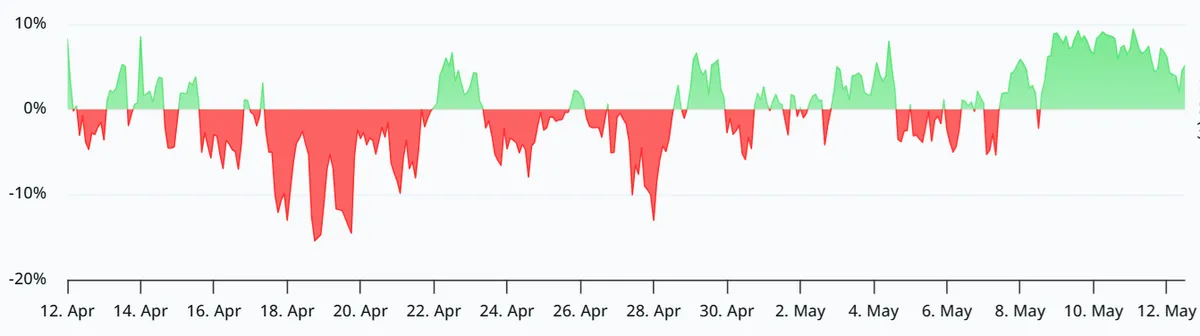
Ether derivatives continue to signal that professional traders have not capitulated despite Ethereum (ETH) failing to clear $2,400 on multiple attempts over the past four weeks. The annualized perpetual futures funding rate sat near 5% on Tuesday, just below the neutral 6%–12% band but well removed from the bear-controlled negative readings recorded last week. At Deribit, ETH put-to-call ratios have remained subdued since May 4, with demand for protective downside structures declining for three straight weeks. Analysts highlight that the 53% DeFi total value locked share, combined with steady spot ETF demand, keeps a path toward $2,600 plausible if support near $2,200 holds.
JPMorgan's tokenized fund filing also intersects with the U.S. regulatory pivot toward stablecoin oversight, with the bank explicitly positioning JLTXX to satisfy reserve requirements under the GENIUS Act. Compliant stablecoin issuers will need to back tokens with highly liquid assets such as Treasurys, cash, and insured bank deposits, opening a sizable distribution channel for institutional money market products on public blockchain rails. The fund will invest in overnight repurchase agreements collateralized by Treasurys, sitting alongside competitor Franklin Templeton's BENJI, which is already accessible across BNB Chain, Canton, and Avalanche networks.
Internal headwinds continue to shadow the Ethereum (ETH) ecosystem even as institutional plumbing matures. The Kelp DAO rsETH bridge was recently drained of more than $290 million through a LayerZero message-spoofing exploit that fed fake collateral into multiple lenders including Aave. The Ekubo protocol suffered a $1.4 million loss tied to EVM v2 swap vulnerabilities, while TrustedVolumes lost $6.7 million via a protocol-logic flaw. These incidents trace to protocol-specific bugs and access control errors rather than weaknesses in Ethereum's base layer or layer-2 bridge designs, reinforcing the urgency behind the Clear Signing standard and broader user-facing security efforts now being formalized.
ETH trades near $2,289 with a 2.34% daily decline as price action consolidates between layered support at $2,247, $2,190, and $2,146 and overhead resistance at $2,315, $2,379, and $2,423. The RSI at 47.87 sits in neutral territory, while the MACD prints a bearish signal consistent with the sideways trend. A reclaim of $2,315 on rising volume would open a retest of $2,379 and align with derivatives positioning that still points toward $2,600. Conversely, a daily close below $2,247 would expose $2,190 and invalidate the constructive thesis built on resilient funding and ETF inflows.
AI-generated, AI-reviewed, under COINOTAG editorial oversight.