

MAPO Crashes 96%, Nakamoto Faces Nasdaq Delisting, Fed Reviews Crypto Master Accounts
MAPO drops 96% in Butter Network bridge exploit, Nakamoto plans 1-for-40 reverse split to dodge Nasdaq delisting, Fed opens crypto master account review.

MAPO, the native altcoin of Map Protocol, collapsed 96% on Wednesday after an attacker exploited the Butter Network cross-chain bridge and minted roughly one quadrillion fresh tokens — a supply tens of thousands of times larger than the legitimate float. The token slid from about $0.003 to $0.0001 within hours as the attacker dumped roughly a billion MAPO into Uniswap decentralized exchange pools, draining around 52 ETH worth roughly $180,000. Map Protocol paused mainnet, blamed the breach on a Solidity contract-layer flaw, and pledged to invalidate any tokens held by attacker-controlled addresses in an upcoming network snapshot. Trillions of malicious tokens remain in circulation, threatening other liquidity venues.
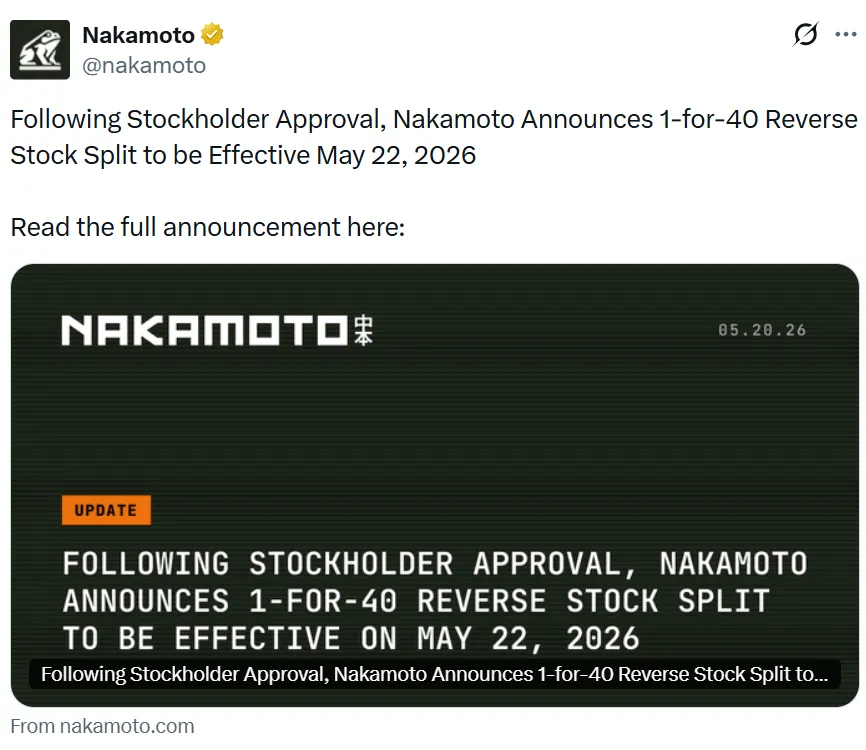
Bitcoin treasury firm Nakamoto will execute a shareholder-approved 1-for-40 reverse stock split on Friday in a last-ditch move to preserve its Nasdaq listing. The company received a deficiency notice on Dec. 10 after its share price spent 30 consecutive sessions below the $1 minimum, leaving until June 8 to regain compliance. The split will compress 696.1 million common shares into 17.4 million. Shares closed at 16 cents on Wednesday, more than 99% below the $25 level reached in May last year, when Nakamoto unveiled its Bitcoin treasury strategy and announced a merger with healthcare provider KindlyMD.
SEC Chair Paul Atkins has instructed staff to seek public input on prediction-market exchange-traded funds, formally extending the regulator's delay on a first wave of event-contract products. The hold affects 24 funds from issuers including Bitwise, Roundhill, and GraniteShares that were filed in February and approaching the end of a 75-day review window. The proposed ETFs offer exposure to outcomes such as the 2028 U.S. presidential race, recession likelihood, and tech-sector layoffs — instruments warning investors they could lose substantially all of their capital. Polymarket and Kalshi together cleared more than $25 billion in monthly volume in April, intensifying pressure on the agency to clarify its stance.
The Federal Reserve has opened public comment on a new payment-account category that could grant qualifying crypto firms direct access to the central bank's clearing and settlement rails. Wednesday's proposal — substantially similar to a December 2025 draft — would let eligible non-depository institutions bypass intermediary banks while denying them intraday credit, discount-window access, or interest on balances. The move follows President Donald Trump's Tuesday executive order directing the Fed to integrate digital assets and blockchain innovation into traditional payment systems. Until the policy is finalized, the Board has urged Reserve Banks to pause decisions on Tier 3 applications, a tier that explicitly captures crypto firms.
The MAPO breach lands during the worst stretch for decentralized infrastructure in recent memory, with at least 18 DeFi and blockchain protocols compromised in May alone. The list includes THORChain, Verus Protocol's Ethereum bridge, Transit Finance, TrustedVolumes, Ekubo, Echo Protocol, and RetoSwap, spanning cross-chain bridges, liquidity venues, and smaller experimental networks. Security researchers note that the Map Protocol exploit relied on a classic Solidity flaw involving dynamic message fields — the attacker re-sent a modified retry payload that hashed identically to a legitimate oracle multisig message. No private keys were stolen, underscoring how protocol-layer logic continues to outpace audit cycles.

Nakamoto's reverse-split scramble reflects broader strain across the Bitcoin treasury cohort. Many publicly listed accumulators have traded below the value of the digital assets on their balance sheets since 2025, the kind of equity bear market that analysts warn will force sector consolidation and outright mergers this year. Nakamoto's first-quarter results illustrate the squeeze: revenue rose 500% quarter-over-quarter, yet the firm posted a $238.8 million net loss, with more than $102 million stemming from a mark-to-market write-down on its 5,058 BTC treasury after the cryptocurrency fell roughly 23% during the period.
This cycle's dominant narrative is convergence — regulatory machinery in Washington, security failures at the protocol layer, and balance-sheet stress at corporate accumulators are tightening simultaneously. The SEC's deliberate slowdown on prediction-market ETFs and the Fed's solicitation of input on crypto master accounts signal a federal push to codify the rules before the next product wave lands. Meanwhile, exploited bridges and distressed treasuries remind market participants that operational risks from the last cycle remain unresolved. The result is a market in which policy formation, security hygiene, and capital discipline must advance in lockstep, or the next breakdown will compound them.

AI-generated, AI-reviewed, under COINOTAG editorial oversight.