

Minnesota Greenlights Bank Crypto Custody Aug 1 as AI Trails Human Engineers
Minnesota greenlights bank and credit union digital asset custody from August 1, while new ARFBench benchmark shows AI still trails human engineers on outages.

Minnesota has become the first midwestern U.S. state to enact a unified legislative framework permitting both state-chartered banks and credit unions to offer custody for Bitcoin and other digital assets. Governor Tim Walz signed bill HF 3709 last week, with the new virtual currency law taking effect August 1. The legislation places Minnesota alongside earlier-moving jurisdictions such as Wyoming, Virginia, and New York, but distinguishes itself by addressing both bank and credit union charters within a single statute. State Representative Steve Elkins, a co-author of the measure, described the milestone as a meaningful shift in how regulated institutions can safeguard customer-held cryptocurrency.
Under the new statute, state-chartered banks are authorized to provide virtual asset custody in either a fiduciary or nonfiduciary capacity, while credit unions are limited to nonfiduciary custodial roles. The law explicitly defines custody services as the safekeeping, controlling, or management of digital assets and their cryptographic private keys, codifying responsibilities that previously sat in regulatory grey area. Community institutions in the state, including the St. Cloud Financial Credit Union, have signaled enthusiasm for the framework, citing cybersecurity standards, compliance obligations, and member protections baked into the text. The move signals that regional players want a competitive answer to specialized custodians and exchange-based storage venues.

For end users, the practical impact centers on a familiar problem: lost access to a self-custodied wallet. Elkins highlighted cases of constituents who effectively lost their holdings after misplacing account credentials, framing bank-administered custody as an institutional backstop against permanent loss. Until now, Minnesotans seeking that kind of safety net typically had to rely on out-of-state specialists or accept the risks of a self-managed cold wallet. The new framework integrates digital assets into the same trust relationships consumers already have with their hometown lenders, while requiring those institutions to meet explicit standards around safety, soundness, and information security obligations.
Elsewhere in infrastructure, a new joint study from Datadog and Carnegie Mellon University has concluded that the most capable artificial intelligence models still cannot match human engineers at diagnosing real production outages. Built from 63 live incidents pulled out of engineers' own Slack threads, the ARFBench benchmark contains 750 hand-verified multiple-choice questions covering 142 monitoring metrics and roughly 5.38 million data points. Researchers argue that incident-response reasoning, not synthetic textbook problems, is the right test for autonomous site-reliability agents. With trillions of dollars in annual losses tied to system outages, the findings carry weight for any sector running mission-critical infrastructure, blockchain networks included.
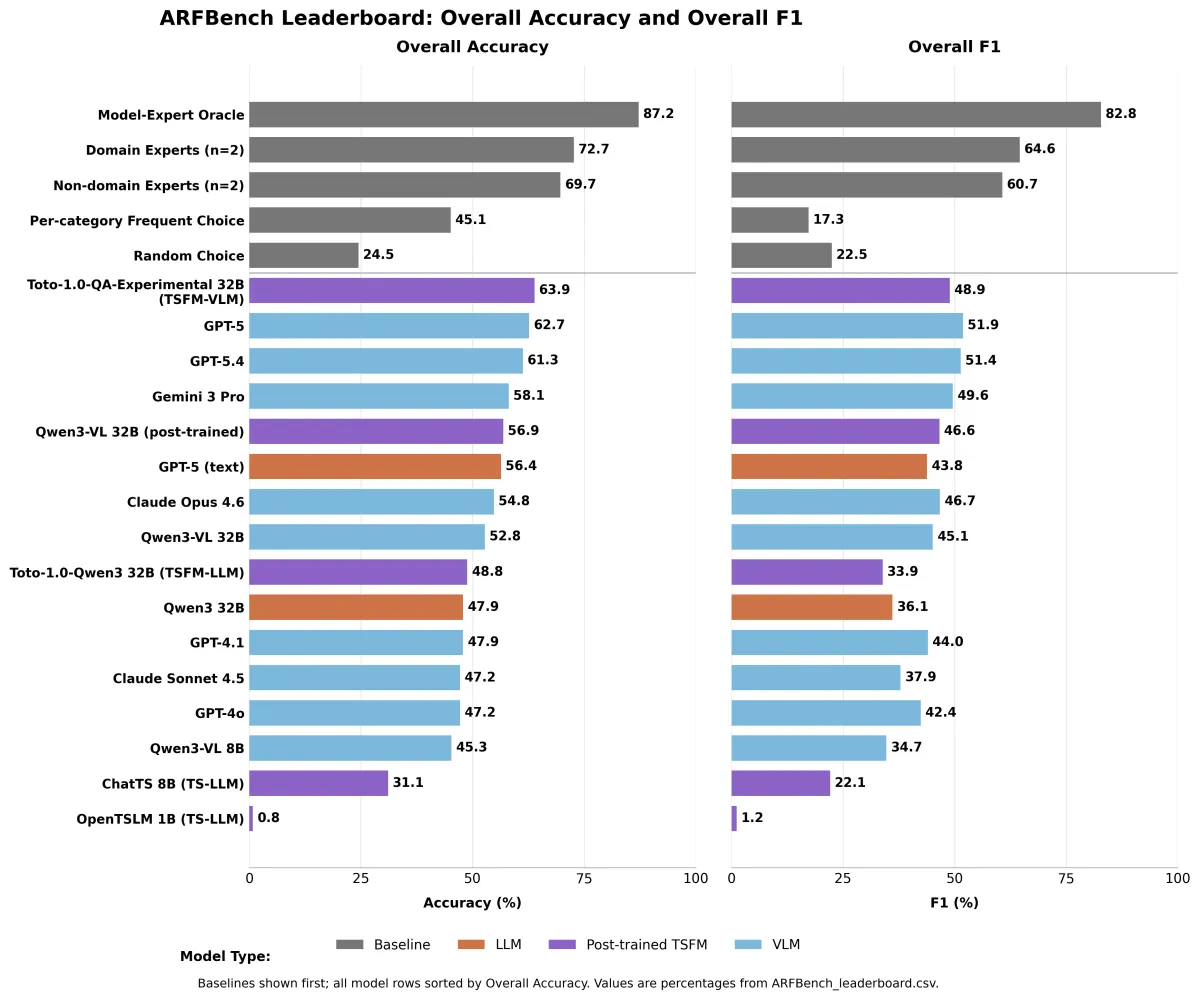
On the benchmark itself, GPT-5 led all evaluated AI systems with 62.7% accuracy, followed by Gemini 3 Pro at 58.1%, Claude Opus 4.6 at 54.8%, and Claude Sonnet 4.5 at 47.2%. By comparison, domain-expert engineers scored 72.7%, and even non-specialist time-series researchers reached 69.7%. No tested model surpassed either human baseline. The gap widened on Tier III cross-metric reasoning questions, where GPT-5 mustered just 47.5% on an F1 measure that penalizes models for gaming answers. Random guessing on the benchmark, for context, returns roughly 24.5%, underscoring that the models do learn structure even when they fall short of practitioners.
The most striking finding may not be that GPT-5 trails experts, but that a theoretical model-expert oracle — pairing AI suggestions with engineer judgment — achieves 87.2% accuracy, well above either group acting alone. Researchers frame this as the realistic ceiling for hybrid teams working through complex anomaly diagnosis. For operators of consensus-driven networks, validator clusters, and on-chain analytics pipelines, the implication is that fully autonomous incident-response agents remain an aspiration rather than a deliverable. The current sweet spot involves AI surfacing candidate hypotheses while seasoned engineers retain final responsibility over remediation decisions in live production environments.
Across both stories, a single arc emerges: the infrastructure underpinning digital assets is maturing into something legible to traditional institutions and operational rigor. Regulatory frameworks are pulling crypto custody into the same supervised perimeter as conventional banking, while production-grade benchmarks remind builders that automation cannot yet substitute for experienced operators. The dominant narrative this cycle is consolidation — of legal clarity, of fiduciary responsibility, and of human-machine workflows that keep DeFi rails and broader on-chain systems resilient at scale. Whether the work happens inside a community credit union vault or on a monitoring dashboard, integration rather than displacement is the direction of travel.

AI-generated, AI-reviewed, under COINOTAG editorial oversight.