

OKX-ICE Launch Oil Perps to 120M Users, China Halts Brokers, Polymarket Hit for $700K
Crypto News
Intercontinental Exchange (ICE), parent company of the New York Stock Exchange, has partnered with OKX to bring perpetual oil futures contracts to the cryptocurrency platform's roughly 120 million retail traders. The new perpetual products will draw on ICE's Brent crude and West Texas Intermediate (WTI) benchmark pricing, marking another bridge between traditional commodity markets and digital asset venues. The contracts will roll out in jurisdictions where OKX already holds licenses to offer perpetual derivatives. ICE holds an equity stake in OKX and the two firms previously signed a March agreement to develop blockchain infrastructure enabling tokenized securities trading on NYSE and crypto futures access for ICE clients.

Prediction market platform Polymarket confirmed Friday that an internal rewards wallet was drained in what appears to be a private key compromise, with on-chain analytics estimating losses of approximately $700,000. The affected wallet handled only internal top-up operations and did not touch user funds, smart contracts, or market resolution mechanisms, according to the platform's development team. On-chain investigators traced the stolen proceeds across sixteen destination addresses, with funds subsequently routed through centralized exchanges and other obfuscation services. Polymarket's core infrastructure on the Polygon network remains operational, though the incident underscores ongoing operational security challenges facing prediction venues handling automated rewards distribution at scale.
China's securities regulator has ordered a two-year wind-down of mainland operations for three major offshore brokerages — Tiger Brokers, Futu Holdings, and Longbridge — citing unlicensed handling of cross-border trading and fund sales for domestic customers. The China Securities Regulatory Commission accused the firms of violating the Securities Law, Securities Investment Fund Law, and Futures and Derivatives Law, and intends to confiscate all illegal gains across domestic and overseas units. Existing users will only be permitted to liquidate positions and withdraw funds during the transition window, with new deposits and buy orders blocked immediately. FUTU and TIGR shares declined on the announcement, trading at $123.84 and $5.84 respectively.
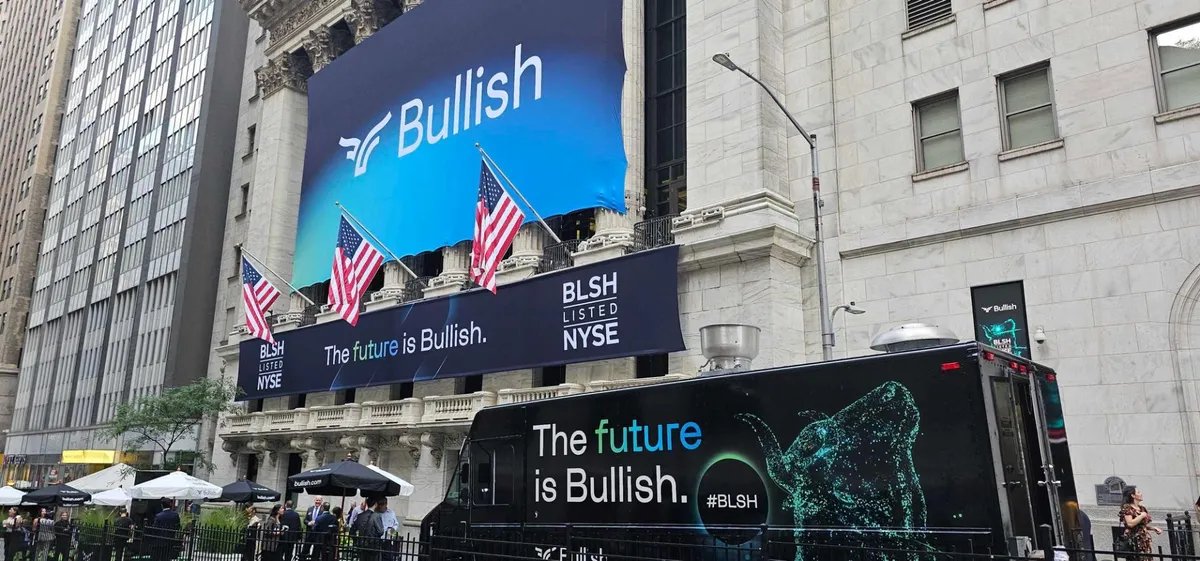
Cathie Wood's Ark Invest accumulated $12.5 million worth of Bullish (BLSH) stock across four consecutive trading days this week, including a $5 million purchase on Thursday. The crypto exchange operator's shares have declined more than 17% over the past two weeks, mirroring weakness across crypto-linked equities during a digital asset bear market stretch in which Bitcoin repeatedly failed to reclaim the $80,000 level. BLSH closed at $35.96 on Thursday. Ark has historically deployed capital into crypto-adjacent public companies during broader market downturns, treating equity drawdowns as accumulation windows for its actively managed exchange-traded fund suite.
The launch of regulated oil perpetuals on a centralized venue follows the runaway success of similar products on Hyperliquid, a decentralized exchange where non-expiring oil futures have generated roughly $1.6 billion in daily trading volume and over $1.3 billion in open interest. Perpetual futures contracts, often called perps, let traders take leveraged directional positions on commodities or digital assets without ever needing to take physical delivery or roll positions forward. Most perp products historically traded on offshore venues outside the regulatory perimeter, though the Commodity Futures Trading Commission has signaled intent to bring such instruments under formal oversight, narrowing the gap between traditional and digital derivatives markets.
The Chinese brokerage shutdown could redirect substantial capital flows toward cryptocurrency rails, with mainland investors facing a $50,000 annual foreign exchange quota that leaves limited legal pathways to overseas markets. Stablecoins such as USDT and over-the-counter trading desks have historically absorbed displaced capital during periods of tightened cross-border restrictions. Frozen positions held at the affected brokerages, combined with the closure of mobile-first access to U.S. and Hong Kong equities, may push portions of that liquidity into digital asset channels. The dynamic echoes prior capital control episodes when mainland demand for offshore exposure translated into elevated activity across peer-to-peer venues and offshore exchange volumes.
Friday's developments illustrate the accelerating convergence between traditional finance and digital asset infrastructure, alongside the persistent operational and geopolitical pressures shaping the sector. Major exchanges like ICE are no longer treating crypto as a separate vertical, while Asian regulators continue tightening controls over capital flows that historically benefited offshore platforms. Institutional allocators are using equity drawdowns to build altcoin-adjacent exposure, and prediction markets remain vulnerable to wallet-level compromises even as their core architectures hold. The thematic arc points toward a maturing market where TradFi integration, regulatory tightening, and capital migration jointly define the cycle's defining structural shifts.
COINOTAG does not provide financial advisory services. This content is for informational purposes only and should not be considered investment advice. Cryptocurrency investments involve high risk.
Add COINOTAG as a Preferred Source
Add COINOTAG to your preferred sources in Google News and Search to see our coverage first.
Add on GoogleAI-generated, AI-reviewed, under COINOTAG editorial oversight.