

News
OKX Launches ICE Oil Perps, MARA Spends $4.3M on CEO Security as AI Agents Rise
ICE and OKX launch Brent and WTI oil perpetual futures, MARA discloses $4.3M CEO security spend, and AI agents promise institutional-grade retail treasury.


The next leap in retail finance is shaping up not as a sleeker brokerage but as a structural rewrite of how household balance sheets work. Three converging forces are pulling once-institutional capabilities into decentralized finance rails: stablecoins functioning as always-on digital cash, the tokenization of real-world assets across equities, bonds and property, and autonomous AI agents capable of executing complex financial instructions. Industry observers argue that always-on agentic infrastructure could let retail accounts sweep idle balances into yield products, lend tokenized securities for passive income, and vote shares automatically, collapsing the historic gap between spending and investing into a single coordinated workflow managed by software.
The economic stakes are substantial. American households are estimated to hold roughly six trillion dollars in checking accounts and close to fifteen trillion when broader cash equivalents are included, much of it earning a small fraction of prevailing money-market rates. That structural drag is calculated to cost retail savers at least one hundred eighty billion dollars in foregone interest each year. Securities lending remains an institutional revenue stream, while retail shareholders vote less than a third of their shares versus about ninety percent for institutions. Tokenized assets sitting on programmable blockchain rails change the calculus, turning dormant balances into income-producing positions managed continuously.
Intercontinental Exchange, parent of the New York Stock Exchange, is partnering with crypto venue OKX to bring Brent crude and West Texas Intermediate oil perpetual futures to digital-asset traders. The new contracts will settle against ICE benchmark prices that already anchor traditional energy markets, marking the first product launched under a broader collaboration disclosed earlier this year when ICE invested in OKX at a twenty-five-billion-dollar valuation. Availability is restricted to jurisdictions where OKX is licensed to offer perpetuals. The launch targets retail traders seeking direct exposure to energy benchmarks inside a regulated framework, expanding crypto-style derivatives beyond purely digital assets.
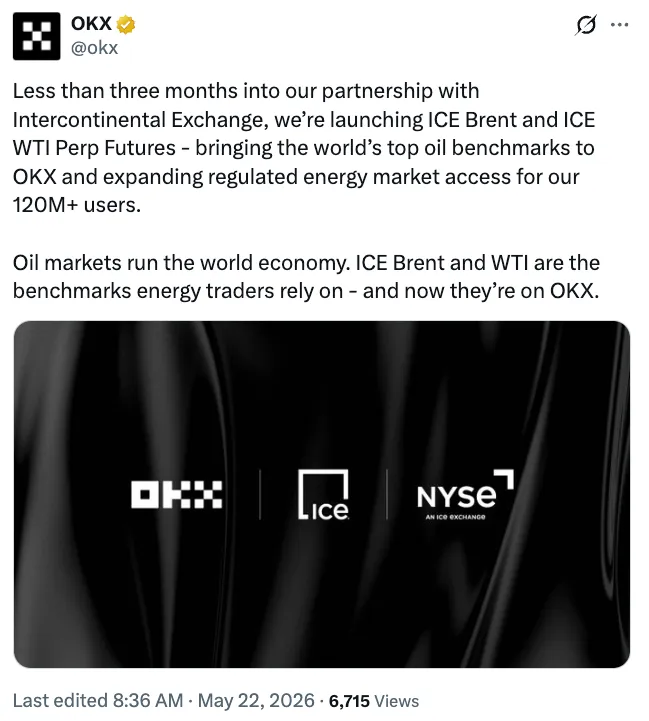
Centralized venues have been steadily pushing into commodity-linked perpetuals over recent months, with several exchanges introducing WTI, Brent and natural gas contracts amid round-the-clock retail demand. Activity has spiked during episodes of oil volatility tied to geopolitical pressure points such as the Strait of Hormuz, reinforcing the appeal of expiry-free instruments for hedging and speculation. Decentralized derivatives platform Hyperliquid has emerged as a competitor in the segment, prompting ICE to lobby regulators to tighten oversight of oil trading on permissionless decentralized exchange infrastructure. The broader pattern points to a convergence of energy markets and crypto-native derivatives architecture.
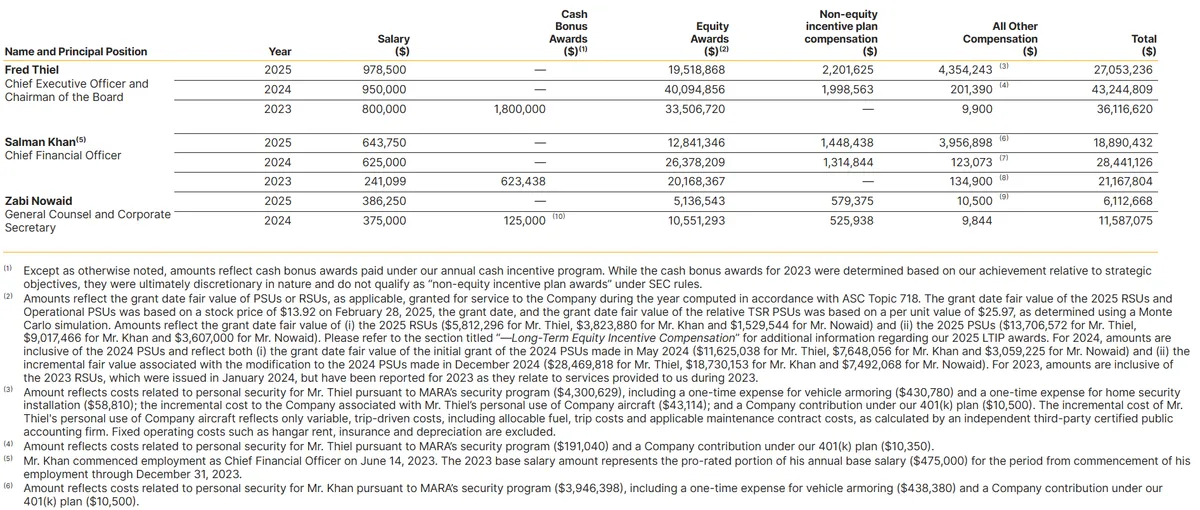
Bitcoin miner MARA Holdings disclosed that it spent roughly four point three million dollars on personal security for Chief Executive Fred Thiel during the 2025 fiscal year, including $430,780 to armor a vehicle and additional outlays on home fortifications and bodyguards. The figure is more than twenty times higher than the $191,040 reported a year earlier, with Thiel's "All Other Compensation" climbing from about $201,390 to $4.4 million. MARA, which carries a market valuation above five billion dollars, also reported $3.9 million in security expenses for Chief Financial Officer Salman Khan, including a further $438,380 for vehicle armoring.
The disclosures arrive against a sharp escalation in physical coercion attempts targeting crypto holders. Independent cybersecurity researchers tracked seventy-two verified physical attacks against industry figures in 2025, a seventy-five percent jump over the previous year, with France leading at nineteen confirmed incidents and triggering official pledges of preventative measures. So-called wrench attacks differ from purely digital theft because they rely on kidnapping, intimidation or violence to force victims to surrender private keys, seed phrases or account credentials. The rising risk profile is reshaping executive compensation packages, family logistics and operational security across mining firms, exchanges and treasury-rich digital-asset companies worldwide.
The throughline across these stories is a maturing crypto economy colliding with the constraints and frictions of legacy finance. Programmable balance sheets, tokenized commodities and round-the-clock derivative markets are pulling traditional assets onto on-chain rails, while the human costs of holding visible wealth on those same rails are climbing in parallel. Institutional capital, regulated venues and AI-driven execution are pushing the industry toward an always-on, retail-accessible model that mirrors institutional sophistication. At the same time, rising physical attacks and executive security budgets reveal the operational risks of a system where private keys still translate directly into transferable wealth.
AI-generated, AI-reviewed, under COINOTAG editorial oversight.