

Payward Hits $507M Q1, Ostium Taps Nasdaq Data, Proof of Talk Draws $18T AUM
Payward posts $507M Q1 revenue, Ostium partners with Nasdaq for onchain equity perpetuals, and Proof of Talk gathers $18T in AUM at the Louvre.
Sleepagotchi has rolled out its AI Sleep Coach minimum viable product, marking the first deployment in a planned wellness ecosystem built on the Solana blockchain. The platform appointed Kenny Wood as chief executive officer, while founding CEO Anton Kraminkin transitions to a strategic advisor role. The project has accumulated two million all-time users on its Telegram Lite version and generated more than $100,000 in revenue during a recent three-week beta. Live integrations now connect to wearables from Whoop, Oura, and Apple Watch, turning daily biometric data into token-enabled coaching, with 78% of users engaging within ten minutes of waking each morning.
Proof of Talk returns to the Louvre Palace in Paris on June 2-3 for its fourth edition, drawing more than 120 confirmed speakers who collectively represent $18 trillion in assets under management. Attendance is capped at 2,500, with 95% of speakers holding chief executive or founder titles. Confirmed participants include Franklin Templeton CEO Jenny Johnson, Swift CIO Tom Zschach, Mastercard CIO Ken Moore, JP Morgan's Emma Landriault, Aave Labs founder Stani Kulechov, Blockstream CEO Adam Back, and VanEck digital assets research head Matthew Sigel. Proof of Pitch runs alongside the main programme, with partners from Arrington Capital, Dragonfly, and Haun Ventures judging early-stage founder presentations.

Payward, the parent company behind Kraken, reported $507 million in adjusted first-quarter revenue as the exchange accelerated its tokenization, derivatives, and stablecoin expansion. Futures trading climbed 51% year-over-year, while assets on platform grew 11% to $40 billion across 6.1 million funded accounts, a 47% jump. The xStocks platform now lists 100 tokenized equities with plans to surpass 500 by year-end. Payward completed acquisitions of tokenization firm Backed, token management platform Magna, and derivatives venue Bitnomial during the quarter, and separately disclosed a deal to acquire stablecoin payments company Reap for up to $600 million in cash and stock.
Onchain perpetuals exchange Ostium has partnered with Nasdaq to become the first decentralized trading venue offering equity perpetual products powered by Nasdaq market data. The platform, built as a DeFi-TradFi bridge, has processed more than $50 billion in cumulative volume across 26,000-plus traders since launch. Ostium offers leveraged exposure to stocks, indices, commodities, ETFs, and forex while keeping users fully self-custodial. Founders Kaledora Kiernan-Linn and Marco Antonio Ribeiro have raised $27.8 million to date, including a $20 million Series A co-led by General Catalyst and Jump Crypto. The tie-up followed months of engineering work around data integrity, security, and display policies.
Kraken has reduced its workforce by roughly 150 employees as the exchange leans more heavily on artificial intelligence tools across internal operations, a move that could push its planned US public listing into 2027. The cuts arrive during a period of softer trading volumes across the sector, with several major venues trimming headcount even as revenue from institutional products climbs. Industry observers note that AI deployment is becoming a structural cost lever for crypto exchanges, replacing functions previously absorbed by larger compliance, support, and engineering teams. The shift suggests trading platforms are positioning leaner cost bases ahead of potential IPO cycles and tightening public-market scrutiny.
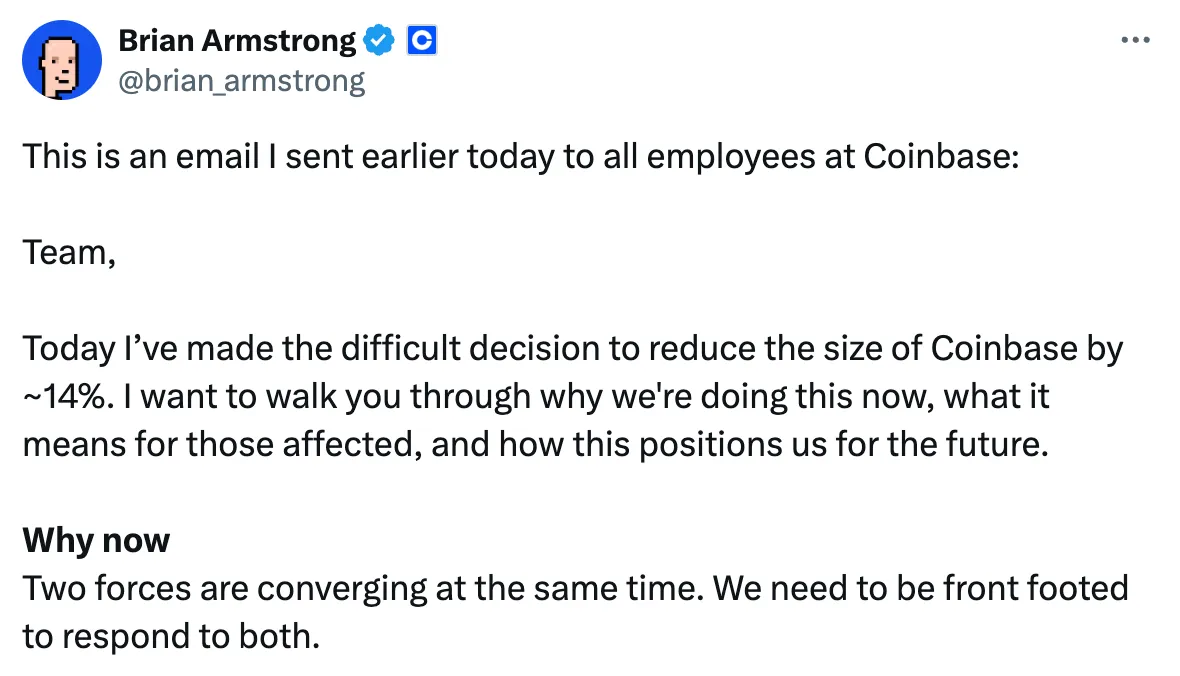
Workforce reductions are spreading beyond exchanges into adjacent crypto infrastructure firms. Coinbase confirmed cuts affecting roughly 700 employees, or about 14% of its workforce, while onchain analytics platform Dune fired 25% of its team as part of a restructuring focused on core products. Dune chief executive Fredrik Haga said the firm remains well capitalized and is sharpening focus on AI tooling and institutional crypto adoption. The pattern underscores a broader industry recalibration: capital efficiency, AI-augmented engineering, and institutional product lines are taking priority over headcount-heavy growth, particularly as venture funding rounds tighten and path-to-profitability metrics dominate boardroom conversations.
This cycle's dominant narrative is unmistakable: institutional capital is colonizing rails that crypto-native firms once defined. Payward's tokenization expansion, Ostium's Nasdaq data tie-up, and the $18 trillion in assets gathering at Proof of Talk all point in the same direction, with TradFi infrastructure converging onto onchain venues. Meanwhile, exchanges are cutting headcount and folding AI into their cost structure, a hallmark of a maturing sector preparing for public-market visibility. Even consumer-facing projects such as Sleepagotchi are rebuilding around AI agents. The current bull-market story now runs through institutional adoption and tokenized equities far more than retail speculation on Bitcoin.
AI-generated, AI-reviewed, under COINOTAG editorial oversight.