

RAIN Surges 44% to Top 3 Prediction Markets, Saylor Pushes STRC Vote, Bitget Launches RWA Platform
Crypto News
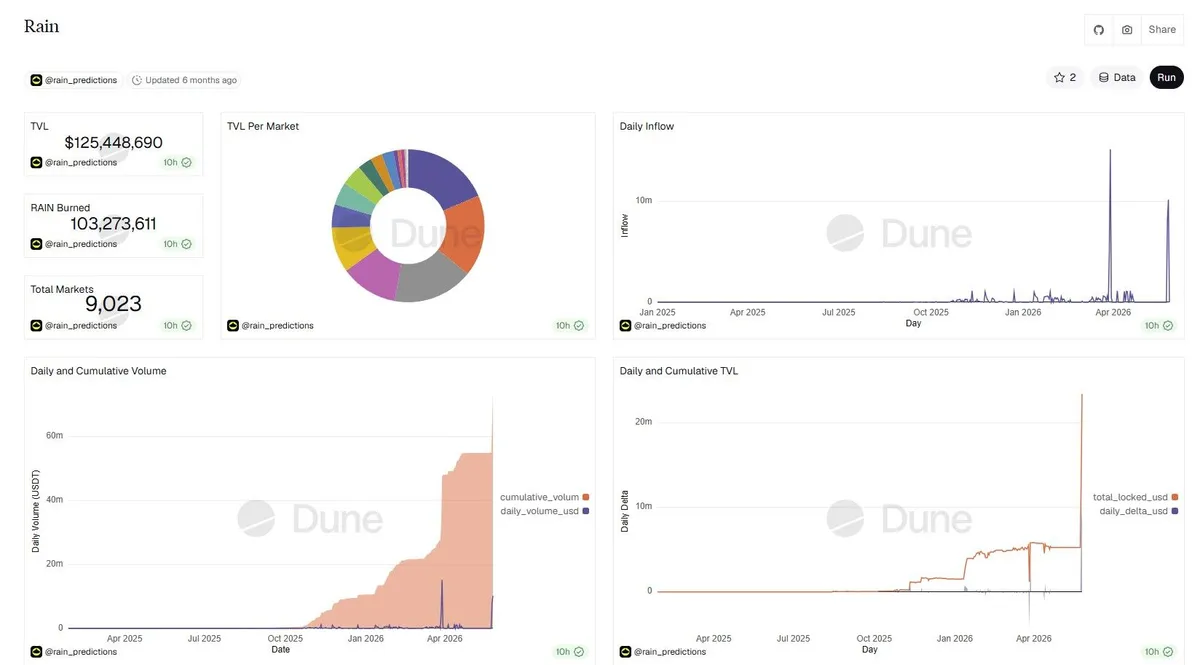
Rain has muscled into the global top three prediction markets by total value locked, joining Polymarket and Kalshi after the Rain Foundation deployed $100 million in fresh liquidity ahead of the protocol's V2 release and the 2026 FIFA World Cup. The capital injection, split evenly between USDT and the project's native altcoin, lifted live TVL to roughly $125.4 million across more than 9,000 active markets. RAIN responded with a parabolic move, climbing 44% in a single day and tacking on another 14% within hours to print a fresh all-time high of $0.01324 and push market capitalization above $8.2 billion.
Michael Saylor is pressing STRC shareholders to approve a switch from monthly to semi-monthly dividend payments, with voting open until June 8. The amendment keeps the annualized yield pinned at 11.5% while doubling payout frequency, a tweak Strategy says will tighten price stability around the instrument's $100 par value and reduce reinvestment lag for the roughly 80% retail holder base. Peter Schiff used the moment to renew his liquidity critique, arguing the firm raises cash by selling preferred shares to buy Bitcoin, then issues more equity to cover the next dividend. He asked publicly what Saylor plans to sell next.
Bitget unveiled Reality, a licensed platform built to tokenize traditional financial assets and route them into the exchange's broader trading stack. The launch debuts rTokens, on-chain representations of US equities and ETFs that are backed 1:1 by real shares custodied with a FINRA-registered, SIPC-protected broker-dealer, with a live Proof of Asset dashboard and CPA-level audit reports running on top. CEO Gracy Chen framed the rollout around her 10% vision, projecting that nearly a tenth of global financial assets could exist in tokenized form by 2030. Tokenized equities will plug into margin, grid, copy trading, staking, and lending products on day one.
Commodity markets flashed a synchronized warning Wednesday as oil, gold, silver, and copper all sold off in the same session, a pattern that cuts against the easy Strait of Hormuz unwind narrative traders reached for first. WTI spot slipped 2.04% to $90.57, Brent eased 1.51% to $94.84, gold gave back 0.51% to $4,484, silver dropped 2.54% to $74.95, and copper softened by 0.34%. A clean geopolitical premium reversal should lift safe-haven metals on disinflation relief; the fact that every leg of the complex fell together points instead to firming US Treasury yields and a stronger dollar pressuring the entire board.
OpenZeppelin co-founder Manuel Aráoz set off a fierce debate after declaring that he now considers every DeFi protocol unsafe, citing the rapid rise of AI coding agents that can autonomously hunt smart contract flaws. The longtime auditor singled out Aave, MakerDAO, and Compound, three protocols his firm has helped secure since 2015, and said he has privately advised friends and family to exit blue-chip positions. He framed the imbalance as decisive because defenders must close every bug while attackers need only one exploit. Aave Chan Initiative founder Marc Zeller pushed back, noting that under 10% of last year's DeFi losses came from codebase flaws.
The Heima team submitted an on-chain proposal to burn 16.5 million HEI tokens drawn from the project's ecosystem allocation, a supply reduction that would tighten circulating supply if token holders sign off. The proposal arrives during a broader wave of programmatic burns and treasury rebalancing across mid-cap projects, with teams increasingly leaning on DAO-style governance votes to validate supply mechanics rather than executing unilateral treasury moves. Routing the burn through an on-chain vote shifts the decision to blockchain-verifiable consent and gives the wider community a direct lever on how ecosystem reserves are managed going forward.
Pulled together, the day's tape sketches a market that is professionalizing on every front. Capital is rotating toward platforms that bolt traditional financial rails onto on-chain infrastructure, from prediction venues absorbing nine-figure liquidity injections to exchanges issuing fully reserved tokenized equities. At the same time, the commodity-wide selloff and Saylor's dividend mechanics highlight how sensitive both crypto-adjacent treasuries and broader risk assets remain to yields and dollar strength. Layered above it all is a security debate forcing protocols to rethink defenses as AI agents narrow the auditor advantage. The dominant thread is institutional rotation meeting tighter macro and security discipline.
COINOTAG does not provide financial advisory services. This content is for informational purposes only and should not be considered investment advice. Cryptocurrency investments involve high risk.
Add COINOTAG as a Preferred Source
Add COINOTAG to your preferred sources in Google News and Search to see our coverage first.
Add on GoogleRelated Tags
AI-generated, AI-reviewed, under COINOTAG editorial oversight.