

Schiff Slams MicroStrategy's $64B Bitcoin Bet as Binance Disputes $850M Iran Report
Peter Schiff renews attack on MicroStrategy's $64B Bitcoin strategy and STRC dividend math as Binance disputes WSJ report on $850M Iran-linked transactions.

Veteran gold advocate Peter Schiff has reopened his campaign against MicroStrategy this week, arguing the firm's five-year accumulation strategy has failed to deliver a meaningful return for shareholders. Schiff said the company has deployed roughly $64 billion into Bitcoin since adopting the treasury model, yet sits on what he characterizes as a negative total return through May 23. The criticism arrived as the broader corporate treasury narrative continues to face questions about valuation premiums, dilution mechanics, and the sustainability of leverage taken on against a volatile reserve asset that has stalled well below the levels needed to validate aggressive accumulation programs.
The core of Schiff's latest critique targets MicroStrategy's STRC preferred stock, whose monthly dividend rate climbed to 11.50% in March 2026 — the seventh consecutive increase since the instrument launched in mid-2025. The rate is adjusted each month to anchor STRC shares near their $100 par value. Schiff contends that funding such a payout requires Bitcoin to compound at roughly 30% annually, a threshold well above the asset's longer-run average since printing its most recent all-time high. He added that ongoing STRC issuance steadily raises the hurdle, since each new tranche enlarges the dividend obligation pool.
In a separate development drawing scrutiny across the sector, Binance Chief Executive Richard Teng publicly rejected a Wall Street Journal investigation alleging the exchange processed $850 million in transactions tied to a sanctioned Iranian financier. In a Friday post on X, Teng described the reporting as fundamentally inaccurate, insisting the platform never knowingly serviced sanctioned individuals and that any flagged activity predated the relevant sanctions designations. He further claimed Binance had concluded its own internal review before the publication made contact, and that material context supplied by the company was omitted from the final article that ultimately appeared in print.
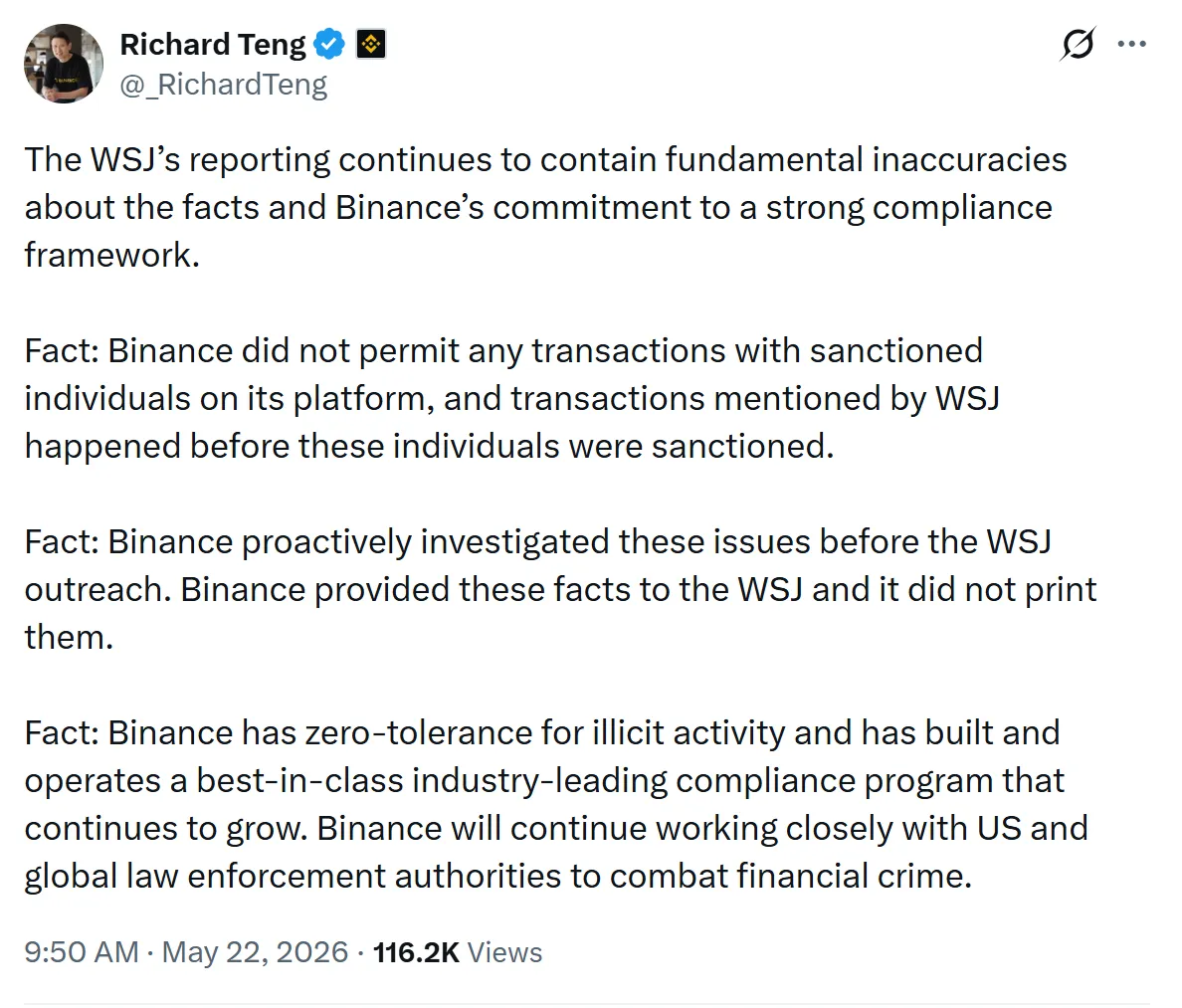
The underlying investigation identified Babak Zanjani — re-sanctioned by the United States in January — as the operator of a clandestine crypto payment network routing $850 million through Binance accounts over a two-year span. His firm Zedcex, plus accounts allegedly linked to family members and a corporate director, reportedly accessed the platform from identical devices. Internal compliance reports are said to have flagged the Zedcex account after detecting logins originating from Tehran in late 2024, generating more than a dozen subsequent alerts before any closure action was finalized despite recommendations from internal investigators to shutter the accounts and notify authorities.
The fresh allegations land against the backdrop of Binance's 2023 guilty plea for anti-money-laundering and sanctions violations, a settlement that carried a record $4.3 billion penalty and a binding commitment to overhaul compliance infrastructure. Reporting earlier this year flagged that the Department of Justice has reopened an inquiry into whether Iranian entities continued to exploit the exchange post-settlement. Binance has previously filed a defamation lawsuit against the Journal and denies any awareness of an active DOJ probe, stating it continues to cooperate with regulators and law-enforcement agencies on tracking illicit blockchain flows across jurisdictions.

Beyond the Zanjani network, the investigation alleges that Iran's central bank moved approximately $107 million in digital assets through Binance accounts during 2025, while a foreign law-enforcement agency reportedly traced an additional $260 million in direct transactions between Binance users and Iranian terrorist-financing actors throughout 2024. The scope of those claims, if confirmed, would mark one of the largest sanctions-evasion exposures attributed to a single centralized venue. The figures also underscore the persistent difficulty of policing cross-border crypto flows even when an operator has deployed enhanced screening tools following a major enforcement action.
Taken together, the week's headlines reinforce a dominant arc shaping the current cycle: regulatory and structural risk weighing on both corporate treasury strategies and centralized exchange operations. The MicroStrategy debate centers on whether leveraged exposure to Bitcoin can outrun rising dividend obligations during a period when prices have struggled to sustain new highs, a question that grows more acute the longer markets trend toward bear market conditions. The Binance dispute, meanwhile, illustrates how unresolved sanctions-evasion claims continue to shadow exchanges already operating under heightened compliance regimes worldwide.
Related Tags

AI-generated, AI-reviewed, under COINOTAG editorial oversight.