

Bitcoin Volatility Drops 56% as Polymarket Disputes Strategy's 32 BTC Sale Ruling
BTC/USDT
$11,597,800,806.45
$64,823.52 / $63,270.00
Change: $1,553.52 (2.46%)
+0.0022%
Longs pay

Bitcoin News
A bitter standoff has erupted on prediction market exchange Polymarket after Strategy Inc, formerly MicroStrategy, confirmed the sale of 32 BTC during the contested window. The market asking whether the company sold any Bitcoin by May 31, 2026 currently prices the No outcome at 99.8 cents, despite the disclosed transaction. Polymarket's adjudication argued that public confirmation arrived outside the resolution timeframe, even though the disposal itself ran from May 26 through May 31. The decision has triggered widespread trader backlash, with users questioning whether settlement integrity hinges on the timing of the event or the timing of disclosure. Roughly $85 million in total volume hangs on the outcome.
The 32 BTC tranche, sold for approximately $2.5 million at an average $77,135 per coin, represents just 0.0038% of Strategy's 843,706 BTC treasury. However, the filing marked the company's first reported sale since December 2022, puncturing the long-standing narrative that chairman Michael Saylor never lets go of coins. Proceeds were earmarked for preferred stock distributions, exposing the capital strain attached to roughly $15 billion in preferred stock obligations. A recent convertible debt buyback further drained available cash, and the structural tension between dividend commitments and the firm's pledge to hold Bitcoin indefinitely has become harder to reconcile. The sale, while symbolic in size, signals a turning point.

Resolution now flows through UMA oracle infrastructure, the dispute mechanism that backs Polymarket settlements. Repeated challenges escalate to UMA's Data Verification Mechanism, where token holders vote within a 48 to 96 hour window. More than $20 million in dispute-affected positions hinge on whether the platform treats disclosure timing or actual event timing as binding. The May 31 slice alone holds $53.86 million in open positions. For participants, the outcome will set precedent on how on-chain settlement blockchain rails handle ambiguous corporate-disclosure scenarios. A ruling against the No resolution would force significant payouts and reshape confidence in Polymarket's oracle layer ahead of further treasury-company disclosures.
Beneath the headlines, Bitcoin's realized volatility has compressed to 17.2%, marking one of the lowest readings in recent months and a 56% collapse from the 39% level seen earlier in the quarter. The one-week realized measure, smoothed over a 30-day window, now trades well below the long-term median of roughly 40%. Such extended compression has historically preceded double-digit directional moves, though the metric itself reveals nothing about direction. Analysts highlight that momentum continues building beneath the surface while spot action stagnates. For traders, the setup signals a coiled market where the next breakout could deliver a 10% to 20% swing in either direction.
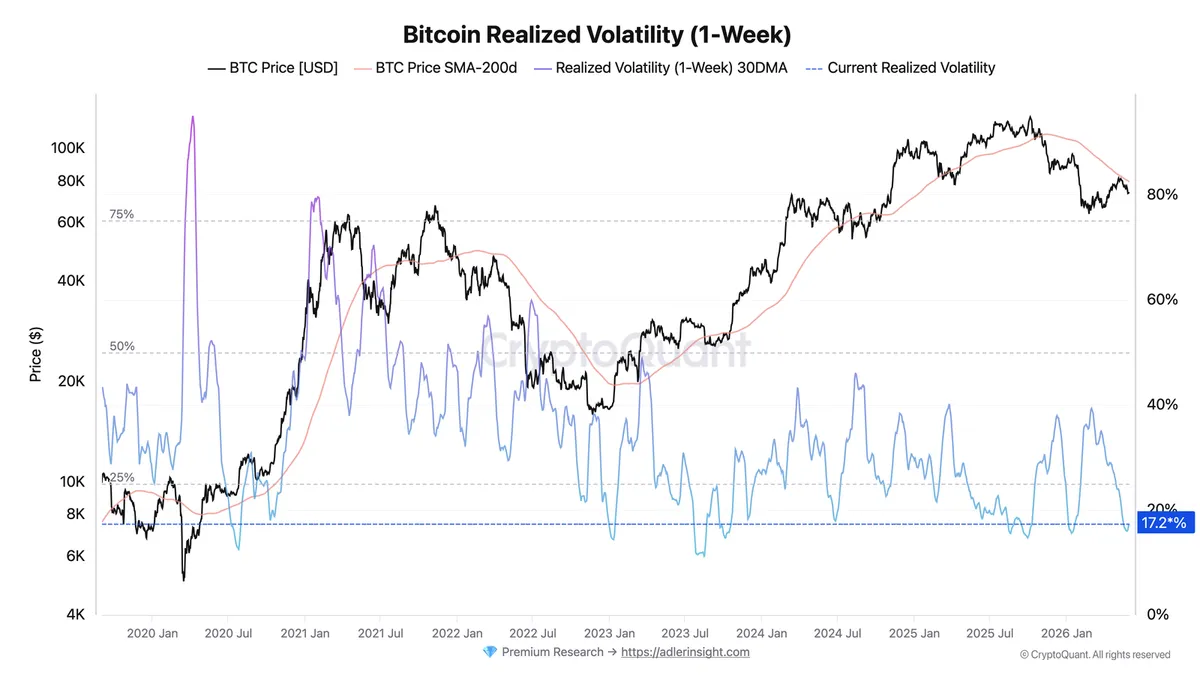
The compression is not confined to short windows. Three-month realized volatility has slipped to 80% from 109% since early April, while the six-month measure dropped to 127% from 148%. The simultaneous decline across multiple horizons indicates that price action has narrowed structurally rather than from a single anomaly. Periods where short, medium, and long-term volatility align lower have repeatedly preceded major repricings, including the early-2024 expansion. With Bitcoin stuck in a tight band, derivatives desks are positioning for an eventual release, monitoring funding rates and options skew for the first signs that one side of the order book begins committing meaningful capital toward a directional thesis.
Network valuation data adds further nuance. The Bitcoin growth rate metric, which compares market capitalization expansion to realized capitalization, has remained negative for more than six months. The 365-day moving average recently slipped to -0.0013, signaling that market value is rising more slowly than the capital embedded on-chain. Researchers interpret the divergence as a cooling phase, where coins continue flowing in at higher cost bases but price refuses to extend proportionally. The pattern suggests accumulation by long-horizon holders absorbing supply from shorter-term participants exiting near breakeven. Until the growth rate flips positive, rallies will likely face resistance from coins recently moved at higher entry points.
Bitcoin trades at $71,112 with a 3.77% daily decline, market capitalization at $1.42 trillion and 24-hour turnover near $24.7 billion. The sideways trend and compressed volatility profile align with the on-chain cooling signal, suggesting a coiled spring rather than directional conviction. A reclaim above $73,500 would invalidate the near-term bear-market micro-structure and re-engage momentum buyers; a daily close beneath $70,000 opens the $68,000 zone where significant cost-basis clusters sit. Neutral momentum readings reinforce the indecision read. Traders should monitor ETF flow data and Strategy's preferred dividend cycle, since either could trigger the breakout the volatility data has been telegraphing for weeks.
COINOTAG does not provide financial advisory services. This content is for informational purposes only and should not be considered investment advice. Cryptocurrency investments involve high risk.
Add COINOTAG as a Preferred Source
Add COINOTAG to your preferred sources in Google News and Search to see our coverage first.
Add on GoogleRelated Tags
AI-generated, AI-reviewed, under COINOTAG editorial oversight.
Comments
More From COINOTAG
Hawkish Fed Pins Bitcoin Near $64K as CLARITY Advances, $165B Selloff Looms
June 22, 2026 at 03:57 AM UTC
Japan Megabanks Plan Yen Stablecoin as CLARITY Act Advances, Bitcoin Near $64K
June 22, 2026 at 03:25 AM UTC
Bitcoin Holds $64K as 17,400 BTC Exit Exchanges, Franklin Templeton Files Dividend-to-BTC ETF
June 22, 2026 at 03:05 AM UTC