

Franklin Templeton Tokenizes BENJI on MoonPay, Galaxy Lands $10M Kalshi Trade, EDGE Plunges 70%
Crypto News
Franklin Templeton has formed a new institutional partnership with MoonPay that lets eligible investors swap stablecoins for the asset manager's tokenized money market fund directly on-chain. The integration connects Franklin Templeton's Benji Technology Platform with MoonPay Trade infrastructure, enabling around-the-clock movement between USDC, USDT, and yield-generating tokenized fund exposure without leaving public blockchain rails. Sandy Kaul, the firm's head of innovation and digital assets, described 2026 as "the year of the universal liquidity layer," referencing a vision where stablecoins, tokenized funds, and digital cash become fully interoperable across trading, lending, and collateral workflows. The $1.74 trillion asset manager said institutional demand for continuous yield mobility has been substantial.
The structural significance of the MoonPay tie-up lies in how BENJI holders gain composable on-chain optionality. Tokenized money market fund balances can now feed directly into treasury management, liquidity provision, collateral posting, and portfolio rebalancing flows without the off-ramp friction that has traditionally stalled institutional adoption. MoonPay Trade, launched in late May, offers a single API spanning more than 200 blockchains for cross-chain routing, settlement, and tokenized asset execution. The deal also marks one of the first major moves by Caroline Pham, MoonPay Institutional CEO and former acting Commodity Futures Trading Commission chair, whose regulatory pedigree reinforces the partnership's compliance backbone for global institutional clients.
Galaxy Digital has opened an institutional over-the-counter prediction-markets desk and inaugurated the platform with a $10 million bilateral trade alongside crypto-native hedge fund Arca, taking a position tied to the passage of the Clarity Act on Kalshi. The desk acts as principal counterparty for hedge funds and family offices seeking event-driven exposure in sizes retail venues cannot accommodate, covering non-sports contracts on Kalshi and Polymarket across economic, political, and geopolitical themes. Jason Urban, global co-head of digital assets at Galaxy, said sophisticated investors increasingly express macro views through event markets. The desk can also pair prediction positions with hedges in equities and commodities for unified risk strategies around a single catalyst.
Backpack, the exchange founded by former FTX employees, has launched Backpack Securities, a hybrid platform offering both U.S.-regulated brokerage access to traditional equities and the ability to convert those holdings into tokenized stock representations that move freely across blockchain networks. The brokerage side delivers genuine equity ownership with cash dividends, corporate actions, and ACATS/DTCC integration; the tokenization layer, built with Solana-based protocol Sunrise, allows positions to interact with self-custodial wallets and DeFi protocols and trade 24/7. CEO Armani Ferrante framed real equity ownership and blockchain-native access as complementary rather than competing models, with rollout beginning in June and additional chain integrations planned thereafter.

The native token of decentralized exchange edgeX plunged from roughly $1.20 to an intra-day low of $0.3663 on Tuesday, a peak-to-trough decline of about 70%, before partially recovering near $0.6474. The edgeX team attributed the move to "deliberate" manipulation by an unnamed external party and stressed the platform itself was not compromised. On-chain investigator ZachXBT pushed back, alleging EDGE supply is concentrated among a small group of insiders and demanding the project publicly disclose its counterparties and market-maker agreements. Only 350 million of the 1 billion maximum supply currently sits in circulating supply, leaving the token structurally exposed to thin-float volatility.
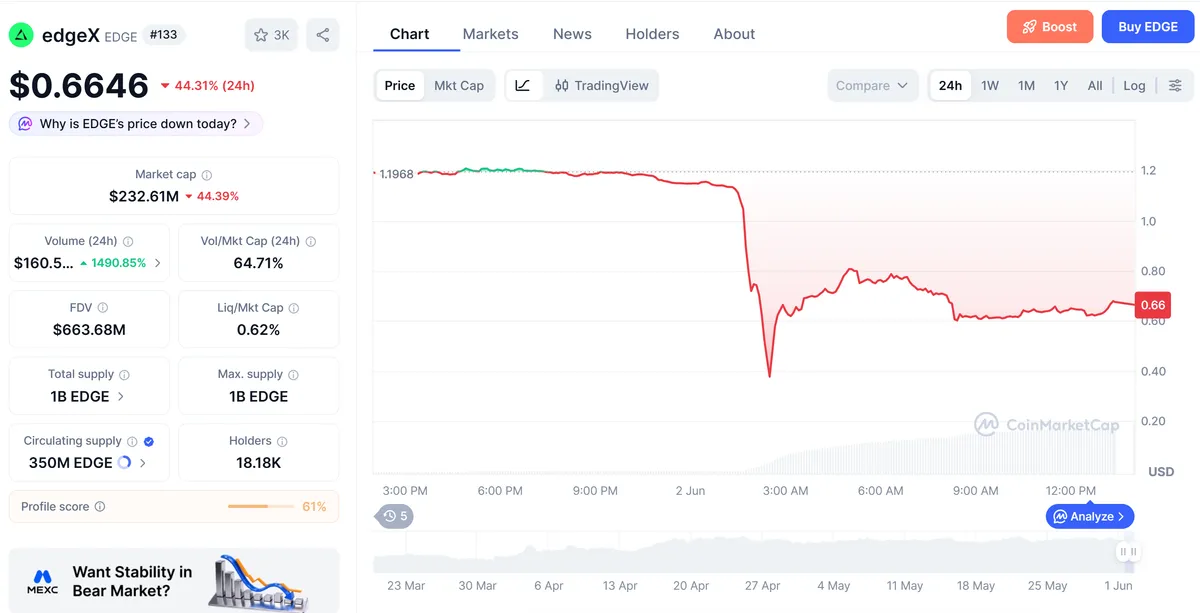
The broader context for the EDGE incident is a sharp pullback in DEX trading volume across all chains, which has retreated meaningfully from recent peak levels. Thinner liquidity makes low-float altcoin launches more vulnerable to violent repricings when even modest sell pressure hits concentrated order books. EdgeX itself remains the 16th-largest DEX by 24-hour trading volume with roughly $137 million in total value locked, but the episode underscores how token-launch design choices — vesting schedules, market-maker terms, and disclosure standards — sit at the center of the trust questions that institutional capital flowing through Galaxy, Backpack, and Franklin Templeton's regulated rails has so far been able to sidestep.
The dominant narrative threading today's coverage is institutional infrastructure formalization. Tokenized money market funds, on-chain prediction desks, and hybrid brokerage rails for tokenized equities each address the same problem: building regulated, capital-efficient pathways for traditional finance to interact with public blockchains without sacrificing compliance. The edgeX episode anchors the counterweight — when supply concentration, opaque market-maker arrangements, and thin floats persist on the decentralized side, even purpose-built venues remain exposed to integrity shocks. The 2026 storyline is increasingly bifurcated: institutional rails accelerate while disclosure and circulating-supply hygiene remain the unfinished work of the broader on-chain ecosystem.
COINOTAG does not provide financial advisory services. This content is for informational purposes only and should not be considered investment advice. Cryptocurrency investments involve high risk.
Add COINOTAG as a Preferred Source
Add COINOTAG to your preferred sources in Google News and Search to see our coverage first.
Add on GoogleAI-generated, AI-reviewed, under COINOTAG editorial oversight.