

PopDEX Closes $30M Round as Crypto VC Funding Falls 74%, Clarity Act Targets Yield
PopDEX closes $30M perp DEX round as crypto VC funding falls 74% MoM to $660M; Clarity Act Section 404 reshapes yield toward compliant infrastructure.

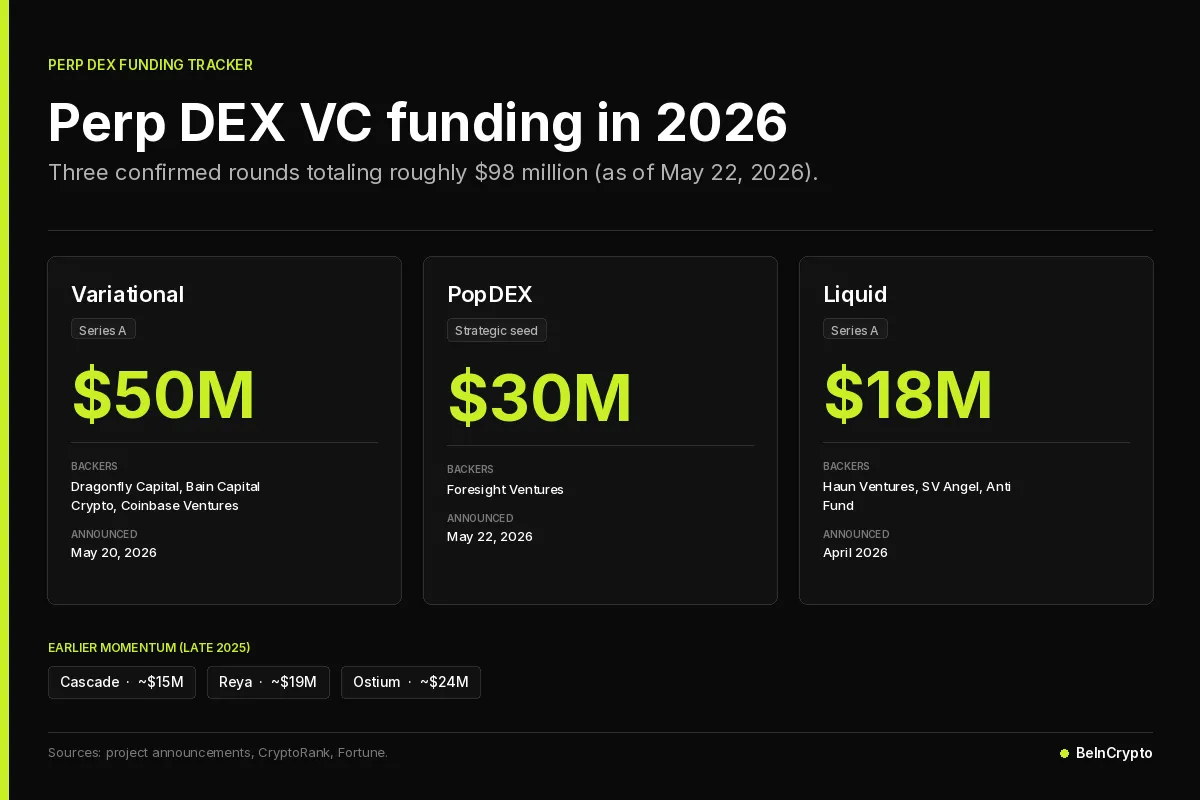
PopDEX has closed a $30 million strategic seed round, signaling continued investor appetite for perpetual decentralized exchanges even as broader crypto venture funding contracts sharply. The round, led by Foresight Ventures, will fund liquidity provisioning, security audits, and team expansion ahead of a wider product rollout. Still in invite-only testing, PopDEX pitches trader-aligned token economics that direct platform revenue to active traders rather than passive holders. The team has yet to disclose mainnet timing, full tokenomics, or audit outcomes. The raise stands out as one of the larger crypto deals of the quarter, drawing attention to capital efficiency and trader incentives in the perpetuals segment.
Venture capital flowing into crypto startups hit its weakest level in over a year, with April funding falling roughly 74% month over month to about $660 million across 62 deals. That figure marks the lowest monthly total since early 2025 and reflects a broader pullback in speculative tech investment. Deal count dropped nearly 49% year over year in the first quarter, even as average disclosed round sizes grew about 76%. Capital is increasingly concentrating in stablecoins, real-world assets, and on-chain derivatives — categories investors view as defensible amid macro tightening. The contraction marks a notable shift from the easy-money conditions that defined the previous altcoin cycle.
The Clarity Act, which has cleared the Senate Banking Committee, contains a provision that could fundamentally reshape how crypto users earn returns. Section 404 would prohibit Digital Asset Service Providers and their affiliates from offering yield solely as a function of holding a digital asset. Industry executives say the rule would effectively end passive hold-to-earn products in their current form, forcing platforms to redesign reward structures. The provision targets a category that has grown rapidly in stablecoins and tokenized treasuries, where users park capital and accrue interest. Compliance teams across major exchanges are already evaluating product roadmaps in anticipation of the framework taking effect.
Joe Vollono, chief commercial officer at stablecoin infrastructure firm STBL, argued the legislation would shift the industry from a hold-to-earn market to a use-to-earn market. Compliant yield strategies, he said, will be required to generate rewards on what would otherwise be idle capital. The thesis points to a new market for yield-as-a-service, where active deployment of assets across compliant DeFi venues replaces simple deposit-and-earn arrangements. AI-driven allocation engines and automated rebalancing tools are positioned to benefit. Vollono, who previously spent over seven years at Morgan Stanley and worked on market structure at SIFMA, said the framework's downstream effects extend well beyond yield products themselves.

The Clarity Act now moves to the full Senate, where it is expected to be merged with the Senate Agriculture Committee version before House reconciliation. An optimistic timeline points to a full vote as early as July, with regulators given roughly 12 months to implement the framework. Once enacted, the legislation would establish the first comprehensive U.S. regulatory framework for digital assets, resolving years of uncertainty over SEC and CFTC jurisdiction. Clearer rules for exchanges, brokers, stablecoin issuers, and decentralized finance platforms could reduce legal risk and improve consumer protections. The bill's progression marks one of the most consequential legislative moments for blockchain markets in a decade.
Industry observers argue regulatory clarity is the precondition for large-scale institutional participation in crypto markets. Banks, asset managers, and pension funds have largely sat out direct exposure beyond spot Bitcoin ETFs because of unresolved legal questions about token classification and custody. Vollono said resolution of these issues allows capital at scale to enter the market — framing the Clarity Act as the real catalyst rather than any single price level or product launch. Analysts highlight that the bill's passage could accelerate tokenization of traditional assets, including treasuries and money market funds, opening multi-trillion-dollar pools of capital to on-chain rails for the first time.
The dominant narrative this cycle is regulatory tightening converging with institutional rotation. Venture money has retreated from speculative bets toward defensible infrastructure — stablecoins, derivatives, and tokenized real-world assets — while Washington moves to codify the rules of the road. The PopDEX raise and the Clarity Act debate sit at opposite ends of the same arc: capital is becoming more selective, and the products that survive will be those built for a compliant, institution-ready market. Traders, builders, and allocators alike are now planning around a near-term horizon in which U.S. policy, not retail speculation, sets the tempo.

AI-generated, AI-reviewed, under COINOTAG editorial oversight.