

Saylor Eyes 2026 Bitcoin Sale as Strategy Slips Underwater, Iran Opens Hormuz Tolls
Michael Saylor says Strategy could sell Bitcoin in 2026 as the firm's 843,768 BTC stack slips underwater near $75,500 spot, with Iran opening Hormuz tolls.

Strategy chairman Michael Saylor has softened his long-held never-sell stance, telling a podcast interview published Friday that the company could offload a portion of its Bitcoin holdings before the end of 2026. Saylor described a potential sale as not unlikely while outlining plans to issue a mix of equity and credit instruments alongside active management of dollar and cash reserves. The remarks mark a notable shift from the firm's historically uncompromising accumulation rhetoric and arrived as MSTR shares closed at $159.89, down nearly 11% over the past 30 days. Saylor framed any divestment within a multivariate model targeting maximum Bitcoin-per-share by 2033.
The timing carries weight because Strategy now sits beneath its own cost basis. The firm has accumulated 843,768 BTC at an average acquisition price of roughly $75,700, while spot is changing hands near $75,489, leaving the position marginally underwater for the first time in this cycle. Saylor argued that signaling sale optionality protects the broader credit profile, noting that markets pricing in a permanent buy-and-hold posture could compress the premium attached to the company's roughly $65 billion Bitcoin treasury. The acknowledgment, raised first during a recent earnings call, reframes Strategy's posture from pure accumulator to active capital allocator across the cycle.

Friday also marked the 16th anniversary of Bitcoin Pizza Day, commemorating the May 2010 transaction in which developer Laszlo Hanyecz paid 10,000 BTC for two Papa John's pizzas worth roughly $41 at the time. At current prices the same stash exceeds $755 million, and at the October 2025 all-time high near $126,000 it briefly crossed the $1.2 billion threshold. The exchange remains the first documented commercial use of the network and a benchmark for how thinly the asset traded when only a few hundred transactions cleared the chain each day with virtually no merchant rails.
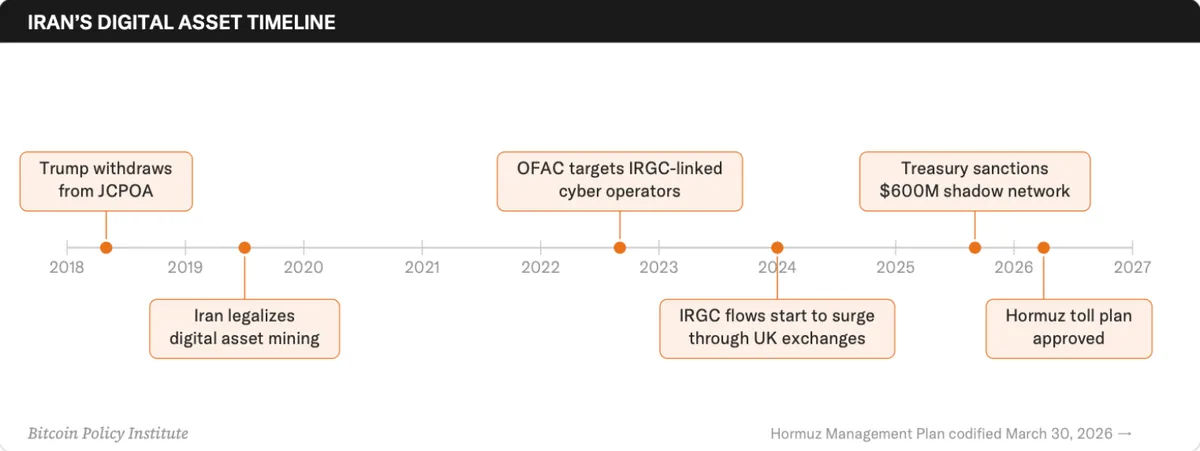
Sixteen years after that order, sovereign-level adoption has emerged as the dominant narrative shift. Iran announced in April that vessels transiting the Strait of Hormuz could settle shipping tolls in Bitcoin, dollar-pegged stablecoins, or Chinese yuan, although on-chain confirmation of actual settlements has yet to surface. The Strait carries roughly a fifth of global seaborne oil flows, making any monetary substitution at that chokepoint a structural signal rather than a curiosity. The move sits alongside parallel US debate over a strategic Bitcoin reserve and selective tax exemptions on Bitcoin payments now circulating through legislative channels.
The infrastructure gap between 2010 and today underscores why anniversary commentary matters. In Hanyecz's era no custodians, ETF wrappers, or institutional desks existed; trades cleared through forum threads and direct transfers. Today a deep liquidity stack including spot ETFs, regulated custodians, and treasury-grade software pipes the asset into pension allocators and listed corporates. Industry voices framed Pizza Day as the moment Bitcoin transitioned from cryptographic experiment into a functional economic network, validating its medium-of-exchange thesis even as price appreciation has since pushed most holders on every exchange toward a store-of-value framing.
Saylor's longer arc continues to anchor the corporate accumulation thesis even as he opens the door to tactical sales. He reiterated that Strategy is running multivariate models literally to determine the optimal mix of issuance and treasury activity for a 2033 horizon, with the explicit goal of maximizing Bitcoin per share. Any sale would represent a first for the firm, and community reaction remains untested given that every previous treasury announcement has been a purchase. The shift signals that even the most ideologically committed corporate holders now treat balance-sheet management as a dynamic exercise rather than a one-way accumulation ratchet.
Bitcoin is trading near $75,489, down 2.8% on the day with a market cap around $1.51 trillion and a session in a confirmed bear market structure. The RSI prints 40.94, weakening momentum without yet entering oversold territory, while a bearish MACD aligns with the prevailing downtrend. Immediate support clusters at $75,151, with deeper bids at $72,659 and $70,280; resistance stacks at $75,874, $78,569, and $80,635. A clean reclaim of $75,874 on rising volume would neutralize the bearish setup, while a breakdown below $72,659 would expose the $70,000 handle and invalidate any near-term recovery thesis.
Related Tags

AI-generated, AI-reviewed, under COINOTAG editorial oversight.