

Bitcoin Slips Below $68K as Sanders Targets 401(k) Rule, Strategy Sells 32 BTC
Sanders and Warren push DOL to scrap Bitcoin 401(k) rule; Strategy sells 32 BTC after 41 months, BTC drops below $68K as MSTR slides nearly 10%.
A bipartisan effort to block cryptocurrency from entering American retirement accounts intensified this week as Senators Bernie Sanders and Elizabeth Warren joined Representative Bobby Scott in a 14-page letter to Acting Labor Secretary Keith Sonderling. The lawmakers urged the Department of Labor to withdraw a proposed rule that would allow 401(k) plan fiduciaries to offer Bitcoin, private equity, and private credit to workers. The letter, sent Monday, argues the proposal violates statutory intent, congressional oversight, existing regulation, and decades of case law. Sanders and Warren framed the measure as a direct threat to the financial security of millions of Americans nearing retirement.
Strategy disclosed in a Form 8-K filing that it sold 32 BTC for roughly $2.5 million between May 26 and May 31, marking the first reduction of its position in 41 months. The proceeds were earmarked to cover preferred stock dividend obligations, a detail that immediately drew commentary across the broader crypto market. While the sale represents only about 0.0038% of the firm's 843,706 BTC holdings—worth approximately $63 billion at current prices—the symbolic weight of breaking a near four-year accumulation streak proved disproportionate to the dollar amount. The firm's average cost basis sits at $75,702, leaving the position with over $6 billion in unrealized losses.
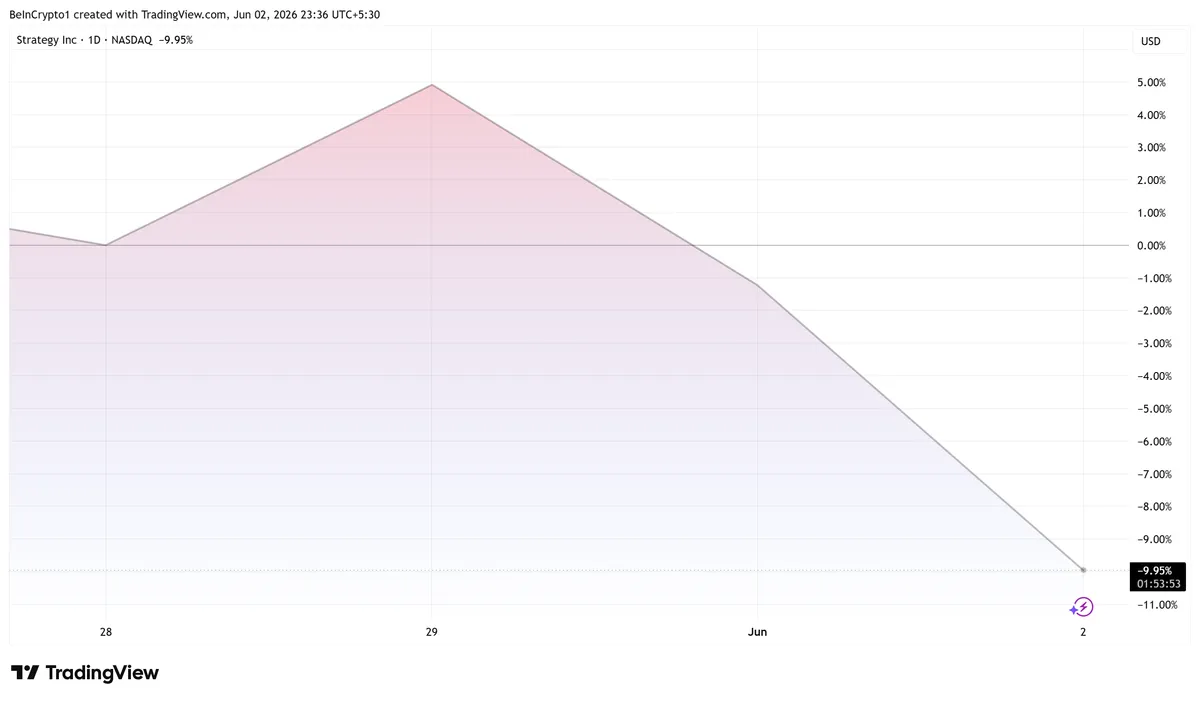
The market reaction to the disclosure was swift and severe. Shares of Strategy closed Tuesday down 9.95%, extending a decline that has erased nearly 70% of the company's market value over the past twelve months. The firm's capitalization has contracted from above $160 billion to roughly $48 billion, a compression that highlights how aggressively the equity market has repriced the premium investors paid for indirect Bitcoin exposure during the prior bull market. Analysts have pointed to the shrinking gap between MSTR's market cap and the notional value of its underlying coins as evidence that the structural appeal of the trade is fading among institutional allocators tracking the position.
The Democratic letter targets the core legal foundation of retirement protection in the United States. Under the Employee Retirement Income Security Act of 1974, fiduciaries managing 401(k) plans must satisfy a strict "prudence" standard, a requirement reinforced by Supreme Court precedent. The proposed rule would invert that framework by presuming prudence whenever fiduciaries follow a procedural checklist. With an estimated $14.2 trillion sitting inside American 401(k) accounts, lawmakers argue the policy would expose ordinary workers to extreme price swings and altcoin assets with limited regulatory oversight. The Financial Industry Regulatory Authority has separately warned that crypto investments carry significant risk of total loss.
The sale also undermines years of public messaging from founder Michael Saylor, who once instructed investors to "sell a kidney if you must, but keep the bitcoin." The decision to liquidate any portion of the holdings—however small—reversed a posture that had become a defining feature of the corporate Bitcoin treasury thesis. Critics quickly framed the move as a solvency-driven concession tied to Strategy's STRC preferred dividend obligations, while defenders argued the optics were poorly handled given the trivial dollar amount involved. The broader question raised by analysts is whether Bitcoin's price discovery has grown unhealthily dependent on the buying behavior of a single corporate treasury.
Bitcoin itself slumped roughly 8.58% during the session, breaking decisively below the $70,000 level and trading near $67,200 at the lows. The drawdown coincided with record outflows from spot Bitcoin ETF products, a flow pattern that has reinforced a defensive posture across derivatives markets. The sequencing—corporate treasury sale, equity reaction, ETF redemption pressure, spot weakness—has reignited a long-running debate over how concentrated Bitcoin's marginal demand has become at the institutional level. Traders are now watching closely for confirmation that long-term holders are absorbing the supply released through forced liquidations and treasury rebalancing rather than capitulating alongside leveraged positions.
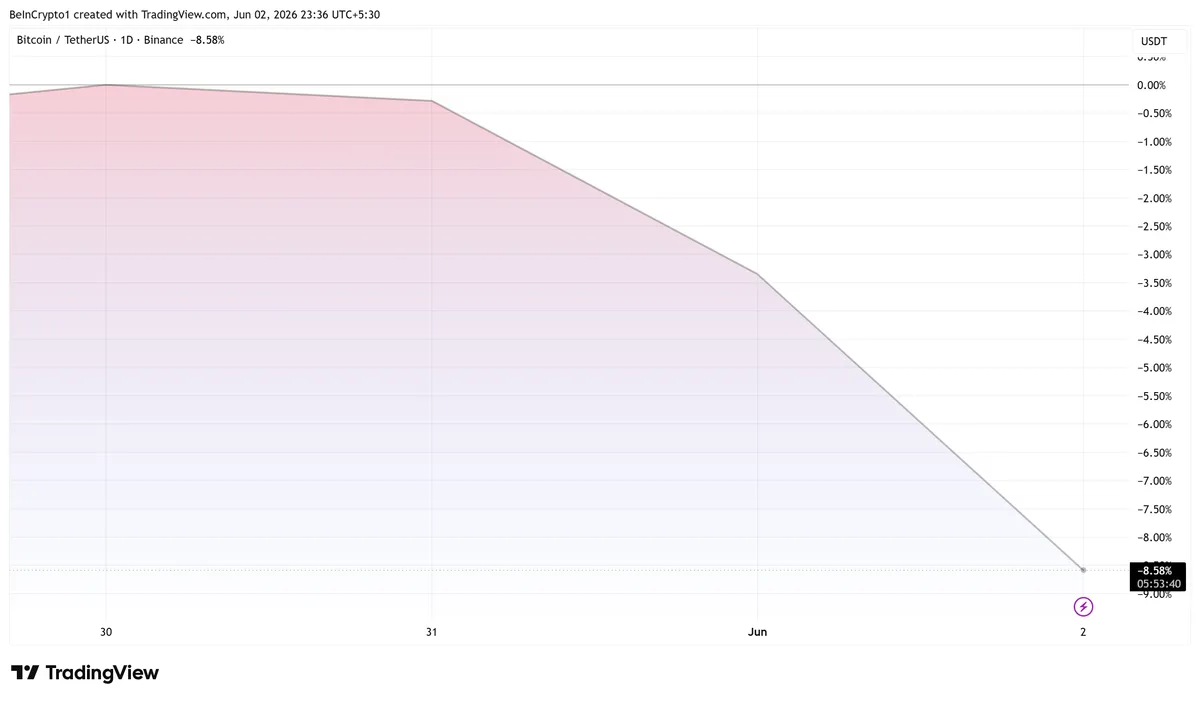
Spot BTC currently changes hands near $67,752, down 4.74% on the day, with $35 billion in volume rotating through the market. The MACD signal remains bearish and the daily RSI has collapsed to 23.08—territory that historically marks deep oversold conditions on the daily candlestick chart and can precede tactical relief rallies. Initial support sits at $66,863, followed by $65,507 and a structural floor at $62,510. On the upside, reclaiming $68,486 would shift short-term tone, with $70,280 and $72,673 as next resistances. A daily close below $65,500 would invalidate the oversold-bounce thesis and open the path toward the deeper $62,510 zone.
Related Tags
AI-generated, AI-reviewed, under COINOTAG editorial oversight.