

Bitcoin Hits Deepest Power Law Discount Since FTX as Strategy Sells 32 BTC, STRC Below Par
Bitcoin slipped to its deepest Power Law discount since the FTX collapse as Strategy sold 32 BTC and STRC slipped below par, throttling its buy engine.

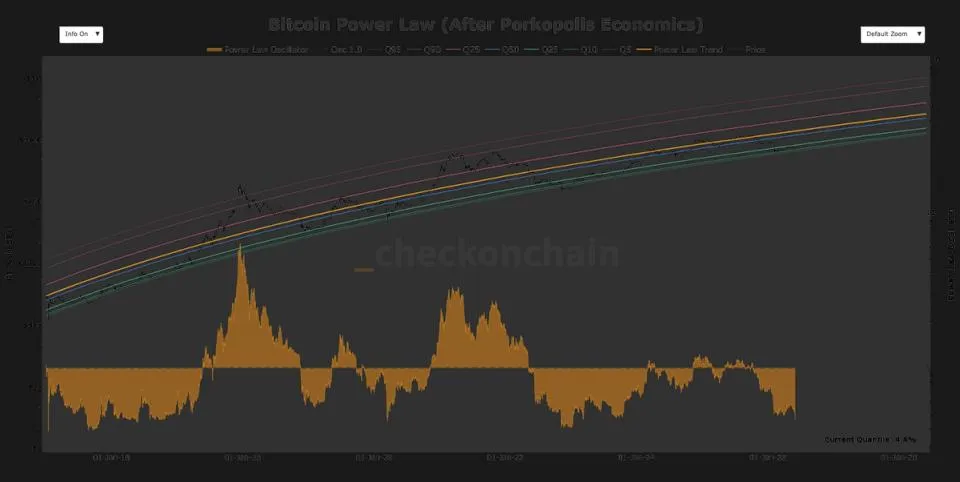
Bitcoin slipped below $66,000 on Wednesday, pushing the largest cryptocurrency into one of the deepest discount zones relative to its long-term Power Law trajectory in years. Popularized by physicist Giovanni Santostasi and refined by Porkopolis Economics, the model plots BTC against time on a logarithmic scale, arguing that growth decelerates as the network matures. On-chain data shows the Power Law Oscillator places Bitcoin cheaper than 95.6% of its trading history. Comparable lows preceded the March 2020 pandemic crash and the November 2022 FTX implosion, each followed by sharp rebounds — though analysts caution the model offers no guarantee the floor will hold this cycle.
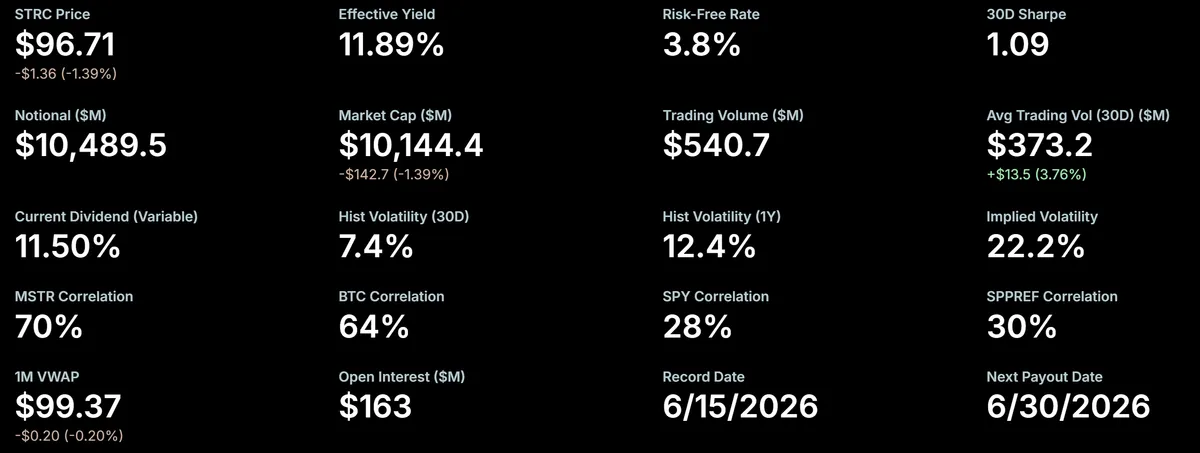
Strategy, the corporate Bitcoin treasury vehicle led by Michael Saylor, sold 32 BTC between May 26 and May 31 to help fund dividends on its preferred stock — its first such disposal since 2022. The amount is negligible against the firm's 843,706 BTC stack, yet the optics rattled markets after STRC, the Variable Rate Series A Perpetual Stretch Preferred Stock that pays 11.50% annually, slipped below its $100 par value. STRC has been the dominant funding engine for Strategy's accumulation this year, eclipsing spot ETF inflows. With the stock trading under par, the company cannot issue fresh shares at value, throttling its primary route to additional Bitcoin.
The strain on Strategy's capital turbine raised pointed questions about whether the playbook can absorb a prolonged drawdown without tipping into a bear market dynamic for the company itself. Executives have framed Bitcoin sales as a last-resort lever, reserved for moments when preferred-stock issuance and common-equity raises cannot meet roughly $1.7 billion in annual dividend and interest commitments. The firm offset some pressure by selling 801,994 MSTR shares the same week, raising $128 million in net proceeds, and continues to hold a $900 million cash reserve earmarked for distributions. Still, the mix of small liquidations and depressed common stock signals the once-frictionless flywheel is grinding rather than spinning.
Beyond corporate treasuries, broader holder data offers cautious optimism. Long-term wallets — coins untouched for at least 155 days — have continued to absorb supply as short-term speculators capitulate, a divergence frequently observed near cycle lows that historically precede a renewed bull market. Realized losses among recent buyers have spiked, indicating that weak hands are exiting while conviction holders accumulate. Exchange reserves remain near multi-year lows, suggesting limited sell-side ammunition once panic fades. Combined with the Power Law discount, these signals echo conditions that preceded prior recoveries, though the absence of a clear catalyst means a re-test of lower support cannot be ruled out before momentum shifts.
Derivatives markets reflect the bearish mood without yet signaling exhaustion. Open interest has compressed alongside spot price, and perpetual funding rates have flipped neutral-to-negative across major venues, with traders paying premiums to maintain short exposure. Implied volatility on at-the-money options has climbed, while skew shows demand for downside protection extending toward the $60,000 strike. Liquidation maps highlight clustered leverage between $64,500 and $66,000, a band that has already been tested intraday. A reclaim above $68,000 would force cascading short covers, whereas a clean break of $64,750 would expose the next material liquidity pocket near $62,500 — coinciding with the model's lower Power Law boundary.
Spot ETF activity has cooled markedly as the drawdown deepens. Net outflows resumed across the eleven US-listed Bitcoin products, with allocators trimming exposure into month-end balance-sheet reviews. The sell pressure coincides with renewed dollar strength and a hawkish repricing of Federal Reserve rate-cut expectations, both unfavorable backdrops for risk assets. Analysts highlight that historical Power Law touches have typically required either a liquidity shock or a policy pivot to ignite recovery. Until macro conditions soften or institutional bids return through regulated wrappers, Bitcoin may continue oscillating within its compressed range, building the basing structure that long-term holders argue is now under construction.
Spot trades near $66,917 after a 3.4% daily slide, with the tape pinned to the $66,792 immediate support shelf. Loss of that level opens probes toward $64,746 and the deeper $62,510 zone, while reclaiming $68,080 is required to neutralize the near-term sell pressure. RSI at 24.62 sits firmly in oversold territory, statistically consistent with relief bounces but offering no guarantee given the confirmed bearish MACD posture and downtrend. Bulls need a daily candlestick close above $70,225 to invalidate the structure; failure to defend $64,746 on rising volume would extend the breakdown and likely accelerate forced deleveraging across leveraged longs.
Related Tags

AI-generated, AI-reviewed, under COINOTAG editorial oversight.