

CLARITY Act Returns to Senate Amid Dimon Pushback as DuckDuckGo Debuts No-AI Search
US Senate revives CLARITY Act debate amid JPMorgan pushback while DuckDuckGo launches No-AI Search extensions after Google AI overhaul backlash.

DuckDuckGo on June 1 rolled out dedicated No-AI Search extensions for Chrome and Firefox, letting users pin its AI-stripped subdomain noai.duckduckgo.com as their default with a single click. Traffic to that subdomain has tripled since Google unveiled its sweeping AI search overhaul at the I/O developer conference in May, and visits remain roughly 84% above baseline. The privacy-focused search firm also confirmed that US app installations hit record numbers over the same window. The launch underscores a quiet but measurable consumer backlash against AI-generated answers replacing the traditional list of blue links most users have relied on for years.
Google described its updated Search experience as the biggest upgrade to its query box in more than 25 years, replacing classic ranked links with generative summaries, expanded text fields, and conversational agents capable of answering questions mid-typed. The redesign has drawn vocal criticism from privacy advocates and rival platforms, with DuckDuckGo founder Gabriel Weinberg accusing the company of force-feeding AI with no way to opt out and arguing that result quality has regressed rather than improved. The episode signals an emerging market for opt-out tooling, even as larger players continue to pour billions into embedding generative models directly inside core consumer products.

On Capitol Hill, the US Senate is set to resume debate this week on the Digital Asset Clarity Act, the long-anticipated market structure bill that cleared the House in July 2025 and advanced through two key Senate committees before the Memorial Day recess. The legislation would significantly expand the Commodity Futures Trading Commission's authority over digital assets and define the regulatory perimeter between commodities and securities for tokens built on blockchain networks. Industry executives have called the package the most consequential financial reform since Dodd-Frank, with Coinbase chief policy officer Faryar Shirzad framing the bill as a generational rewrite of US capital markets oversight.
JPMorgan Chase chief executive Jamie Dimon used a Friday appearance to publicly oppose the bill in its current form, telling lawmakers the banking sector will not accept provisions that allow crypto firms to pay interest on customer deposits and on stablecoin balances. Dimon's intervention adds a powerful voice to a coalition of traditional financial institutions worried that yield-bearing instruments routed through DeFi protocols and centralized exchanges could siphon deposits out of regulated banks. The pushback widens the gap between the House-passed version and what Senate banking lawmakers will support, raising the odds of last-minute amendments around interest payments, custody rules, and disclosure standards for tokenized equities.
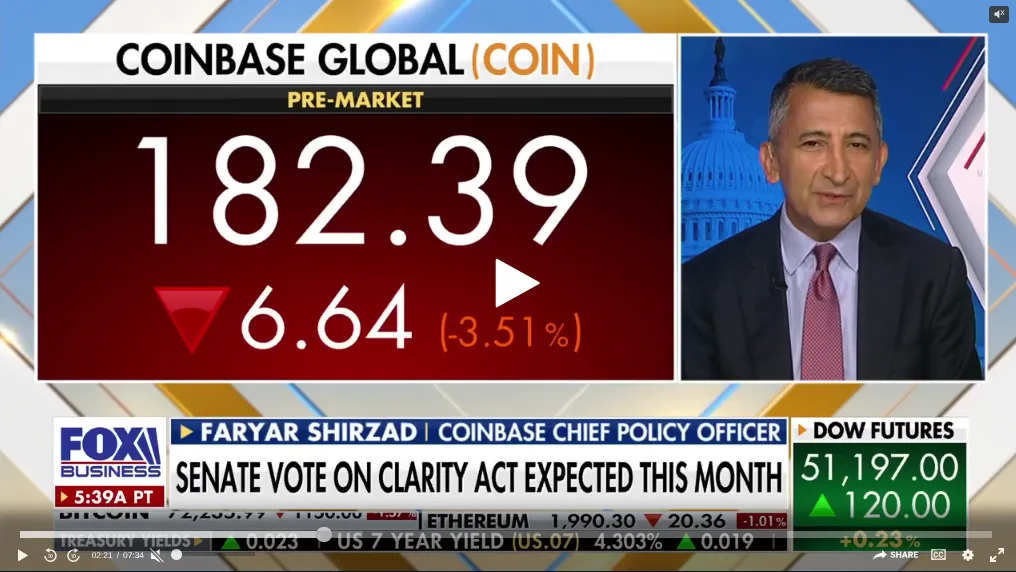
A parallel dispute centers on ethics. Senator Kirsten Gillibrand warned in May that there will be no one voting for this bill if it lacks an ethics provision, signaling that Democrats are prepared to block passage unless the chamber adopts conflict-of-interest language. Republican members of the banking committee opted to defer amendments on the issue, arguing it belongs on the full Senate floor. Senator Elizabeth Warren has also flagged President Donald Trump's personal crypto ventures as a backdrop to the debate. With Republicans needing 60 votes to advance the package, securing Democratic support without diluting the bill's core market structure provisions remains the central challenge.
Adding to the calendar pressure, the public comment window on the GENIUS Act, the federal stablecoin framework already signed into law, is also set to close this week. White House crypto adviser Patrick Witt told industry stakeholders in May that the administration is targeting US Independence Day as an informal deadline for the CLARITY vote, though officials concede the schedule depends on the ethics impasse. Some Senate observers now expect a consolidated package may reach the floor as soon as August, covering both Bitcoin-related custody rules and broader altcoin classification frameworks.
The week's headlines trace a single arc: rapid technological change is colliding with slower institutional governance. Consumers are revolting against AI-saturated search even as Washington races to codify a market structure framework for digital assets that could redefine how blockchain firms, banks, and regulators interact. Stablecoin issuers, centralized venues, and operators of every major DEX are watching the Senate negotiations for signals on what activities the United States will sanction, restrict, or leave to the states. Whether the CLARITY Act passes intact, gets amended down, or stalls again, the next sixty days will shape crypto policy through 2027.

AI-generated, AI-reviewed, under COINOTAG editorial oversight.