

Coinbase Opens Deribit Options to US Institutions as Dimon Slams Clarity Act and AI Models Split on Facts
Coinbase opens Deribit options to US institutions, Jamie Dimon attacks the Clarity Act, Dell powers an AI rally, and a study shows AI models disagree on 67%…

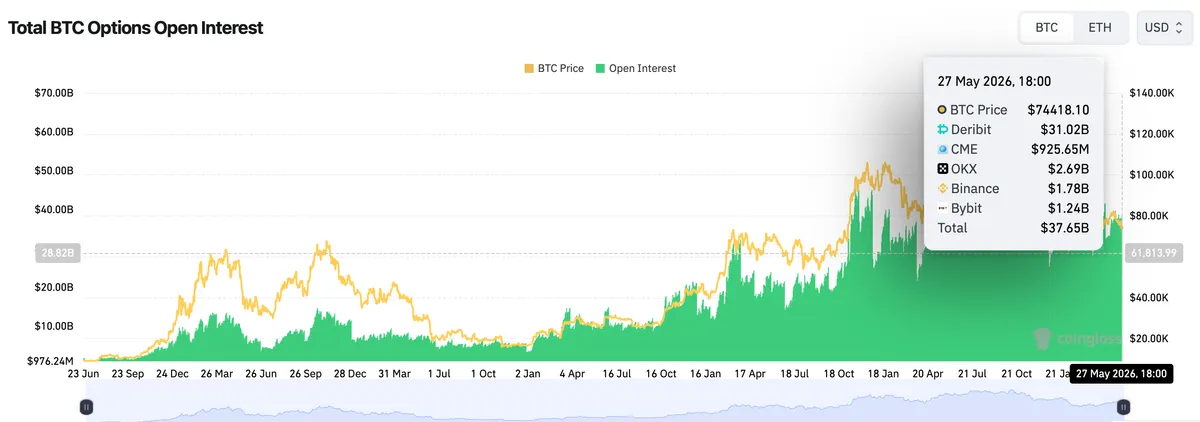
Coinbase Financial Markets has opened the door for US institutional clients to access global crypto options and perpetual futures through a CFTC-regulated futures commission merchant, including direct connectivity to Deribit's options venue. The launch follows recent CFTC guidance permitting a regulated FCM to route US flow into international derivatives liquidity, and Coinbase is the first to qualify. Deribit, acquired in August 2025, dominates the segment with roughly $31 billion in Bitcoin options open interest as of May 27, dwarfing OKX, Binance and Bybit. Institutional onboarding has begun, with broader retail access slated for a later phase.
JPMorgan Chase chief executive Jamie Dimon used a Friday television appearance to attack the pending Clarity Act and personally criticize Coinbase chief Brian Armstrong. Dimon argued the digital-asset market structure bill, as drafted, allows crypto firms to effectively pay interest on stablecoin deposits without bank-equivalent safeguards, and fails to properly address Anti-Money Laundering and Bank Secrecy Act obligations. He confirmed that JPMorgan and peer banks intend to oppose the legislation in its current form. Dimon also accused Armstrong of spending hundreds of millions of dollars in Washington to push the bill through, calling the executive's lobbying effort unacceptable to the banking sector.
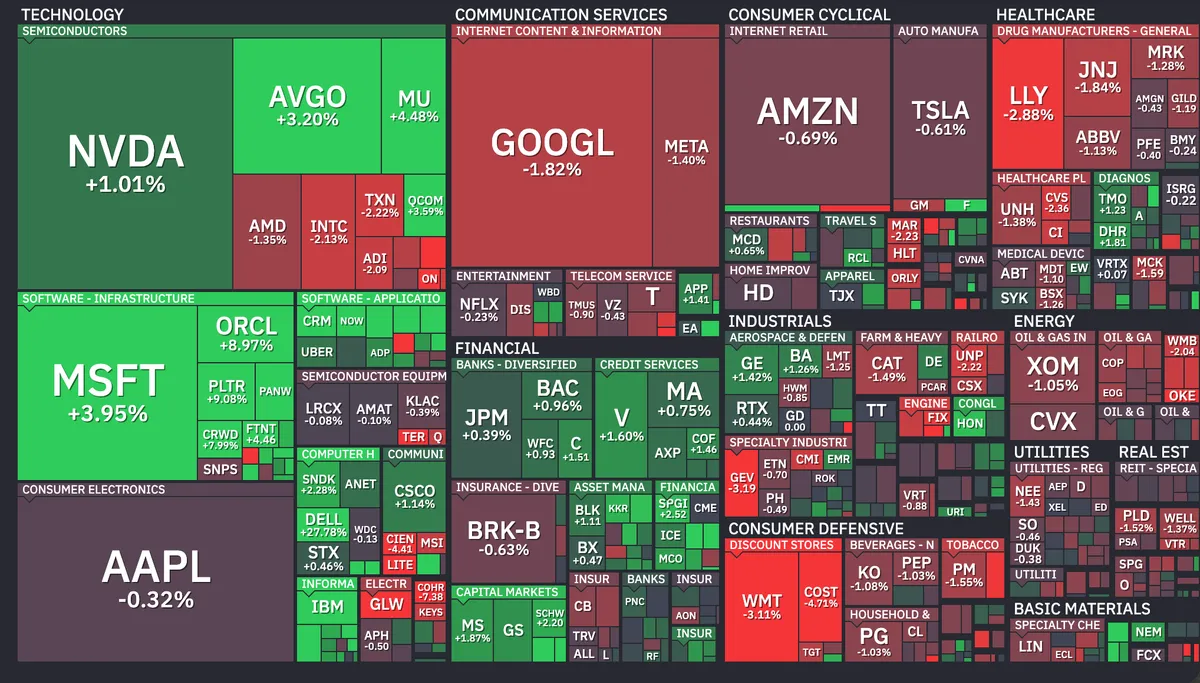
US equities pushed higher into Friday's close as a record quarter from Dell reignited the AI infrastructure trade and softening oil prices boosted risk appetite. The S&P 500 added 0.37% to clear 7,591, while the Dow advanced 0.76% and the Nasdaq gained 0.39%. Dell shares surged 28.54% after the company booked $24.4 billion in AI orders and recognized $16.1 billion in AI server revenue during its first fiscal quarter, with revenue up 88% year over year. Hewlett Packard Enterprise climbed 14.04% and Super Micro added 10.11%, while Oracle, Microsoft and Micron all participated in the rotation, signaling the AI capital-expenditure cycle is broadening beyond core chipmakers.
Crude oil retreated further as President Donald Trump publicly outlined proposed terms for a US-Iran agreement, including a permanent halt to Iranian weapons-grade enrichment, the immediate reopening of the Strait of Hormuz to unrestricted shipping, and the clearance of water mines from the waterway. The diplomatic framing eased the geopolitical risk premium that had been embedded in energy markets, freeing capital to rotate into equities and high-beta assets. The combination of falling energy costs and a credible diplomatic track produced a notable easing in volatility expectations, with traders increasingly positioning for a softer second-half macro backdrop and a constructive setup for altcoin liquidity conditions.
A new academic study has found that frontier AI models disagree on basic factual judgments roughly two-thirds of the time. Researcher Kosta Jordanov at Lenz Research fed 1,000 real-world fact-check claims, submitted by actual users rather than benchmark sets, to GPT-5.4, Claude Opus 4.7, Gemini 3 Pro, Gemini 3 Pro with Search and Sonar Pro, asking each to assign one of four verdicts. On 672 of the claims at least one model broke from the majority, and in 34% of cases one model labeled a claim true while another labeled it false. The panel's Krippendorff alpha of 0.639 falls well below the 0.8 reliability threshold typically required for interchangeable judges.
The broader US derivatives complex continues to migrate onshore, intensifying competition for the offshore venues that have historically dominated crypto perpetuals. CME Group recently unveiled plans for a crypto index futures contract tracking a basket of seven assets, including Bitcoin, Ether, Solana and XRP, and is scheduled to launch Bitcoin Volatility futures on June 1, settling against a 30-day measure of expected BTC volatility derived from CME options. Kraken parent Payward also closed its acquisition of CFTC-regulated venue Bitnomial during May. Together these moves point to a structural rebuild of US crypto derivatives infrastructure under formal blockchain oversight regimes.
Taken together, Friday's storylines describe a market caught between accelerating institutional integration and unresolved political conflict. Coinbase's regulated bridge to Deribit, CME's expanding derivatives suite and Payward's Bitnomial deal show how rapidly US infrastructure is absorbing the offshore DeFi-adjacent perpetuals business, while Dimon's broadside makes clear that legacy banks intend to contest the terms of that integration in Congress. Macro tailwinds from a softer oil tape and an AI capex super-cycle support risk appetite, yet the Lenz study underscores how thin the epistemic ground is becoming as automated information systems struggle to converge on shared facts driving bull market narratives.

AI-generated, AI-reviewed, under COINOTAG editorial oversight.