

Crypto Funds Bleed $1.67B as Binance Adds US Stocks, ECB Warns on Stablecoins
Crypto funds bled $1.67B in a third weekly outflow streak as Binance rolled out 7,000 US equities and the ECB pressed the case for a digital euro.

Crypto exchange-traded products extended their losing streak to a third consecutive week, recording $1.67 billion in net outflows over the past seven days and bringing cumulative redemptions to $4.21 billion across the period. Total assets under management contracted to roughly $141 billion, the lowest reading since early April. The withdrawal pace marks the second-largest weekly outflow of 2026, with analysts attributing the persistent risk-off tone to escalating Iran-related geopolitical tension that has overwhelmed any cushioning effect from US legislative progress on the CLARITY Act framework. The current pattern mirrors the January-February episode that produced five straight negative weeks of redemptions.
Bitcoin investment vehicles bore the brunt of the retreat, shedding $1.44 billion in a single week — the largest weekly outflow recorded for the asset class so far in 2026. The figure surpassed the previous week's record and compressed year-to-date Bitcoin fund inflows sharply to roughly $1.2 billion, down from $2.6 billion only seven days earlier. Bitcoin product assets under management fell to $114.6 billion. The selling appears concentrated in US-listed spot ETFs, which posted $1.42 billion in redemptions over the same window — the third-largest weekly outflow on record for the segment, indicating domestic institutions drove the divestment.
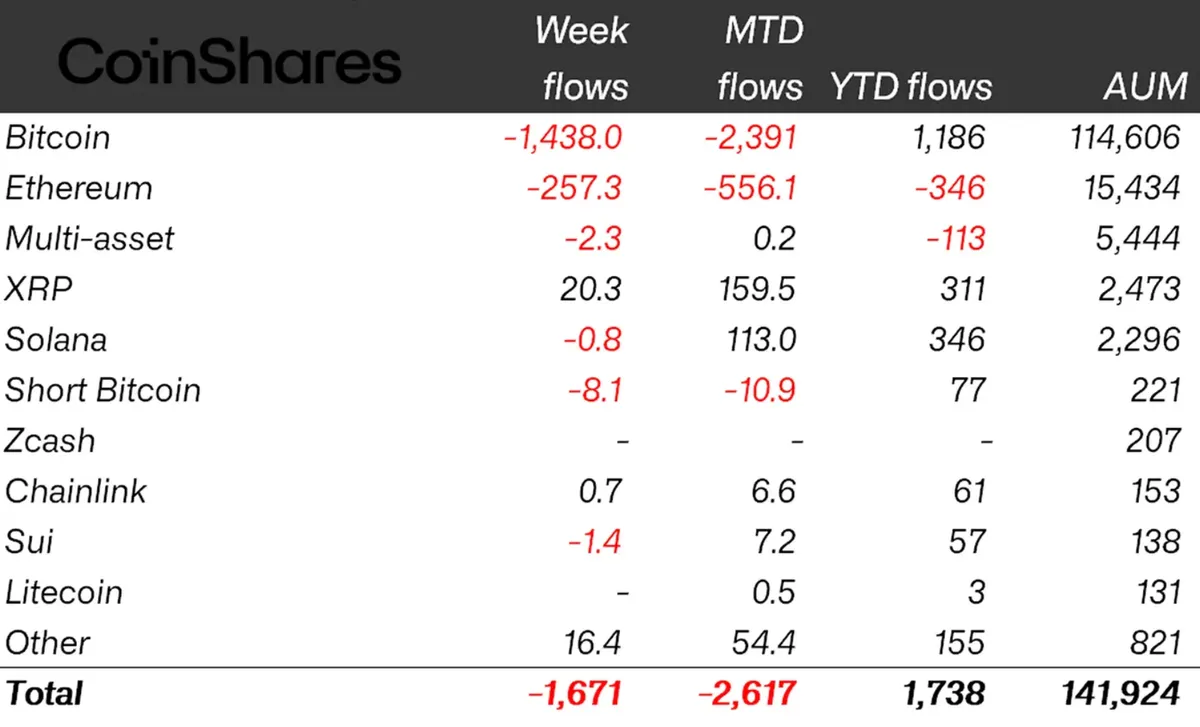
Ethereum-focused funds extended their own losing streak, recording $257 million in net outflows and pushing year-to-date redemptions to $346 million. US spot Ether ETFs alone accounted for $241 million of that figure over a third straight week of withdrawals. Altcoin participation collapsed, with only five assets attracting meaningful inflows above $1 million — down from nine in the prior reporting period. XRP led the modest bright spots with $20.3 million in net subscriptions, followed by Hyperliquid funds at $10.8 million and Near products at $7.6 million. The narrowing breadth signals investors are reducing aggregate exposure rather than rotating between digital assets.
The geographic distribution of selling reveals an overwhelmingly American-led repositioning, with US-domiciled funds responsible for $1.63 billion of the global outflow figure. Germany joined the broader risk-off shift with $25.7 million in redemptions, breaking a recent pattern of resilience. Sweden contributed $6.6 million in outflows and Hong Kong added $4.5 million, while the Netherlands stood as the only meaningful inflow destination at just $1.3 million — a sharp deceleration from the $6.6 million recorded the prior week. The concentration of pressure in US accounts underscores how domestic institutional sentiment continues to dictate the pace of the global crypto fund retreat.
Binance launched commission-free trading of more than 7,000 US-listed equities and ETFs for eligible users, with fractional shares available from five dollars and select securities accessible on a 24/5 schedule. The offering is enabled through the exchange's Abu Dhabi Global Market-based broker-dealer subsidiary, Nest Trading Limited. The platform also confirmed plans to roll out tokenized stocks — branded bStocks — in the coming weeks, pending regulatory approval from Ontario's Financial Services Regulatory Authority. Purchases of tokenized equities will settle primarily in USDC on-chain, with optional support for BNB, USDT, USD1, and United Stables, signaling an aggressive push toward a multi-asset financial super app spanning blockchain rails and traditional securities.

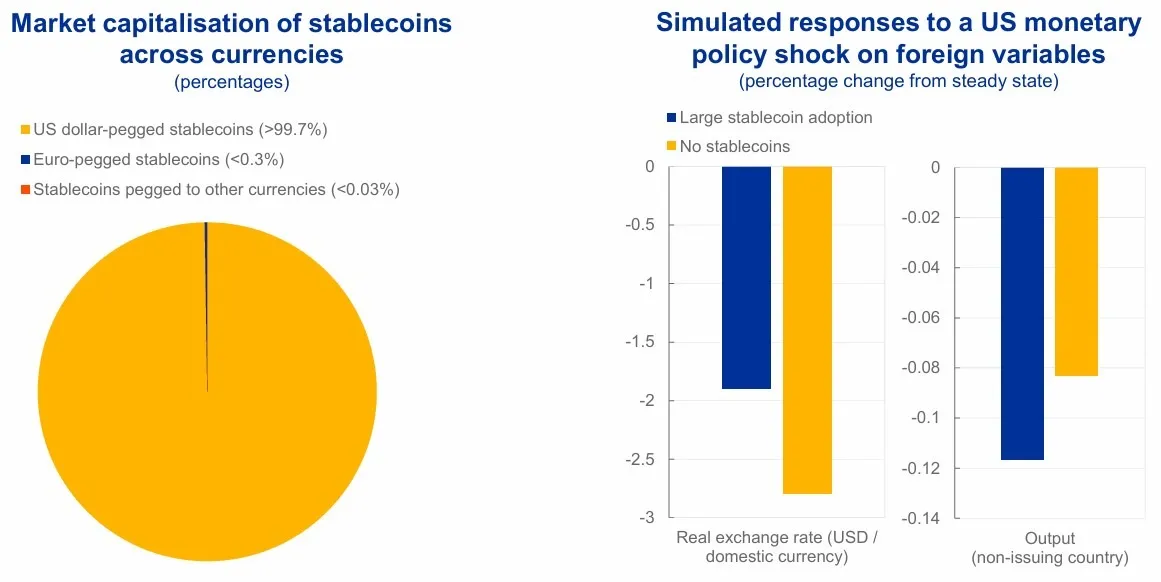
European Central Bank Executive Board member Isabel Schnabel argued that the rapid expansion of dollar-pegged stablecoins reinforces the structural case for a digital euro and tokenized wholesale settlement infrastructure. Speaking in Seoul, she compared stablecoins to money market funds, warning of run dynamics, fire-sale risks, bank disintermediation, and weakened monetary policy transmission. Schnabel cautioned that the near-total dollar denomination of stablecoin supply could further entrench US monetary hegemony if left unchallenged. The Eurosystem's response combines a retail digital euro with the upcoming Pontes settlement bridge, which connects distributed ledger venues used in DeFi to TARGET services, scheduled to launch in the third quarter of 2026.
The week's developments crystallize a bifurcated narrative now defining the cycle. Institutional capital is retreating from passive crypto exposure on geopolitical and macroeconomic headwinds, with billions exiting regulated wrappers in the United States. Simultaneously, the underlying market structure is being rebuilt through tokenization — Binance courting traditional equities on-chain, the ECB advancing public money modernization, and stablecoins entering deeper regulatory scrutiny. Short-term flows favor defensive positioning, but the longer arc points to convergence between traditional finance and on-chain settlement. The pace of regulatory clarity, rather than spot price action alone, will likely determine which institutions accelerate participation versus those tactically reducing exposure.

AI-generated, AI-reviewed, under COINOTAG editorial oversight.