

Crypto Market Sheds 7% as Total Cap Hits $2.3T, CFTC Opens US Perp Door, Microsoft Launches Scout Agent
Crypto market cap falls to $2.3T as CFTC clears US perpetual futures, Alphabet raises $80B for AI, Microsoft launches Scout agent, Movement pivots to payments.

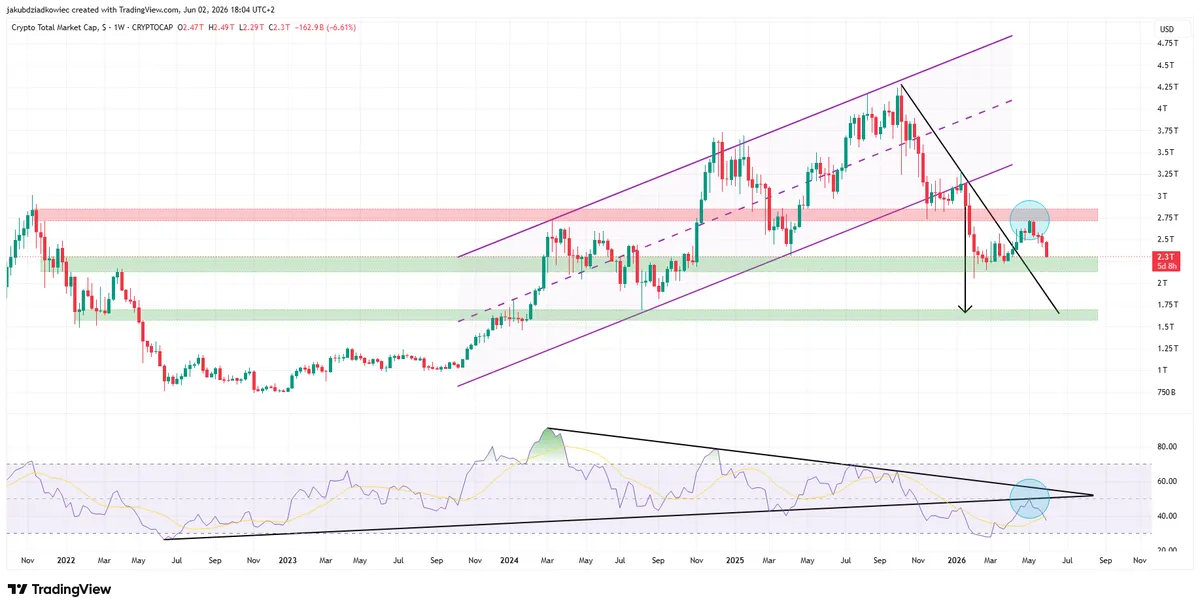
The total crypto market capitalization slid to roughly $2.32 trillion on Tuesday, erasing close to 17% of value in under three weeks and sending sentiment firmly into fear territory. Bitcoin changed hands near $67,400, down about 4.5% on the day, while Ethereum, BNB, Solana and XRP all printed deep red candles. Weekly charts confirm a rejection at the $2.7 trillion resistance and a clean break below the ascending channel that defined the 2024-2025 advance, with the measured move pointing toward $1.7 trillion. The Relative Strength Index has returned to oversold on the daily, suggesting a short-term bounce is possible before any broader recovery attempts form.
The Commodity Futures Trading Commission formally opened the door for crypto perpetual futures in the United States, a structurally meaningful shift for a product that has operated almost entirely offshore. Perps carry no expiry, eliminating rollover risk, and use funding payments between longs and shorts to keep prices tethered to spot. Total futures volume across major venues hit a 12-month low in May at roughly $2.9 trillion, a level last seen in late 2023, with Binance still dominating activity ahead of OKX, Bybit and Gate. Domestic perp venues now have a regulated path to compete on liquidity and margin against established offshore exchanges.
Bitwise Chief Investment Officer Matt Hougan described crypto as a "contrarian bet" in a Tuesday memo, arguing the asset class has been forced into a painful metamorphosis as AI equities, robotics names and SpaceX absorb risk capital. With the Nasdaq-100 up 43% year-over-year, Hougan said the playbook has shifted from momentum trade to fundamentals-driven positioning. Unlike past cycles, capital is not rotating into Bitcoin as a safe haven but into smaller assets with idiosyncratic stories — Hyperliquid up 72% in a month, Zcash 50%, Stellar 44% and BNB 17%. Regulatory uncertainty around the Clarity Act, which Polymarket prices at 55% odds of passing, continues to cap large-cap rallies.
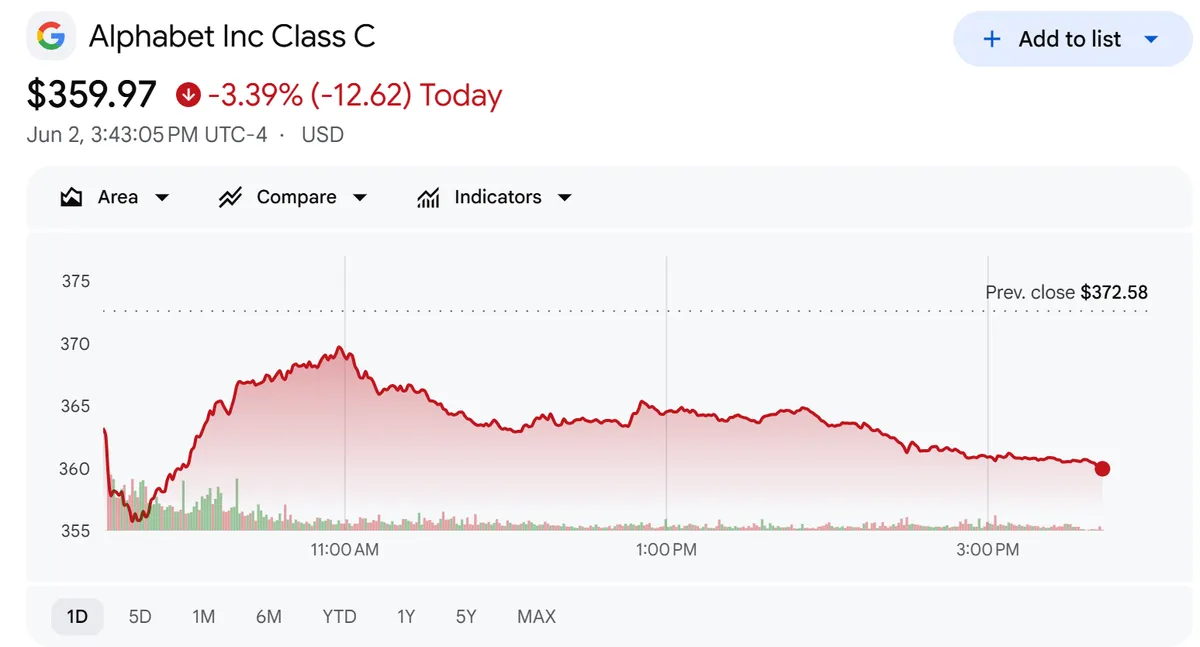
Alphabet shares opened down roughly 3.5% on Tuesday after the parent of Google unveiled an $80 billion equity raise to fund artificial intelligence infrastructure, reversing a buyback program that had retired about 13% of shares outstanding since 2019. The package combines a $30 billion concurrent public offering with a $40 billion at-the-market program beginning in the third quarter, alongside a $10 billion private placement that includes $10 billion of Class A and Class C stock purchased by Berkshire Hathaway. Alphabet now guides 2026 capital expenditures of $180 billion to $190 billion, roughly double 2025 levels, with another step-up flagged for 2027 to support data centers, custom silicon and Gemini compute.
Microsoft used its Build 2026 keynote to introduce Scout, the company's first "Autopilot" agent, built on the OpenClaw open-source framework that has accumulated 180,000 GitHub stars since its January launch. Scout connects to Teams, Outlook, OneDrive and SharePoint and runs persistently in the background, handling cross-time-zone scheduling, flagging stalled decisions and reserving focus blocks ahead of deadlines without explicit prompts. Microsoft is wrapping the agent in enterprise security controls and contributing policy primitives back to OpenClaw. The distribution advantage is the story: Scout ships into the 1.4 billion-strong Windows installed base, dwarfing the developer audience already running OpenClaw via terminal.
Movement, the Move-language network, said it has secured access to licensed payment rails in the United States, Canada and the European Union, pivoting hard toward stablecoin settlement, remittances and cross-border treasury services. The team did not name its regulated partners but framed the buildout as bridging traditional banking with on-chain settlement, with emerging markets as a priority where remittance costs remain elevated. The Movement Network Foundation also disclosed a token buyback covering roughly 19% of investor-allocated supply, equivalent to about 4.2% of total supply, after the MOVE market cap collapsed from a $2.5 billion peak to near $54 million. The pivot echoes similar stablecoin pushes from Solana, Polygon and Aptos following passage of the US GENIUS Act.
The day's headlines stitch into a single arc: capital is migrating out of altcoin speculation and into AI infrastructure at scale, leaving digital assets to grind through a fundamentals-led reset rather than a liquidity-fueled rally. Alphabet's $80 billion raise and Microsoft's Scout launch reaffirm where institutional dollars are flowing, while the crypto market's $2.3 trillion test and 12-month low in derivatives volume measure the cost of that rotation. Yet the CFTC's perpetuals opening, Movement's payments pivot and the broader stablecoin infrastructure buildout point to a quieter structural story — regulated rails are being laid even as the speculative bull market cools, setting the stage for the next institutional cycle.
Related Tags

AI-generated, AI-reviewed, under COINOTAG editorial oversight.